




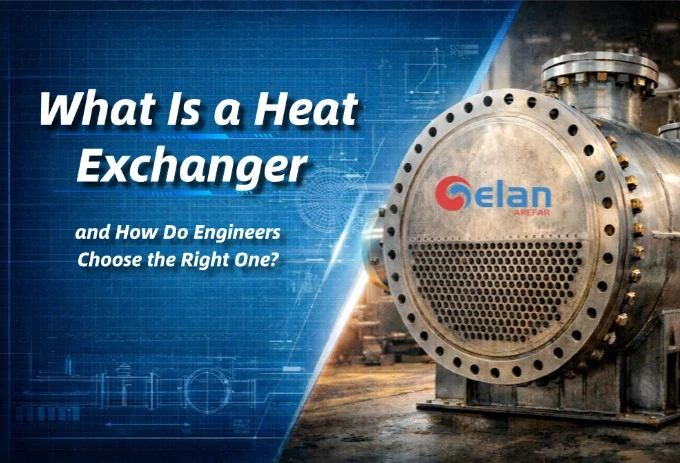
In our design office at Gelan Petro, we often say that a refinery is only as healthy as its thermal balance. When we consult with EPCs (Engineering, Procurement, and Construction) across the United States, we realized that while many can provide a heat exchanger definition, few can bridge the gap between a theoretical heat exchange process and a piece of equipment that survives a 5-year run without unplanned shutdowns. We don't just manufacture hardware; we engineer process reliability.
CONTENT:
- What Is a Heat Exchanger and Its Functions?
- How Does a Heat Exchanger Work in Real Conditions?
- Which Heat Exchanger Type Should You Actually Use?
- How Are Heat Exchangers Designed Differently for Oil & Gas and High-Temperature Service?
- Why Do Heat Exchangers Fail? (Field Experience)
- FAQs About Heat Exchangers
- Conclusion
What Is a Heat Exchanger?
Whenever a new junior engineer walks into our heat exchange station, the first question they ask is always the same: "What is a heat exchanger, exactly, in a high-stakes environment like this?""
At its core, the heat exchanger definition is simple. A heat exchanger is a device designed to transfer heat between two or more fluids—liquids, vapors, or gases—at different temperatures, without letting them mix. In a refinery or petrochemical plant, the exchanger definition goes far beyond a basic "tool". It becomes a critical node where the entire energy balance must close.
Here's a real-world analogy we often use. Imagine hot soup in one cup and cold water in another. Place a metal spoon between them. Heat moves through the spoon, but the liquids never mix. That's exactly how industrial heat exchangers enable controlled heat exchange.
In practice, when we consult with EPC teams or review FEED studies, our focus is always practical: does the heat exchanger function close the energy loop efficiently? Can we anticipate fouling, corrosion, or thermal stress before startup? These questions sit behind every "what is a heat exchanger" discussion—because on site, performance matters more than the dictionary.
What Is the Function of a Heat Exchanger in a Process System?
At a refinery or petrochemical plant, a heat exchanger is far more than just a piece of metal. Its job is simple to say but critical in practice: move energy to the right place, at the right time, and at the lowest cost. Based on our site experience at Gelan, I usually see heat exchangers serving three main roles in a process loop.
Heat Exchanger Roles and Practical Tips
| Role | Why It Matters | Typical Equipment Type | Real-World Tip |
|---|---|---|---|
| Energy Recovery | Reduce fuel use, reuse heat | Shell & Tube | Look at exit temps—don't waste usable energy |
| Temperature Control | Keep reactions stable | Plate / Plate-Fin | Monitor inlet/outlet delta T closely |
| Equipment Protection | Prevent thermal shock, extend life | Finned Tube Air Cooled | Match design to downstream machine limits |
1. Recover Energy Instead of Wasting It
Hot streams leaving reactors or furnaces often carry a lot of usable heat. A heat exchanger in industry captures waste heat.
Think of it like using leftover heat from cooking to warm your kitchen instead of opening a window. This is how plants cut fuel use and reduce operating costs. For example, shell & tube exchangers in crude oil preheating units handle >30 bar and >260°C, making them ideal for high-temperature energy recovery.
2. Control Process Temperature
Many chemical reactions only run well within a narrow temperature window. A heat exchanger system keeps that temperature stable.
- Too hot → product quality drops, equipment may get damaged
- Too cold → reaction rates slow down
The exchanger acts like a temperature buffer in the process loop. Plate or plate-fin exchangers can provide tight temperature control in low-to-medium pressure systems, such as in pharmaceutical or food processing.
3. Protect Downstream Equipment
Before fluids enter compressors, pumps, or separators, temperature often must be adjusted. A properly designed industrial heat exchanger prevents thermal shock and extends equipment life.
We often tell EPC teams: temperature control is not just about efficiency—it's about reliability. Finned tube air-cooled exchangers, for instance, are used in cooling loops where water isn't available, keeping downstream machinery safe from overheating.
How Does a Heat Exchanger Work in Real Industrial Conditions?
In real plants, a heat exchanger working principle is very simple. Every unit relies on three basic steps. If one step is weak, overall performance drops.
Step 1: Heat Moves Because Temperatures Are Different
Heat only flows when one side is hotter than the other.
A bigger temperature difference means stronger heat transfer.
That's why, during FEED reviews, we always look at inlet and outlet temperatures first.
If the temperature difference is too small, adding more surface area will not fix the problem. The heat exchanger performance will still be limited.
Step 2: The Metal Wall Slows Heat Down
After leaving the hot fluid, heat must pass through a metal wall.
This wall is usually carbon steel, stainless steel, or alloy steel.
The wall is necessary—but it also slows heat transfer.
Many non-technical buyers think thicker metal is always safer. In reality, thicker walls reduce heat transfer efficiency. That's why wall thickness must balance three things:
- Pressure strength
- Corrosion allowance
- Heat transfer ability
Step 3: Fouling Slowly Kills Performance
In real operation, heat exchanger surfaces never stay clean.
Dirt and deposits build up and act like insulation.
We often use this simple example:
A shower head with scale still works, but water flow drops fast.
A fouled heat exchanger behaves the same way—slow loss, then sudden problems.
From our engineering team's desk: This is why we always ask EPC teams early:
- What fluid is flowing inside?
- What impurities are present?
- How often can cleaning be done?
Ignoring these questions usually leads to exchangers that are undersized or hard to maintain.
Why This Matters for EPCs and Owners
A heat exchanger rarely "stops" suddenly. Problems show up as lower efficiency, higher pressure drop, or frequent maintenance. At Gelan, we don’t size heat exchangers based only on datasheets. We design them around real process conditions, maintenance needs, and long-term operation.
If your project needs heat exchanger selection that works in real industrial conditions—not just on paper—Gelan's engineering team can help.
Which Heat Exchanger Type Should You Actually Use?
When clients ask us which heat exchanger type they should use, our answer is never “it depends” without context. In real projects, the right heat exchanger selection follows clear rules.
At Gelan, we usually guide EPCs and owners through three practical questions. Before choosing a heat exchanger, we look at the process conditions first:
- Is the fluid clean or dirty?
- Are pressure and temperature stable?
- Will operating conditions change over time?
Heat Exchanger Types at a Glance
| Type | Typical Applications | Max P & T | Maintenance Tip | Advantage / Disadvantage |
|---|---|---|---|---|
| Shell & Tube | Oil & gas, refineries | >30 bar, >260°C | Tube bundle removable | Pros: Robust; Cons: Large footprint |
| Plate & Frame | Food, pharma, HVAC | Low-medium pressure | Gaskets easy to disassemble | Pros: Efficient; Cons: Potential leaks |
| Finned Tube (Air Cooled) | Industrial air heaters | Varies by design | Keep fins clean | Pros: Water-free; Cons: Fin damage risk |
Tips: If the process is harsh, unstable, or hard to clean, simpler and more robust exchanger types perform better long-term.
Recommended Heat Exchanger Types by Process Condition
| Process Condition | Recommended Type | Why It Works |
|---|---|---|
| High pressure or temperature | Shell and tube heat exchanger | Strong structure and wide material options |
| Dirty or fouling fluids | Shell and tube heat exchanger | Easier mechanical cleaning |
| Clean fluids, limited space | Plate heat exchanger | Compact and efficient |
| Large flow rates, gas cooling | Air-cooled heat exchanger | No cooling water required |
From the Gelan Project Desk: We don't just recommend a heat exchanger type. We check how it will be operated, cleaned, and repaired over its full life cycle.
Our advantage is practical: we speak process, mechanical, and project language at the same time, helping EPCs avoid redesigns.
If you want help with heat exchanger selection that works beyond startup, request a technical consultation with Gelan engineers. We design for real operation.
How Are Heat Exchangers Designed Differently for Oil & Gas and High-Temperature Service?
In oil & gas and petrochemical plants, a heat exchanger design follows very different rules. Temperatures are higher. Pressures are harsher. And mistakes cost much more. From our work at Gelan, high-temperature oil and gas heat exchangers must be designed for survival first—efficiency second.
Higher Temperature Changes Everything
In high-temperature service, metal does more than carry heat. It expands, weakens, and ages faster. That’s why high temperature heat exchangers use:
- Thicker tube sheets
- Stronger materials
- Larger expansion allowances
Without proper thermal stress design, tubes crack and leaks appear early. This is one of the most common failures we see in retrofits.
Pressure and Temperature Work Together
Many oil & gas services combine high temperature with high pressure. That combination drives the entire heat exchanger design. During FEED reviews, we always check:
- Design pressure margins
- Tube-to-tubesheet joint type
- Shell-side stress under upset conditions
A design that works in low-pressure chemical plants often fails here.
Material Selection Is Not Optional
For high-temperature process heat exchangers, carbon steel alone is often not enough. Depending on service, we may select:
- Stainless steel for oxidation resistance
- Low-alloy steel for strength at temperature
- Special alloys for hydrogen or sulfur service
Material choice directly affects exchanger life—not just cost.
Why Do Heat Exchangers Fail Even When the Design Looks Right?
In many projects, a heat exchanger failure does not come from bad calculations. On paper, the heat exchanger design often looks perfect. But in real operation, exchangers fail for reasons the datasheet never shows. From our field experience at Gelan, the problems usually fall into four clear areas.
1. Real Fluids Are Dirtier Than Assumed
- Designs often assume clean fluids, but real process streams carry impurities.
- Fouling builds faster than expected, reducing heat duty and increasing pressure drop.
- This is the most common reason exchangers underperform within the first year.
2. Operating Conditions Change Over Time
- Many exchangers are designed for one “normal” operating point.
- In reality, startups, shutdowns, and load swings stress the unit.
- Thermal expansion and vibration slowly damage tubes and joints. A design ignoring upset conditions is fragile.
3. Maintenance Was Not Part of the Design
- Some exchangers fail simply because they cannot be cleaned properly.
- Tube bundles may be inaccessible or hard to remove, leading to corrosion under deposits.
- As we often say: a heat exchanger that cannot be maintained is already a risk.
4. Design Codes Are Met, but Experience Is Missing
- Meeting ASME Section VIII or TEMA standards is necessary but not sufficient.
- Codes set minimum safety—they don’t guarantee long-term reliability.
- Experience fills the gap between calculations and real-world operation.
FAQs Engineers and Buyers Actually Ask About Heat Exchangers
How do I know which heat exchanger type to choose?
It depends on fluid type, temperature, pressure, and space. Shell-and-tube exchangers are common for high-pressure oil & gas service, while plate exchangers suit clean fluids with tight temperature control.
When in doubt, Gelan’s engineering team can help you select the right type for your process conditions. Contact Gelan here for a custom recommendation.
Why does my heat exchanger lose efficiency even if the design looks correct?
Most often because of fouling, corrosion, or operating conditions changing. Real-world fluids are rarely as clean as design assumptions, and maintenance limitations make performance drop faster.
How often should a heat exchanger be cleaned?
It depends on the fluid properties and fouling rate. In oil & gas, some exchangers need cleaning every few months; others last years. Regular inspection and monitoring are key.
Can I predict heat exchanger failure before it happens?
Yes, with careful monitoring of temperature approach, pressure drop, and flow rates. Deviations from expected performance often signal early fouling or corrosion.
Do design codes guarantee a heat exchanger will never fail?
No. Codes like ASME or TEMA ensure safety, but they don’t guarantee long-term reliability. Experience-based design and consideration of real operation conditions are crucial.
When should I call an engineer instead of just buying a standard exchanger?
Anytime your project involves high temperature, high pressure, corrosive fluids, or limited space. Early consultation prevents mistakes that cost time and money later.
Our engineers at Gelan are ready to provide customized guidance for complex projects. Contact us today to discuss your application.
Is a car radiator a heat exchanger?
Yes! A car radiator is a type of heat exchanger. It transfers heat from the engine coolant to the air without mixing the two. Think of it like a mini industrial heat exchanger for your car. While smaller and simpler, the same thermal performance principles apply.
What’s the difference between radiator and heat exchanger?
The main difference is scale and application. Radiators are designed for engines or HVAC units, handling low-pressure fluids. Industrial heat exchangers handle high-pressure, high-temperature fluids in refineries or chemical plants, often following ASME/TEMA standards.
Are heat exchangers used in cars the same as industrial ones?
Not exactly. Car radiators and oil coolers are simpler, usually air-cooled finned tube types. Industrial units can be shell-and-tube, plate, or plate-fin designs, engineered for fouling resistance and high thermal efficiency under harsh conditions.
What’s the difference between a boiler heat exchanger and a process exchanger?
A boiler heat exchanger recovers energy from combustion gases to produce steam, mainly for heating. A process exchanger transfers heat between process fluids, like crude oil or chemicals, without producing steam. I always compare it to cooking: one boils water (boiler), the other simmers sauces without boiling (process exchanger).
Conclusion
Choosing the right heat exchanger is key to efficiency and reliability. With real-world conditions in mind, Gelan Petro helps you select and design exchangers that keep your plant running smoothly—long after startup.