




In many EPC heat exchanger datasheets, you will see notes like this:
- TEMA Type: AES
- TEMA Class: R
- Design Code: ASME Section VIII
At that moment, many buyers ask the same question: what is TEMA, and why does it appear in almost every shell-and-tube heat exchanger specification?
In many refinery and petrochemical projects I've worked on, this confusion is very common. These short codes are not random labels. They simply describe the exchanger structure, its classification, and the design approach behind it.
In this article, I will explain what TEMA is, what different TEMA heat exchanger types mean, how TEMA classes are used in industry, and how engineers determine the right configuration during real project design. Let's break it down.
CONTENT:
- What Is TEMA?
- What Do TEMA Types Mean?
- What Are TEMA Classes?
- [Hot] How Engineers Choose a TEMA Heat Exchanger Type?
- How TEMA Standards Affect Heat Exchanger Design?
- FAQs About TEMA Heat Exchangers
- Conclusion
What Is TEMA?
Before looking at exchanger structures, we should first answer a simple question: what is TEMA?
The definition of TEMA is straightforward. TEMA stands for the Tubular Exchanger Manufacturers Association (https://tema.org/), an organization formed by major shell-and-tube heat exchanger manufacturers. The association publishes a set of widely used TEMA standards that guide the design and construction of shell-and-tube heat exchangers.
For many buyers reading a project datasheet, another common question quickly follows: is TEMA a code, a standard, or some kind of certification? In fact, these terms mean different things in engineering documents. The table below shows how they are typically used in exchanger specifications.
| Term | Meaning |
|---|---|
| TEMA | Tubular Exchanger Manufacturers Association |
| TEMA Standards | Industry design guidelines for shell-and-tube heat exchangers |
| ASME Code | Pressure vessel code governing safety and pressure containment |
In simple terms, TEMA heat exchanger standards focus on exchanger construction practices, while codes such as ASME Section VIII govern pressure vessel safety requirements.
Once you understand this, the next question naturally becomes: what do those TEMA types like AES or BEM actually mean?
What Do TEMA Types Mean?
What Do AES, BEM, and BEU Actually Mean?
You may notice codes like AES, BEM, or BEU in many exchanger specifications. Many buyers naturally start to wonder what these TEMA heat exchanger types actually mean.
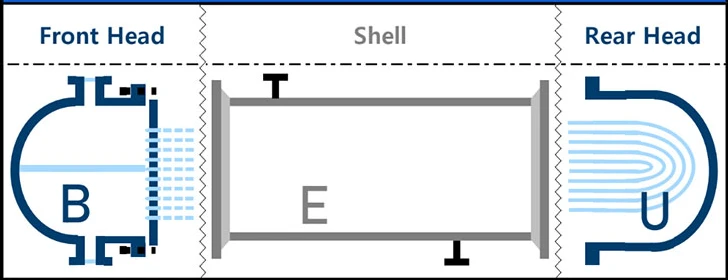
These codes describe the mechanical configuration of a shell-and-tube heat exchanger. Each TEMA type uses a three-letter designation to identify the major structural sections of the equipment. This naming system is known as the TEMA designation. The three letters represent three key sections of the exchanger:
| Letter Position | Section | What It Refers To |
|---|---|---|
| First Letter | Front Head | The stationary head or channel where the tube-side fluid enters |
| Second Letter | Shell | The outer shell that contains the tube bundle |
| Third Letter | Rear Head | The rear-end construction that allows tube expansion or maintenance |
In other words, the TEMA designation for shell and tube heat exchangers follows a simple structure:
Front Head – Shell – Rear Head
But another question naturally follows: are these letters chosen freely, or does TEMA define a fixed set of options?
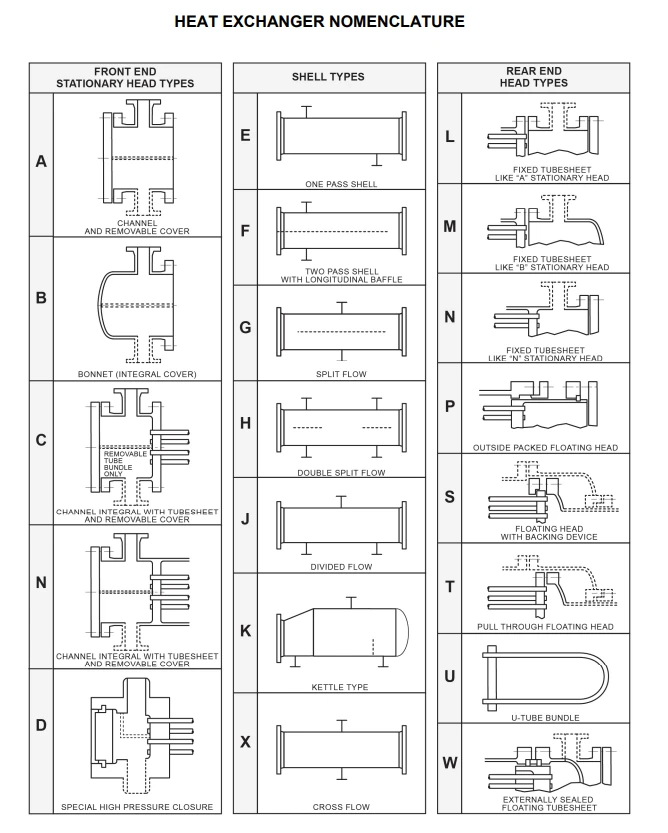
In reality, each letter in the TEMA designation for shell and tube heat exchangers is selected from a predefined group of component designs defined by the TEMA standard. Engineers use this TEMA heat exchanger nomenclature to quickly describe exchanger structure in EPC specifications, vendor quotations, and technical datasheets.
In other words, a shell-and-tube exchanger is assembled from several interchangeable sections.
| Section | Common TEMA Options |
|---|---|
| Front Heads | A, B, C, N, D |
| Shell Types | E, F, G, H, J, K, X |
| Rear Heads | L, M, N, P, S, T, U, W |
The diagram below illustrates the main TEMA heat exchanger types and component configurations defined by the standard.
Once you understand this logic, the exchanger configuration becomes much easier to interpret. For example:
| TEMA Type | TEMA Heat Exchanger Diagram | What the Letters Mean | Typical Design |
|---|---|---|---|
| BEM heat exchanger | 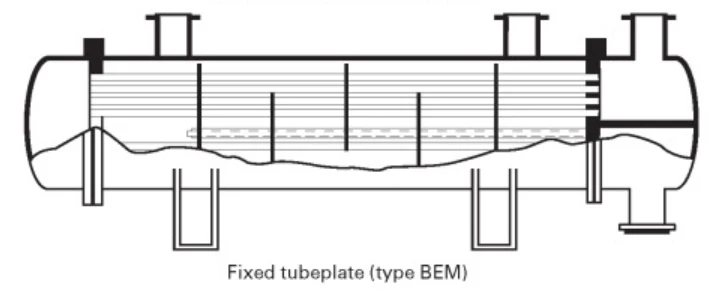 | B front head + E shell + M rear head | Fixed tubesheet exchanger |
| AES heat exchanger | 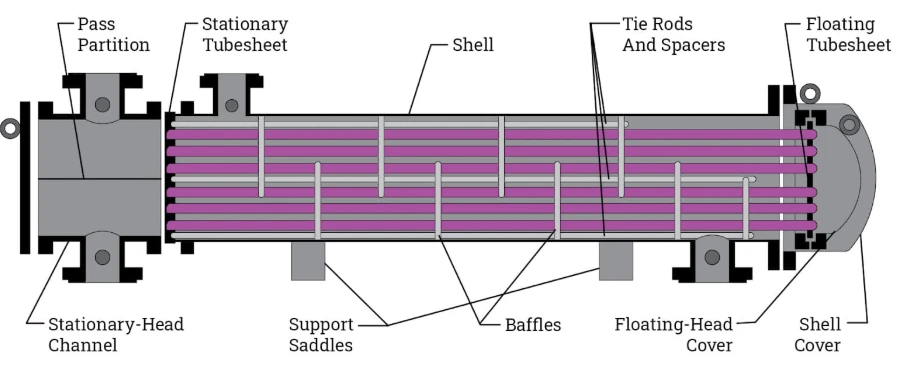 | A front head + E shell + S rear head | Floating head exchanger |
| BEU heat exchanger | 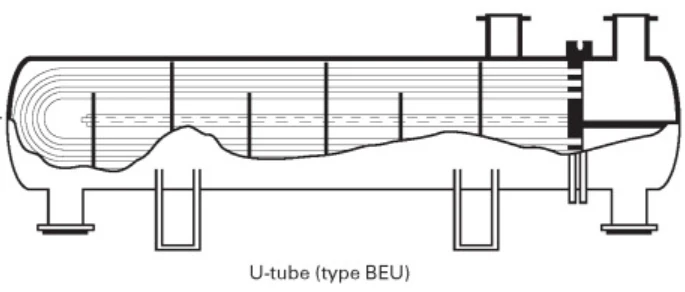 | B front head + E shell + U rear head | U-tube exchanger |
Engineers use this TEMA heat exchanger nomenclature as a quick way to describe exchanger structure in datasheets, EPC specifications, and vendor documents. By looking at the three-letter code, experienced engineers can immediately understand the basic construction of the equipment.
However, the TEMA system actually allows many possible combinations of front heads, shells, and rear heads. In real projects, though, engineers only use a limited number of TEMA exchanger types. The reason is that exchanger configuration is usually determined by operating conditions, maintenance needs, and thermal expansion requirements.
Why Only Certain TEMA Types Are Common in Real Projects
Although the TEMA classification of heat exchangers provides many possible combinations, engineers rarely choose a configuration simply by picking three letters.
In real projects, the exchanger design is usually determined by process conditions first. Factors such as thermal expansion, fouling tendency, pressure level, and maintenance requirements strongly influence which TEMA heat exchanger type is practical.
From experience working on refinery and petrochemical equipment projects, most exchangers fall into three major design families.
| Design Family | Typical TEMA Types | Key Feature |
|---|---|---|
| Fixed Tubesheet | AEL, BEM, AEM, NEN | Tubesheet welded to shell |
| U-Tube | BEU, AEU | Tubes bent into U shape |
| Floating Head | AES, BES, AET, BET | Tube bundle allowed to expand |
These designs mainly differ in how they handle thermal expansion and how easily the tube bundle can be cleaned or removed.
Comparison of Common TEMA Types
| TEMA Type | Main Advantage | Main Limitation | Typical Applications |
|---|---|---|---|
| BEM heat exchanger | Simple and low-cost construction | Shell side cannot be mechanically cleaned | Oil coolers, condensers |
| AES heat exchanger | Floating head allows thermal expansion and cleaning | Higher fabrication cost | Petrochemical process exchangers |
| AET / BET | Easy bundle removal for maintenance | Larger shell diameter required | High-temperature service |
| BEU heat exchanger | Handles large thermal expansion | Tubes difficult to mechanically clean | Steam heaters, process heaters |
In refinery and petrochemical plants, designs such as BEM, AES, and BEU are among the most commonly specified TEMA heat exchanger types because they offer a practical balance between cost, maintainability, and operating reliability.
Once engineers understand the exchanger TEMA type, the next specification on the datasheet usually refers to TEMA class, which indicates the severity of service and the industry application of the equipment.
What Are TEMA Classes?
After identifying the TEMA heat exchanger type, another specification often appears in exchanger datasheets: the TEMA class.
Many buyers notice designations such as Class R, Class C, or Class B, but are not always sure what they represent.
Unlike the TEMA type, which describes the mechanical configuration of the exchanger, the TEMA class heat exchanger designation indicates the intended service severity and industry application.
The TEMA standard defines three main classes:
| TEMA Class | Industry Application | Design Characteristics |
|---|---|---|
| R Class | Petroleum and refinery service | Heavy-duty construction designed for high pressure and severe operating conditions |
| B Class | Chemical process industry | Balanced design suitable for general chemical processing |
| C Class | General commercial service | Lighter construction used for less demanding duties |
In refinery and petrochemical projects, TEMA Class R heat exchangers are the most common because process conditions often involve higher pressures, higher temperatures, and stricter reliability requirements.
In contrast, TEMA Class C heat exchangers are typically used in less severe services such as utility systems or general industrial heat transfer applications.
From an engineering perspective, the class mainly affects factors such as:
- allowable stresses
- corrosion allowances
- mechanical construction details
- inspection requirements
In other words, the TEMA class tells engineers how robust the exchanger must be for a specific industry or service environment.
For example, a refinery exchanger specification might include:
In this case:
- AES describes the exchanger configuration
- Class R indicates refinery-grade construction
- ASME Section VIII governs pressure vessel safety
Together, these specifications define how the exchanger should be designed, fabricated, and inspected.
How Engineers Choose a TEMA Heat Exchanger Type
When reviewing an exchanger specification, many people assume that engineers simply choose a TEMA heat exchanger type first. In reality, the process usually works the other way around.
In most EPC projects, the exchanger configuration is determined only after the process conditions and thermal design have been analyzed. The final TEMA type is essentially the result of several engineering decisions.
A typical workflow often looks like this:
In other words, the TEMA heat exchanger design is not chosen in isolation. It is determined by how the exchanger must operate within the overall process system.
Key Factors That Influence TEMA Type Selection
Several technical factors influence which TEMA type heat exchanger engineers select:
| Design Factor | Why It Matters |
|---|---|
| Temperature difference | Large thermal expansion may require floating head or U-tube designs |
| Fouling tendency | Dirty fluids require exchangers that allow mechanical cleaning |
| Operating pressure | Some header types are better suited for high-pressure service |
| Maintenance requirements | Certain designs allow easier bundle removal and inspection |
| Allowable pressure drop | Shell configuration affects hydraulic performance |
For example:
| Operating Condition | Typical TEMA Choice |
|---|---|
| Large temperature difference | Floating head or U-tube exchangers |
| Frequent mechanical cleaning required | Removable bundle designs |
| Clean service with minimal fouling | Fixed tubesheet exchangers |
These parameters are usually defined in the TEMA heat exchanger data sheet, which guides the mechanical configuration of the equipment.
How Manufacturers Support the Selection Process
In real projects, exchanger manufacturers often participate in this stage of engineering. The supplier may review the heat exchanger datasheet, verify the thermal design assumptions, and confirm that the selected configuration is practical for fabrication and maintenance.
At Gelan Petro, we typically support EPC contractors and plant owners in two ways.
1. Design + Manufacturing Support
In some projects, the exchanger configuration is not fully defined during early engineering. Our team reviews the process conditions and helps recommend suitable TEMA heat exchanger types based on operating temperature, fouling behavior, and maintenance requirements. This usually involves reviewing the process heat exchanger data sheet, evaluating thermal expansion and cleaning requirements, and recommending appropriate TEMA exchanger configurations.
2. Build-to-Design Manufacturing
In many refinery or petrochemical EPC projects, the exchanger configuration has already been defined by the engineering contractor. In these cases, Gelan manufactures the equipment strictly according to the approved design, following the specified TEMA heat exchanger fabrication requirements, material specifications, and applicable codes such as ASME Section VIII.
Both collaboration models are common in large industrial projects, and the choice usually depends on how far the project engineering has progressed.
How TEMA Standards Affect Heat Exchanger Design
The TEMA standards do more than define exchanger types. They also influence how shell-and-tube heat exchangers are designed, constructed, and maintained in real industrial projects.
In practice, TEMA heat exchanger standards provide engineering guidance that helps ensure exchangers from different manufacturers follow consistent structural principles. These guidelines affect several important aspects of exchanger design.
| Design Area | How TEMA Standards Affect It |
|---|---|
| Mechanical construction | Defines exchanger components such as stationary heads, shells, tubesheets, and channel designs |
| Tube bundle arrangement | Provides guidance for tube layout, pitch, and bundle geometry |
| Maintenance considerations | Defines removable bundle designs and cleaning accessibility |
| Fabrication tolerances | Specifies machining and assembly tolerances |
In real projects, these guidelines directly influence how exchangers are engineered and fabricated. For example, during Gelan projects, our engineers review exchanger datasheets and confirm details such as tube layout, bundle configuration, and maintenance accessibility to ensure the design aligns with TEMA heat exchanger standards.
Another point that often causes confusion is the relationship between TEMA standards and pressure vessel codes. In most refinery and petrochemical projects, exchanger design follows both TEMA and ASME Section VIII, but each standard serves a different role.
| Standard | Role in Heat Exchanger Design |
|---|---|
| TEMA | Defines exchanger configuration, construction details, and maintenance considerations |
| ASME Section VIII | Governs pressure vessel strength, materials, and safety requirements |
In simple terms, TEMA focuses on exchanger structure and serviceability, while ASME ensures the pressure boundary meets safety requirements. Together, these standards guide both the engineering design and the fabrication of industrial shell-and-tube heat exchangers.
FAQs About TEMA Heat Exchangers
What's TEMA Full Form in Heat Exchanger?
TEMA stands for Tubular Exchanger Manufacturers Association. It is an industry organization that publishes design standards for shell-and-tube heat exchangers used in refinery, petrochemical, and chemical processing plants.
These TEMA standards define exchanger configuration, mechanical construction, and maintenance requirements.
What Is an AES Heat Exchanger?
An AES heat exchanger is a shell-and-tube exchanger with an A-type front head, E-type shell, and S-type floating rear head according to the TEMA heat exchanger designation system.
This configuration uses a floating head design, which allows the tube bundle to expand independently from the shell. Because of this, AES heat exchangers are commonly used in refinery and petrochemical services where large temperature differences occur between the shell side and tube side fluids.
What Is a BEM Heat Exchanger?
A BEM heat exchanger is a shell-and-tube exchanger with a B-type front head, E-type shell, and M-type rear head.
This configuration is a fixed tubesheet exchanger, meaning the tubesheet is welded directly to the shell. The design is simple and cost-effective, which makes BEM heat exchangers common in applications such as oil coolers, condensers, and general process heat transfer.
Is TEMA required for all heat exchangers?
No. TEMA standards mainly apply to shell-and-tube heat exchangers used in industrial process plants.
Other heat exchanger types, such as plate heat exchangers or air-cooled heat exchangers, typically follow different design standards. However, for refinery, petrochemical, and chemical processing plants, TEMA heat exchanger standards are widely used because they provide consistent mechanical design practices.
Is TEMA a legal code like ASME?
No. TEMA is an industry standard, not a pressure vessel code.
The TEMA standard defines exchanger configuration, mechanical construction, and maintenance considerations. In contrast, ASME Section VIII is a pressure vessel code that governs material requirements, structural strength, and safety rules.
In most industrial projects, TEMA and ASME are used together during exchanger design and fabrication.
Can engineers choose any TEMA type?
Not always. The final TEMA heat exchanger type depends on thermal design calculations, maintenance requirements, fouling tendency, and operating pressure.
These factors determine whether a fixed tubesheet, floating head, or U-tube configuration is most appropriate.
What is the most common TEMA heat exchanger type?
Several TEMA heat exchanger types are widely used in refinery and petrochemical plants.
Common industrial configurations include BEM exchangers, AES exchangers, and BEU exchangers, because these designs provide a practical balance between cost, maintenance access, and thermal expansion capability.
Conclusion
In this article, we introduced what is TEMA, how TEMA heat exchanger types are defined, what TEMA classes mean, and how these standards influence exchanger design and fabrication in real industrial projects.
Understanding these concepts helps engineers and buyers read exchanger specifications more clearly and communicate more effectively with EPC contractors and equipment suppliers.
In Gelan projects, our engineers regularly review exchanger datasheets with EPC teams to ensure the selected configuration follows TEMA heat exchanger standards and the project's fabrication requirements. If you are evaluating exchanger specifications or planning a new project, feel free to contact the Gelan team to discuss suitable exchanger configurations and manufacturing solutions.