


Does turnkey literally mean “turn the key”? The term turnkey project often appears in construction and industrial engineering, but what is the real turnkey project meaning?
As a project consultant with over 14 years of experience in oil, gas, and petrochemical projects, I often see engineers and buyers confused about this concept. In this guide, I will explain turnkey project delivery in simple terms—what turnkey project really means, how turnkey solutions work, and how to choose the right contractor or supplier.
CONTENT:
- What Is Turnkey Project?
- What Is Turnkey Solution?
- How Does a Turnkey Construction Work from Design to Operation?
- What Are the Advantages of Turnkey Project Delivery?
- Examples of Turnkey Projects in Different Industries
- How to Choose the Right Turnkey Contractor or Supplier
- FAQs About Turnkey Projects
- Conclusion
What Is Turnkey Project?
So what is turnkey project in practice? In simple terms, the turnkey project definition describes a project delivery model where one contractor takes responsibility for the entire project. This usually includes engineering design, procurement, construction, and final commissioning.
In practice, the turnkey project definition usually includes several clear features:
| Key Feature | What It Means |
|---|---|
| Single Point Responsibility | One turnkey contractor manages the entire project, including design, procurement, construction, and commissioning. The owner deals with only one main partner. |
| Complete Project Scope | The contractor delivers the full system from engineering design to final startup. This reduces gaps between suppliers and project stages. |
| Clear Budget Structure | Many turnkey projects use fixed or agreed pricing. This helps owners control cost and estimate project investment earlier. |
| Defined Project Schedule | Design, procurement, and construction are coordinated by the same team. This often shortens the overall project timeline. |
| Centralized Project Management | A unified turnkey project management structure improves coordination between engineers, suppliers, and subcontractors. |
| Consistent Quality Control | The same contractor controls engineering standards, equipment selection, and installation quality across the project. |
| Reduced Owner Workload | The client does not need to coordinate many vendors. Most project responsibilities stay with the contractor. |
| Clear Risk Allocation | In most cases, the turnkey contractor is responsible for schedule, cost, and system performance. |
What Is Turnkey Solution?
If we compare the two concepts simply:
- Turnkey Project = an entire plant or facility
- Turnkey Solution = a system, process unit, or equipment package inside that project
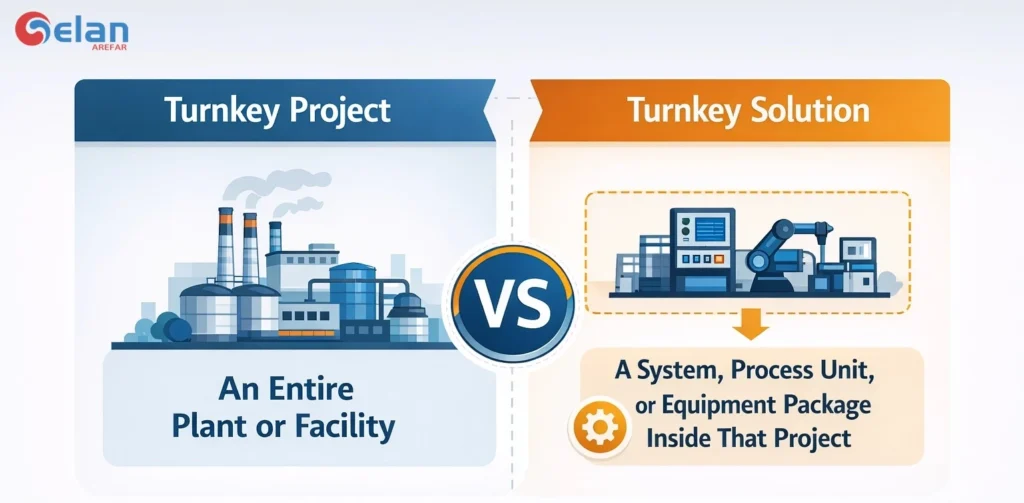
In other words, a turnkey project usually refers to the delivery of a complete facility, while a turnkey solution focuses on a specific system within that project. From an engineering perspective, if we define turnkey solution, it usually includes several integrated services:
- Engineering design and technical specification
- Equipment manufacturing and supply
- System integration
- Installation support
- Testing and commissioning
Once delivered, the system is ready to operate as part of the larger facility.
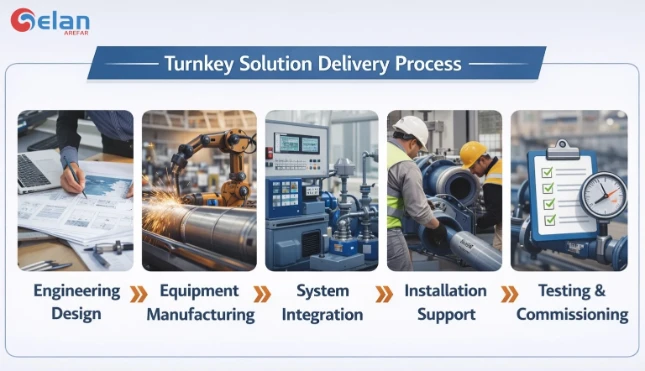
In many industrial projects, the definition of turnkey solution also involves collaboration between EPC contractors and specialized equipment manufacturers. The EPC contractor manages the overall plant construction, while experienced suppliers deliver integrated systems that fit directly into the project design. These systems are commonly delivered as turnkey project solutions within the larger facility.
How Does a Turnkey Construction Work from Design to Operation?
After understanding what is turnkey project and turnkey solution, let’s introduce how does turnkey construction actually work in a real project?
In most industrial developments, the turnkey project follows a structured process from early engineering to final operation. A typical turnkey construction process usually includes the following stages.
1. Engineering Design
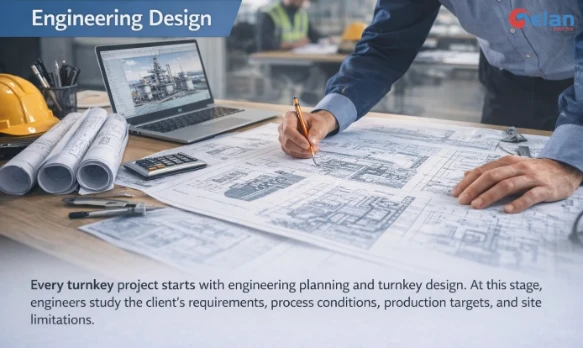
Every turnkey project starts with engineering planning and turnkey design. At this stage, engineers study the client’s requirements, process conditions, production targets, and site limitations.
The work usually begins with feasibility studies and conceptual design. Engineers then move to detailed engineering drawings, equipment specifications, and process calculations. This stage defines how the facility will operate and what major systems are required.
In industrial projects, engineering teams also review safety requirements, environmental compliance, and energy efficiency during this phase. In my experience, good engineering decisions at this stage often determine the long-term reliability and operating cost of the entire turnkey project.
2. Procurement
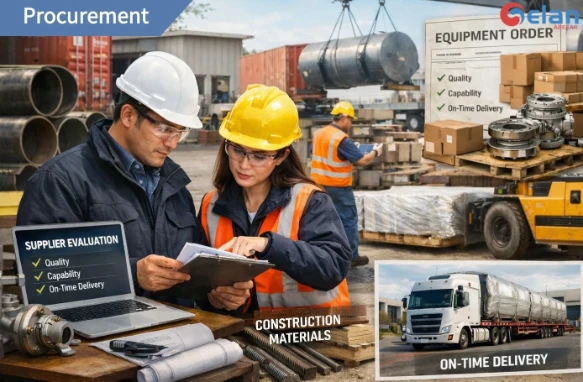
Once the engineering scope is defined, the turnkey contractor begins procurement. This stage involves selecting qualified suppliers, purchasing equipment, and arranging construction materials.
In many turnkey projects, procurement runs in parallel with engineering activities. This approach helps reduce project duration and improves cost control. Contractors normally pre-qualify suppliers based on manufacturing capability, quality standards, and delivery reliability.
Strong supplier coordination is an essential part of turnkey project management, because equipment delivery schedules and fabrication quality directly affect the next construction stage.
3. Equipment Manufacturing
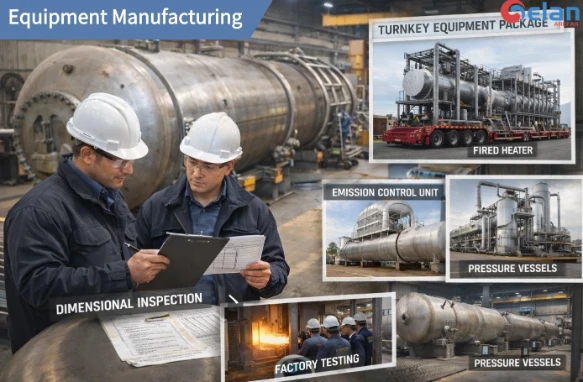
Industrial plants depend on large engineered equipment that must be manufactured before installation. Typical examples include pressure vessels, fired heaters, heat recovery systems, large heat exchangers, and emission control units.
In many turnkey projects, these systems are delivered as turnkey project solutions by specialized manufacturers. Instead of supplying individual components, the manufacturer designs, fabricates, assembles, and tests a complete equipment package.
For example, in refinery and petrochemical projects, equipment packages such as fired heaters, pressure vessels, or waste heat recovery systems are often engineered and supplied by specialized manufacturers like Gelan, working together with the EPC contractor. This approach allows complex industrial systems to be delivered as integrated modules rather than separate pieces of equipment.
Factory testing, dimensional inspection, and quality verification are usually completed before shipment. Delivering equipment in integrated modules helps reduce on-site installation time and improves overall construction efficiency.
4. Installation and Construction
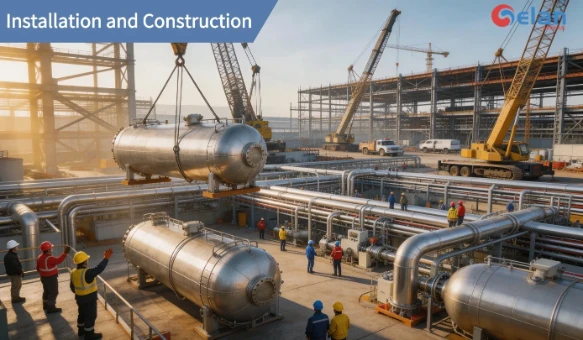
After equipment arrives at the site, the construction phase begins. Teams carry out mechanical installation, piping assembly, electrical integration, instrumentation setup, and structural construction.
During this stage, the turnkey contractor coordinates multiple engineering disciplines and subcontractors. Many construction activities happen at the same time, so scheduling and site coordination are critical to maintain project progress.
Clear communication between engineering teams, equipment suppliers, and construction crews helps keep the turnkey construction schedule on track and prevents conflicts between different systems during installation. (Source: Engineering News-Record Project Delivery Reports)
5. Testing and Commissioning
The final stage prepares the facility for turnkey operation. Engineers inspect equipment, run system tests, and confirm that all components perform according to design specifications.
Commissioning usually includes system startup, performance verification, safety checks, and operator training. Control systems are calibrated and integrated so the entire facility operates as a coordinated process.
Once all systems run correctly, the contractor formally hands the project over to the owner. At this point, the plant is ready for full production.
What Are the Advantages of Turnkey Project Delivery?
After working on several refinery and petrochemical projects, I have seen why many owners consider turnkey projects as a preferred delivery model. Compared with traditional multi-contractor construction, a turnkey structure can simplify project execution and reduce management complexity.
However, like any project strategy, turnkey project delivery also has limitations. Owners should understand both the advantages and the possible risks before choosing this model.
Advantages and Disadvantages of Turnkey Project Delivery
| Aspect | Advantages for Project Owners | Potential Disadvantages |
|---|---|---|
| Project Management | Managing a turnkey project is usually simpler. The owner works with one main contractor instead of coordinating multiple vendors. | The owner has less direct control over daily engineering and construction decisions. |
| Risk Allocation | Many project risks are transferred to the turnkey contractor, including schedule delays, cost overruns, and system performance. | If the contractor lacks experience, the project risk may still increase. Choosing the right contractor becomes critical. |
| Cost Control | Fixed or structured contracts allow better budget planning and clearer project investment estimates. | Initial contract prices may appear higher because the contractor includes risk buffers in the bid. |
| Schedule Efficiency | Engineering, procurement, and construction activities can overlap, which often shortens project timelines. | If delays occur, they can affect the entire project because all stages depend on the same contractor. |
| Quality Assurance | When one contractor manages the entire project, it is easier to maintain consistent engineering standards and quality control. | Quality still depends on the contractor's internal management and supplier network. |
From my experience, most challenges in turnkey projects do not come from the delivery model itself. They usually happen when the contractor is not properly selected or when project specifications are unclear during the early engineering stage.
In practice, different project needs may require different delivery approaches:
| Project Situation | Recommended Approach | Typical Examples |
|---|---|---|
| Large facilities requiring full project coordination | Turnkey project managed by a main contractor | Refineries, chemical plants, power plants, large infrastructure projects |
| Projects that require complete plant delivery | Turnkey construction solutions where one contractor handles engineering, procurement, construction, and commissioning | New industrial plants or large process units |
| Specific systems or equipment inside a larger project | Work with specialized equipment manufacturers | Fired heaters, pressure vessels, heat recovery systems, emission control systems |
| EPC contractors needing reliable equipment packages | Partner with experienced suppliers such as Gelan | Integrated equipment modules or process system packages |
In many industrial developments, EPC contractors manage the overall plant while specialized manufacturers deliver critical systems as turnkey project solutions. This collaboration allows complex facilities to be built more efficiently, with each party focusing on its area of expertise.
To better understand how this delivery model works in the real world, it is helpful to look at several turnkey projects examples across different industries.
Examples of Turnkey Projects in Different Industries
Turnkey projects are widely used in industries where complex systems must be designed, built, and delivered as an integrated solution. Instead of managing many separate contractors, owners often rely on industrial turnkey solutions to simplify project delivery.
Below are several common examples of turnkey projects across different sectors.
| Industry | Typical Turnkey Projects | Typical Turnkey Systems |
|---|---|---|
| Oil & Gas / Petrochemical | Refineries, petrochemical plants, hydrogen production units | Fired heaters, pressure vessels, heat recovery systems |
| Power Generation | Combined-cycle power plants, waste heat recovery units | HRSG systems, boiler packages, emission control units, Solid oxide fuel cell systems |
| Environmental Systems | Industrial emission control and waste gas treatment | Thermal oxidizers, VOC treatment systems, incinerators |
| Industrial Processing | Chemical plants, manufacturing facilities | Process modules, heat exchangers, equipment skids |
In many industrial plants, EPC contractors build the overall facility, while specialized manufacturers supply key equipment packages.
Selecting the right turnkey contractor or supplier is critical for project success. The next section explains how project owners evaluate potential partners.
How to Choose the Right Turnkey Contractor or Supplier
In industrial projects, owners usually evaluate several factors before selecting a turnkey contractor or turnkey supplier. The right partner should not only provide engineering capability, but also ensure reliable project delivery.
1. Industry Experience
First, check whether the contractor has experience with similar turnkey projects. Projects in oil & gas, petrochemical processing, and power generation often involve complex engineering requirements. Contractors with proven project references usually understand these technical challenges better.
- Has the company completed projects in the same industry (oil & gas, petrochemical, power, etc.)?
- Can they provide project references or case studies?
- Do they understand the specific process systems used in your facility?
- Have they delivered similar turnkey solutions before?
2. Engineering and Design Capability
A reliable partner must have strong engineering capability. In turnkey projects, early engineering decisions affect equipment selection, system integration, and long-term plant performance.
- Do they have in-house engineering teams?
- Can they provide process design calculations or system drawings?
- Do they understand industry design codes (such as ASME, API, or TEMA)?
- Can they integrate multiple systems within the project?

3. Manufacturing and Supply Capacity
For equipment-based systems, the turnkey supplier must also have reliable manufacturing capability. It is important to verify fabrication capability, production facilities, and quality control procedures. Reliable manufacturing capacity helps ensure that equipment can be delivered according to the project schedule.
- Do they have their own fabrication facilities?
- What is their production capacity and lead time?
- Do they perform factory acceptance tests (FAT) before delivery?
- Can they manage logistics for large industrial equipment?
4. Project Management and Delivery Performance
A successful turnkey project requires strong coordination between engineering, procurement, and construction teams.
- Do they have experienced project managers?
- What is their historical on-time delivery rate?
- Can they manage multi-discipline engineering coordination?
- Do they have clear project communication procedures?
Strong project management helps reduce schedule delays and integration problems.
5. Quality Systems and Certifications
Quality control is another critical factor in evaluating a turnkey contractor or supplier.
- Do they have certified quality management systems (ISO 9001)?
- Are welding, inspection, and testing procedures documented?
- Can they provide material traceability and inspection reports?
- Do they comply with required engineering standards and regulations?
Quality management systems ensure that equipment meets safety and regulatory requirements.
Example Turnkey Contractors and Suppliers in the Industry
In large industrial projects, owners often work with experienced EPC contractors or specialized equipment suppliers depending on the project scope. Some well-known companies in the industry include:
Major EPC / Turnkey Contractors:
- Bechtel Corporation – one of the largest EPC contractors involved in refineries, LNG terminals, and large infrastructure projects.
- Fluor Corporation – provides EPC services across energy, chemicals, mining, and infrastructure sectors.
- Technip Energies – widely involved in LNG, petrochemical, and energy transition projects.
- Saipem – known for large offshore and petrochemical engineering projects worldwide.
Specialized Equipment and System Suppliers:
- Gelan Petro (also known as Gelan) – process equipment manufacturer that can deliver heat exchangers, process modules, or emission control systems as turnkey equipment packages.
FAQs About Turnkey Projects
What does turnkey mean in construction?
Turnkey in construction means a contractor delivers a complete project that is ready to operate. The contractor handles engineering, procurement, construction, and commissioning. When the project is finished, the owner can immediately start using the building, plant, or system.
What is the difference between a turnkey project and design-build?
The main difference is scope: a turnkey project delivers a fully operational facility, while design-build usually covers only design and construction. Turnkey projects include additional stages such as equipment procurement, system integration, and commissioning—so the owner receives a ready-to-operate system, not just a completed structure.
How do integrated turnkey solutions reduce project time?
Integrated turnkey solutions reduce project time by allowing multiple project stages to run in parallel. Engineering design, equipment manufacturing, and procurement can happen simultaneously, which reduces delays caused by coordination between different contractors.
Are turnkey projects more expensive?
Not necessarily. Turnkey projects may have higher initial contract prices, but they often reduce overall project risk and total cost. Because one contractor manages the entire project, coordination problems, design conflicts, and construction delays are less likely.
What industries use turnkey projects?
Turnkey projects are commonly used in industries that require complex engineering systems—such as oil and gas processing, petrochemical plants, power generation, industrial manufacturing, and environmental treatment systems. These industries often rely on industrial turnkey solutions to simplify project delivery.
Can turnkey solutions apply to a single system?
Yes. A turnkey solution can apply to a specific system or equipment package within a larger project. For example, fired heaters, pressure vessels, emission control units, or heat recovery systems can be delivered as turnkey equipment packages and integrated into the plant by the EPC contractor.
Conclusion
Understanding what does turnkey mean helps project owners plan complex industrial projects more effectively.
In many turnkey projects, EPC contractors manage the overall facility while specialized manufacturers supply key equipment systems.
For static equipment and modular process packages, companies like Gelan provide engineered equipment and skid modules that integrate into larger turnkey installations.