

TL;DR
- •If you need higher efficiency, a smaller footprint, and clean service, a plate heat exchanger is often the better choice.
- •If you need to handle higher pressure, higher temperature, dirty media, or heavier operating conditions, a shell and tube heat exchanger is usually the safer option.
- •There is no single best design. The right choice depends on process conditions, space limits, maintenance needs, and project requirements.
Need to handle higher pressure, higher temperature, limited space, or dirty fluid, but not sure which heat exchanger to choose?
As Gelan's Overseas Sales Director and Senior Project Consultant, I've worked with buyers across oil, gas, and petrochemical projects for over 14 years. In this guide, I will compare plate heat exchanger vs shell and tube in a simple and practical way, so you can see which option fits your process better.
CONTENT:
- Advantages and Disadvantages of Shell and Tube Heat Exchangers
- Advantages and Disadvantages of Plate Heat Exchangers
- Key Differences Between Plate and Shell & Tube Heat Exchangers
- Which Heat Exchanger is Right for Your Application?
- FAQs
- Conclusion
Advantages and Disadvantages of Shell and Tube Heat Exchangers
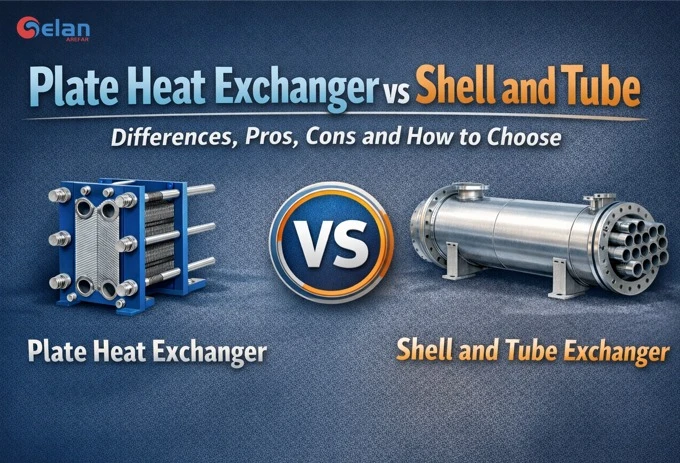
A shell and tube heat exchanger is made of one outer shell and a bundle of tubes inside. One fluid flows through the tubes, while the other flows around the tubes inside the shell. Heat moves through the tube walls from one fluid to the other.
Advantages
- Handles tougher conditions: It is a better fit for higher pressure and higher temperature service.
- Works better with dirty fluids: It is often a safer choice when the fluid is more likely to foul, scale, or carry solids.
Disadvantages
- Larger size: To get the same duty, it often needs more space than a plate design.
- Harder to clean: Once fouling builds up, cleaning can take more time and more work, especially on the shell side.
Design Philosophy
A shell and tube heat exchanger is usually designed to keep working even when fouling is expected. Instead of trying to avoid buildup completely, the design often includes extra heat transfer area to allow for performance loss over time.
Advantages and Disadvantages of Plate Heat Exchangers
A plate heat exchanger uses a pack of thin metal plates to transfer heat. Two fluids flow in separate channels between the plates, and heat passes through the metal surface without the fluids mixing.
Advantages
- High efficiency in a small size: The thin plates and fast flow help transfer heat very well, so the unit can do a lot of work without taking up much space.
- Easier to clean: In many plate-and-frame designs, the unit can be opened, so the plate surfaces are easier to inspect and wash.
Disadvantages
- More limited pressure and temperature range: It is usually a better fit for moderate service, not the most severe operating conditions.
- More sensitive to dirty service and gasket wear: Narrow channels can clog more easily, and in higher-temperature service, gaskets may need more attention or replacement.
Design Philosophy
A plate type heat exchanger is designed to keep fluid moving fast across the plate surface. This helps reduce buildup and keeps heat transfer performance more stable.
Heat Exchanger Selection
Looking Beyond Plate vs Shell & Tube?
Explore the broader heat exchanger family and see how operating conditions, fluid characteristics, fouling risk, and maintenance needs influence exchanger selection.
Explore Heat Exchanger Types & Selection →Key Differences Between Plate and Shell & Tube Heat Exchangers
| Parameter | Shell and Tube Heat Exchanger | Plate Heat Exchanger |
|---|---|---|
| Basic design | A tube bundle inside a shell | A stack of thin plates |
| Heat transfer efficiency | Usually less efficient than plate designs in the same clean-duty case | Usually transfers heat faster in clean liquid service |
| Space needed | Larger and heavier | Smaller and more compact |
| Pressure and temperature | Better for high pressure and high temperature | Better for moderate conditions |
| Dirty fluids | Better for dirty, scaling, or solids-carrying fluids | Better for cleaner fluids |
| Cleaning and maintenance | Usually harder and slower to clean once fouling builds up | Often easier to inspect and clean; many units support CIP |
| Future expansion | Capacity is usually more fixed after installation | In many gasketed designs, capacity can be increased by adding plates |
| Cost | Often higher upfront in many heavy-duty applications, but it depends on duty and materials | Often lower installed cost in compact, clean-duty applications |
| Best fit | When you need stronger pressure/temperature handling and tougher service reliability | When you want high efficiency in a small space |
- Plate vs shell and tube heat exchangers is usually a choice between efficiency and compact size on one side, and tougher operating range on the other.
- For higher pressure, higher temperature, and dirtier service, a shell and tube heat exchanger is usually the safer choice. That is why it is still widely used in heavier industrial applications, even though it often needs more space than a plate design.
- From a buyer's point of view, the choice is simple: if you want stronger heat transfer in a smaller footprint, plate is often the better option; if you need a unit that can handle tougher operating conditions more comfortably, shell-and-tube is often the better fit. If your project is moving toward heavier-duty service, it is also worth looking at Gelan's shell and tube heat exchanger solutions, including skid-mounted options for more integrated plant layouts.
If you are still not sure which type fits your project, the application scenarios in the next section can give you a more practical reference.
Which Heat Exchanger Is Right for Your Application?
| Typical Application Scenario | Shell and Tube Heat Exchanger | Plate Heat Exchanger | Why |
|---|---|---|---|
| Oil and gas processing | Yes | — | Higher pressure, higher temperature, and heavier-duty service are more common |
| Petrochemical plants | Yes | — | Better suited for tougher process conditions and dirtier media |
| Chemical processing | Yes | Yes | Depends on pressure, temperature, and fluid cleanliness |
| Mining and heavy industry | Yes | — | More suitable for severe service and harder operating conditions |
| High-pressure or high-temperature service | Yes | — | Shell-and-tube usually has a wider operating range |
| Dirty fluids or higher fouling risk | Yes | — | More tolerant of fouling, solids, and harsher media |
| Skid-mounted modular systems | Yes | Yes | Both can be used, but shell-and-tube is often chosen for heavier-duty customized skids |
| HVAC and district heating | — | Yes | Compact size and high efficiency are often more important |
| Food, beverage, and clean utility service | — | Yes | Cleaner fluids and easier cleaning often make plate units a better fit |
| General water-to-water heat transfer | — | Yes | Plate units are often preferred when space saving and efficiency matter more |
Also Read: What is Plate and Frame Heat Exchanger?
If your application is closer to heavy industrial service, a shell and tube heat exchanger is often the more practical choice. If it also needs a more integrated layout, Gelan can support shell and tube heat exchanger projects in skid-mounted configurations as well.
The table above shows typical application trends for reference only. In real projects, heat exchanger selection is often not fully standard, and many units need to be customized based on actual process conditions, such as pressure, temperature, fluid properties, fouling risk, corrosion risk, materials, and layout requirements. If you are not sure which type fits your project, you can also contact Gelan for further support.
FAQs About Plate Heat Exchanger vs Shell and Tube
Which heat exchanger is better for high-pressure applications?
A shell and tube heat exchanger is usually better for high-pressure applications. It is generally a safer choice when pressure and temperature are both high.
Is a plate heat exchanger more efficient than a shell and tube heat exchanger?
Yes, in many clean liquid applications, a plate heat exchanger is more efficient. It transfers heat faster in a smaller space, which is why many buyers choose it for compact systems.
Which one is cheaper: plate or shell and tube heat exchanger?
It depends, but a plate heat exchanger is often cheaper in clean, compact applications. A shell and tube heat exchanger may cost more upfront, but it can be the better value for tougher service.
What is the difference between shell and tube and plate heat exchanger?
The main difference is where each one works best. A plate heat exchanger is usually better for clean service, high efficiency, and small space. A shell and tube heat exchanger is usually better for high pressure, high temperature, and dirty service.
Is a brazed plate heat exchanger better than shell and tube?
No, not always. In a brazed plate heat exchanger vs shell and tube comparison, brazed plate is often better for compact and clean service, while shell-and-tube is often better for harsher industrial duty.
When should I choose a plate and frame heat exchanger instead of shell and tube?
Choose a plate and frame heat exchanger when your fluid is relatively clean, space is limited, and easy cleaning matters. It is often a good fit for HVAC, clean water service, and other compact systems.
Which heat exchanger is easier to clean and maintain?
A plate and frame heat exchanger is usually easier to clean and maintain. It can often be opened for inspection and washing, while a shell and tube heat exchanger usually takes more time to clean once fouling builds up.
Conclusion
There is no single best answer in plate heat exchanger vs shell and tube selection. The right choice depends on your actual service conditions.
If your application is clean, compact, and efficiency-driven, a plate heat exchanger is often the better fit. If your project involves higher pressure, higher temperature, or heavier-duty service, a shell and tube heat exchanger is usually the safer choice.
At Gelan, we support shell and tube heat exchanger projects for oil and gas, petrochemical, and other industrial applications, including skid-mounted solutions. If you are not sure which type fits your project, Gelan can help you review the application and recommend a suitable direction.