

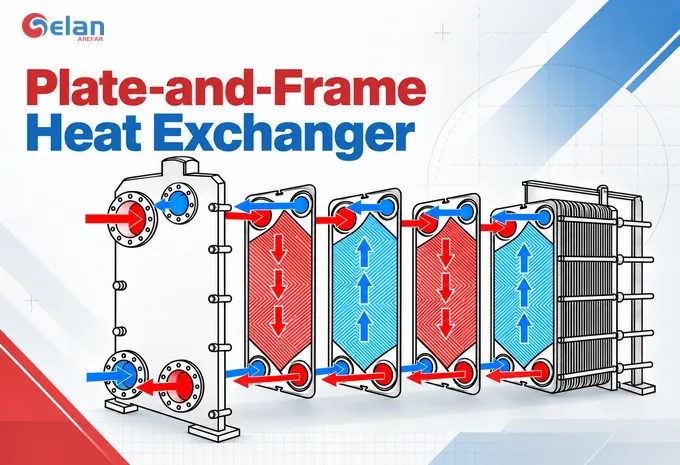
This guide focuses on plate-and-frame heat exchangers. If you are looking for a shell-and-tube heat exchanger or an air-cooled heat exchanger for your project, you can contact Gelan. With extensive manufacturing experience, strong production capabilities, and professional engineering and design support, Gelan can manufacture these heat exchangers according to your project requirements.
If you are new to heat exchangers, you may feel confused when you first see the term “plate-and-frame heat exchanger.” You may want to know what it is, why it is called “plate and frame,” and what its relationship is with a plate heat exchanger and a gasketed plate heat exchanger—two terms that often appear together with it.
Whatever questions you have about plate-and-frame heat exchangers, you can find the answers in this guide. In addition to the questions mentioned above, you will also learn how a plate-and-frame heat exchanger works, how it differs from other plate heat exchangers and shell-and-tube heat exchangers.
Part 1. What is a Plate and Frame Heat Exchanger?
First of all, let’s clearly explain what a plate-and-frame heat exchanger is. It is a type of plate heat exchanger used to transfer heat between hot and cold fluids without allowing them to mix under normal operating conditions.
You may still wonder why it is called a “plate-and-frame heat exchanger.” The answer comes from its structure.
Structure of a Plate-and-Frame Heat Exchanger
A typical plate-and-frame heat exchanger consists of the following components:
Plate Pack:
● Heat-Transfer Plates
● Sealing Gaskets
Frame:
● Fixed Frame Plate
● Movable Pressure Plate
● Upper Carrying Bar
● Lower Guide Bar
● Support Column
● Tightening Bolts
● Nuts
● Washers
● Bearing Boxes
● Mounting Feet
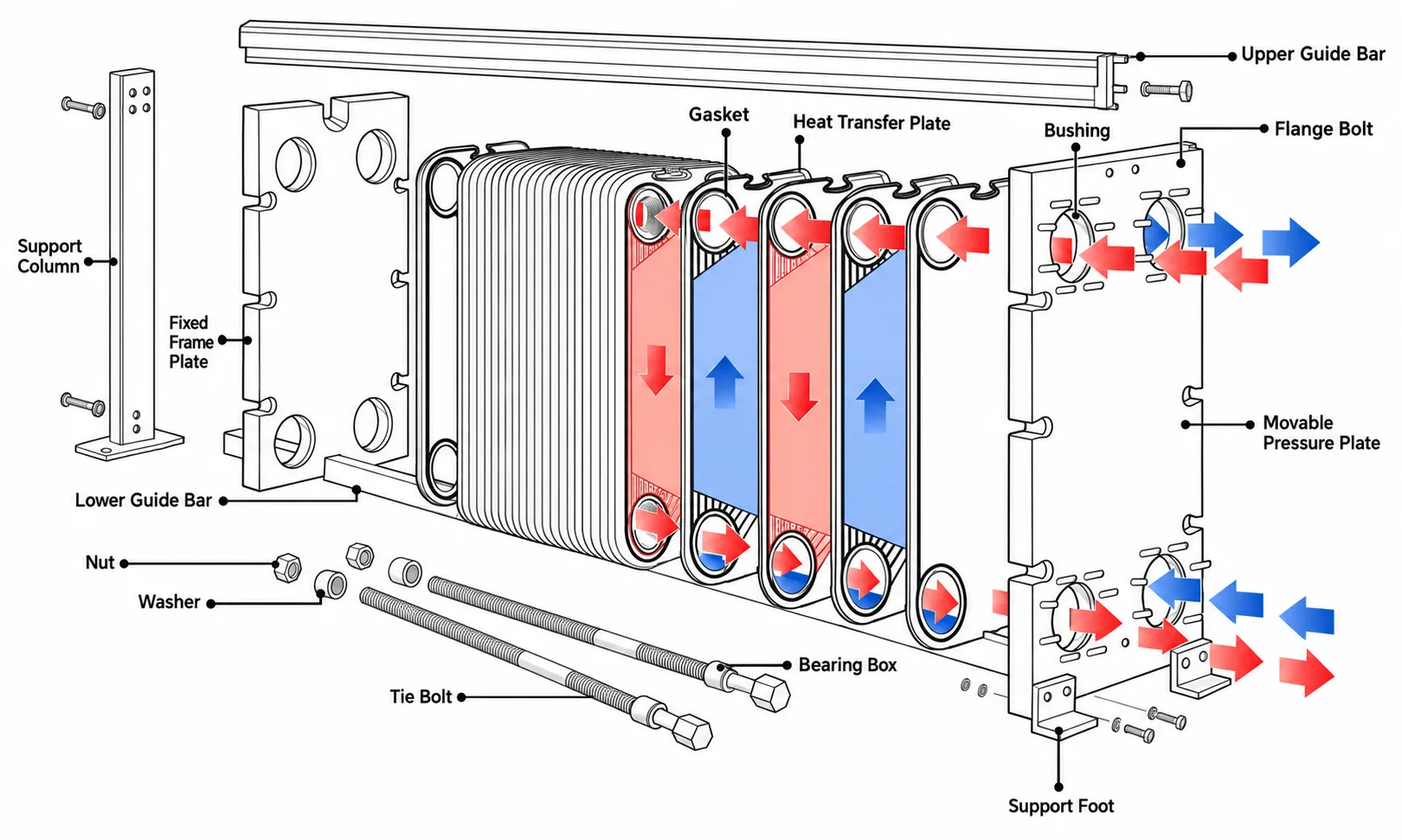
As you can see from its structure, a plate-and-frame heat exchanger gets its name from its two major sections: the plate pack and the frame.
How Does a Plate-and-Frame Heat Exchanger Work?
After understanding its definition and structure, you may want to know how a plate-and-frame heat exchanger works. Before explaining its working principle, you should first understand the functions of the plates and frame.
Functions of the Plates
The plate pack consists of a group of corrugated metal plates assembled together. Its major functions are to:
1. Keep the hot and cold fluids separated
2. Provide the surfaces through which heat is transferred
3. Form alternating flow channels for the two fluids
4. Create turbulence through the corrugated patterns to improve heat transfer
5. Support adjacent plates at their corrugation contact points
Functions of the Frame
Unlike the heat-transfer plates, the frame is not the primary heat-transfer surface. Its major functions are to:
1. Support and align the plates
2. Clamp the plates and gaskets tightly together
3. Keep the plate pack properly sealed
4. Support the fluid connections
5. Allow the plate pack to be opened for inspection, cleaning and maintenance
After understanding the functions of these two major sections, you can easily understand how a plate-and-frame heat exchanger works.
First, the hot and cold fluids enter the heat exchanger through separate connections, which are usually located on the fixed frame plate. The fluids then pass through the corner ports and enter separate, alternating channels formed between adjacent plates.
The gaskets control which channels each fluid can enter. As a result, the hot fluid flows through one set of channels, while the cold fluid flows through the neighboring channels. The two fluids do not normally mix because the metal plates and gaskets keep them separated.
As the fluids flow across the corrugated plate surfaces, heat passes from the hot fluid through the plates and into the cold fluid. The corrugated patterns also create turbulence, which improves heat transfer and helps distribute the fluids across the plate surfaces.
In a typical counterflow arrangement, the hot and cold fluids move in opposite overall directions. During this process, the hot fluid gradually becomes cooler, while the cold fluid becomes warmer. Finally, they leave the heat exchanger through their respective outlets.
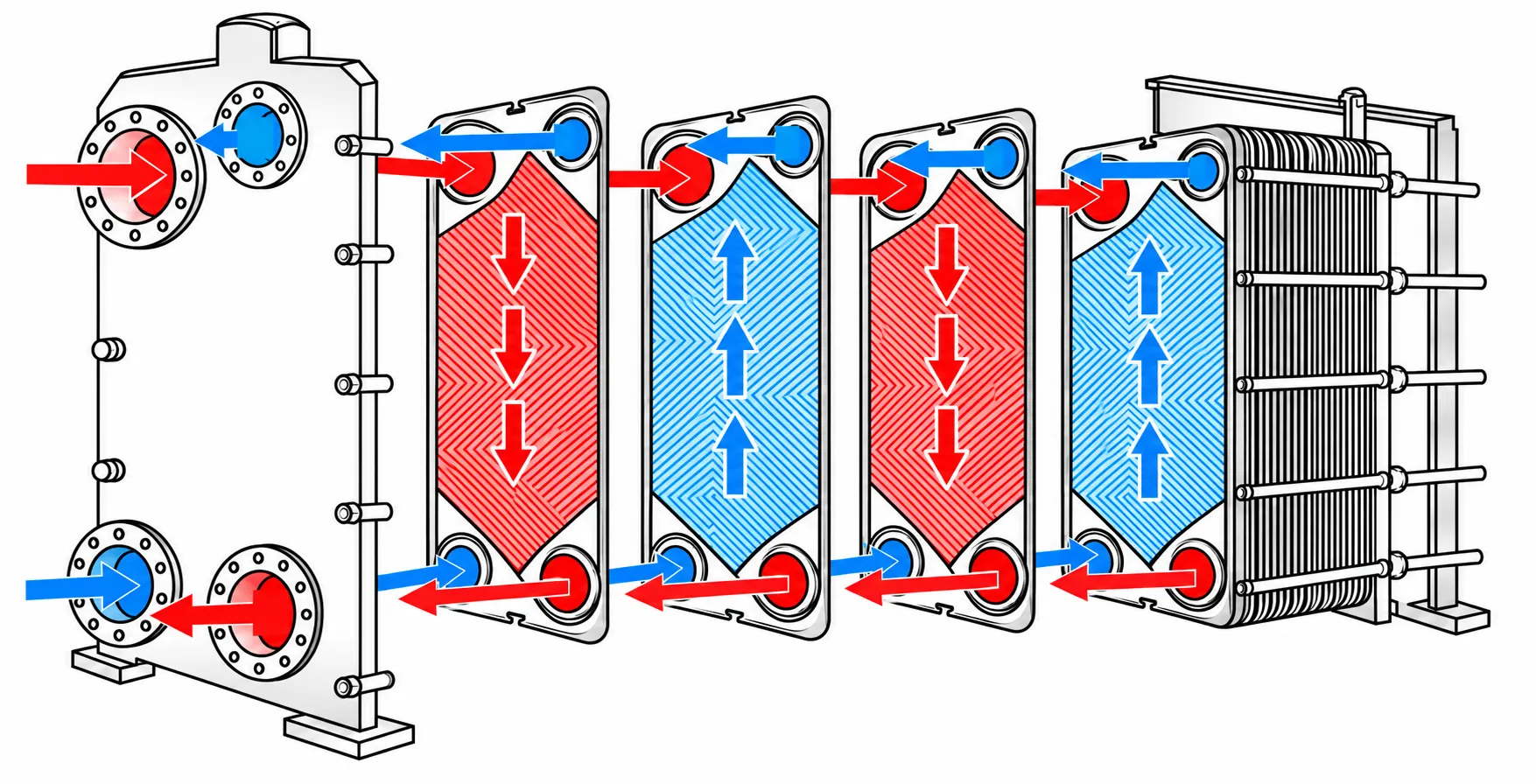
Plate and Frame Heat Exchanger vs Gasketed Plate Heat Exchanger: Are They Same?
You already have a clear picture of what a plate-and-frame heat exchanger is. However, you may still be confused about its relationship with a gasketed plate heat exchanger because these two names often appear together. So, are they the same type of heat exchanger?
For the most common design, the answer is yes. A conventional plate-and-frame heat exchanger uses gaskets between the heat-transfer plates. Therefore, it is also commonly called a gasketed plate heat exchanger or a gasketed plate-and-frame heat exchanger.
However, the two names describe the heat exchanger from different perspectives:
● Plate-and-frame describes its structure. The heat-transfer plates are assembled into a plate pack and clamped together inside a supporting frame.
● Gasketed describes how the plates are sealed. Gaskets are installed between the plates to seal the plate pack and direct the hot and cold fluids into their respective flow channels.
Therefore, when people mention a conventional removable-plate design, “plate-and-frame heat exchanger” and “gasketed plate heat exchanger” usually refer to the same equipment.
However, the two terms are not technically identical in every case. Plate-and-frame heat exchangers can also include semi-welded or fully welded designs. In a semi-welded design, pairs of plates are welded together to form cassettes, while gaskets are still used between the cassettes. In a fully welded design, the plate pack does not rely on conventional inter-plate gaskets for sealing.
Now, you should have a clear understanding of what a plate-and-frame heat exchanger is and how it works. You may then want to check whether it meets your application requirements. To make this decision, you should first understand its advantages, limitations and major types.
Advantages of a Plate-and-Frame Heat Exchanger
A plate-and-frame heat exchanger offers the following advantages:
1. High Heat-Transfer Efficiency: The hot and cold fluids flow through alternating channels separated by thin metal plates. The corrugated plates create turbulence, while the counterflow arrangement maintains a strong temperature difference between the two fluids. These features allow heat to be transferred efficiently.
2. Easy to Install, Open and Clean: A gasketed plate-and-frame heat exchanger has a relatively simple and compact structure. The plate pack can be opened for inspection, mechanical cleaning, gasket replacement and maintenance.
3. Easy to Adjust the Heat-Transfer Capacity: For a gasketed design, plates can normally be added or removed to increase or reduce the available heat-transfer area.
4. Lower Installation and Maintenance Costs: Its compact size can reduce installation space and supporting requirements. The removable plates can also make cleaning and maintenance easier in suitable applications.
5. Space-Saving Design: Plate-and-frame heat exchangers provide a large heat-transfer area within a relatively small footprint. Therefore, they are suitable for applications with limited installation space.
Limitations of a Plate-and-Frame Heat Exchanger
Although plate-and-frame heat exchangers offer many advantages, they also have some limitations:
1. Temperature Limitations: Gasketed designs are not suitable for extremely high temperatures.
2. Pressure Limitations: Conventional gasketed plate-and-frame heat exchangers generally have lower pressure limits. Excessive pressure can cause gasket leakage or damage to the plate pack.
3. Risk of Clogging: The narrow flow channels may become blocked when handling fluids containing large particles, fibres or heavy solids. Wider-gap or specially designed plates may be required for these fluids.
4. Gasket Maintenance: Gaskets may age, harden, swell or become damaged over time, especially when exposed to high temperatures or incompatible chemicals. They therefore require regular inspection and eventual replacement.
Types of Plate-and-Frame Heat Exchangers
After understanding these advantages and limitations, you may want to know which type of plate-and-frame heat exchanger is suitable for your application. Based on how the plates are sealed or joined, there are two major types:
1. Gasketed Plate-and-Frame Heat Exchanger: It uses gaskets to seal the plates and direct the fluids into their respective channels. It can be opened for cleaning, maintenance and plate replacement. However, the gaskets may be affected by high temperatures or incompatible fluids.
2. Semi-Welded Plate-and-Frame Heat Exchanger: Pairs of plates are welded together to form cassettes, while gaskets are used between the cassettes. It provides better resistance to aggressive fluids while remaining partly openable for maintenance. However, its welded channels are more difficult to access and clean.
Part 2. Plate-and-Frame Heat Exchanger vs Plate-and-Shell vs Brazed
Plate heat exchangers are available in several different structural designs. Three common options are plate-and-frame, plate-and-shell and brazed plate heat exchangers. Here, I will compare these three common designs to help you understand their differences and determine whether a plate-and-frame heat exchanger or another design is more suitable for your application.
| Comparison | Plate-and-Frame | Plate-and-Shell | Brazed Plate |
|---|---|---|---|
| Plate Joining and Sealing | All-gasketed or semi-welded | Usually fully welded | Brazed, commonly with copper or nickel |
| Overall Structure | Plate pack compressed inside an external frame | Welded plate pack installed inside a pressure shell | Compact brazed plate pack without a conventional frame |
| Compactness | High | High | Very high |
| Heat-Transfer Performance | High | High | High |
| Temperature Capability | Generally limited by gasket material | Generally suitable for higher temperatures | Depends on plate and brazing materials |
| Pressure Capability | Generally low to moderate | Generally high | Moderate to high, depending on the model |
| Can Be Opened | Yes for all-gasketed; partly for semi-welded | Usually no | No |
| Mechanical Cleaning | Easy or partly possible | Limited | Generally not possible |
| Capacity Expansion | Plates may be added within the frame limit | Generally not possible | Not possible |
After checking the comparison above, you may have a general idea of the differences between plate-and-frame, plate-and-shell and brazed plate heat exchangers. So, which one should you choose for your application?
If your operating temperature and pressure are within the allowable limits of the selected plates and gaskets, and you need to open the heat exchanger for inspection, mechanical cleaning or maintenance, a plate-and-frame heat exchanger may be your option.
If your application involves higher temperatures, higher pressures or more demanding fluids, you may need to choose a plate-and-shell heat exchanger. Its welded and gasket-free plate pack makes it more suitable for these working conditions. However, it is more difficult to open, mechanically clean or expand.
If you need a compact and lightweight heat exchanger for relatively clean fluids, a brazed plate heat exchanger may be your option. However, it normally cannot be opened, mechanically cleaned or expanded. You should also check whether the fluids are compatible with the brazing material.
Part 3. Plate-and-Frame Heat Exchanger vs. Shell-and-Tube Heat Exchanger
After comparing plate-and-frame heat exchangers with other types of plate heat exchangers, you may also want to know the differences between plate-and-frame and shell-and-tube heat exchangers. Both are popular heat exchanger designs. So, which one should you choose for your application? Here, I will compare them to help you make the right selection.
| Comparison | Plate-and-Frame | Shell-and-Tube |
|---|---|---|
| Heat Duty | Suitable for small to large duties | Suitable for small to very large duties |
| Heat-Transfer Performance | Generally higher per unit of heat-transfer area | Generally lower per unit of heat-transfer area |
| Temperature | Limited by the plate and gasket materials | Suitable for a wider temperature range |
| Pressure | Generally suitable for low- to moderate-pressure services | Generally more suitable for higher-pressure services |
| Fluid Properties | More suitable for clean, low- to medium-viscosity fluids | More suitable for high-viscosity, dirty or complex fluids |
| Capacity Adjustment | Plates can be added or removed within the frame and design limits | Generally not adjustable after manufacturing |
| Installation Space | Requires less installation space | Generally requires more installation space |
From the comparison above, you can see that a plate-and-frame heat exchanger may be your option when you need high heat-transfer performance, adjustable capacity and a compact installation.
If your application involves higher temperatures, higher pressures, very large heat duties or more demanding fluids, a shell-and-tube heat exchanger may be more suitable.
Final Words
Now, with this guide, you should have a clear picture of what a plate-and-frame heat exchanger is, how it works, its advantages and limitations, and how it differs from other common heat exchangers.
If you find that a plate-and-frame heat exchanger meets your application requirements, you can select the proper type based on the temperature, pressure, fluids, heat duty and maintenance requirements. If a shell-and-tube heat exchanger is more suitable for your project, you can contact Gelan for engineering and manufacturing support.