

TL;DR
- •Trays usually fit high-throughput, fouling, solids-containing, or variable-load duties.
- •Packing usually fits clean fluids, vacuum service, heat-sensitive products, and high-purity separation.
- •Selection should review feed conditions, separation targets, pressure drop, operating range, maintenance, and lifecycle cost.
- •The final design must define the tray or packing type, material, tray count or packing height, and supporting internals.
- •For new or revamp projects, Gelan can review process data, vessel drawings, and operating records before preparing a proposal.
Trayed and packed columns are the two main types of distillation column. They differ in capacity, pressure drop, operating range, maintenance, and suitable services.
From more than a decade of refinery and petrochemical project experience, I have seen many selection mistakes lead to fouling, unstable throughput, and higher maintenance costs. This article uses three practical steps to determine whether trays or packing better fit the duty.
CONTENT:
- What Is a Distillation Column, and Why Do Column Internals Matter?
- How to Choose Between a Tray and Packed Distillation Column in 3 Steps
- How Do Column Internals Affect Distillation Column Diameter and Height?
- What Data Is Needed for Distillation Column Internals Selection?
- FAQ About Distillation Column Trays and Packing
- Conclusion
What Is a Distillation Column, and Why Do Column Internals Matter?
A distillation column is a vertical process vessel. It separates a liquid mixture into products with different boiling ranges. It is widely used in crude oil refining, vacuum distillation, petrochemical separation, gas processing, and chemical production. It may also be called a distillation tower, distillation fractionating column, fractionating column, or fractionation column.
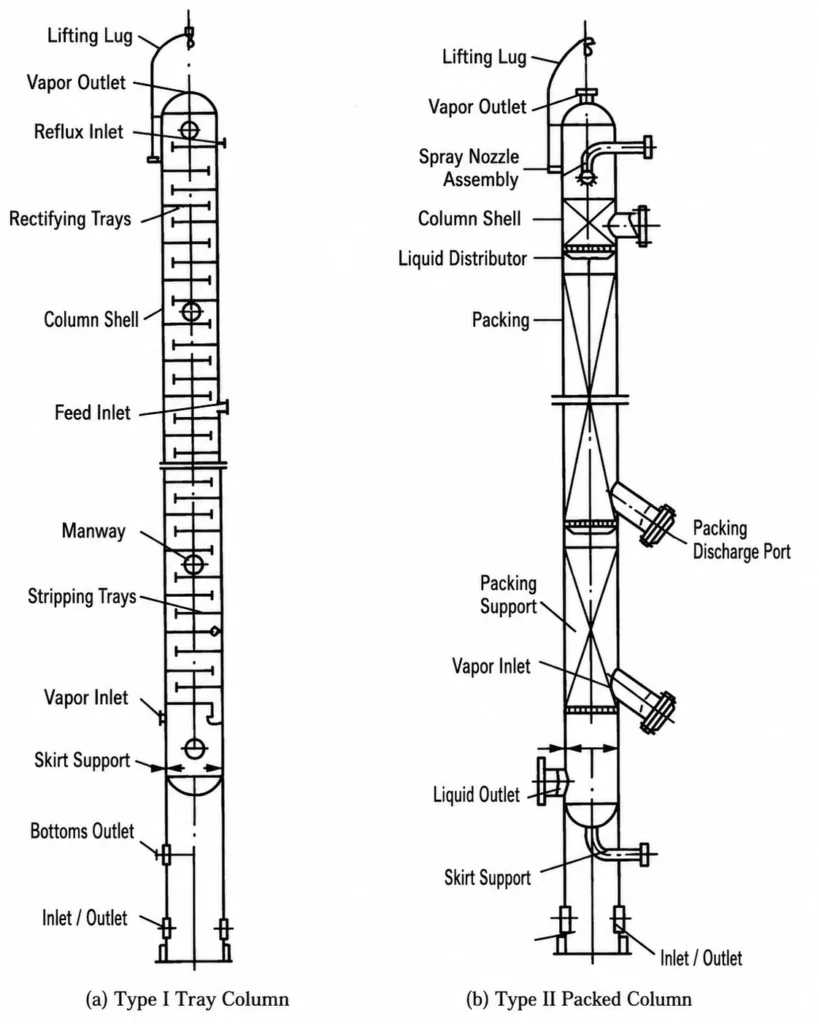
The shell contains the process fluid and pressure. The column internals create the contact between rising vapor and descending liquid. Most industrial columns use one of two main designs:
- Distillation column tray: Horizontal trays hold a liquid layer. Vapor passes through the tray openings. Each tray forms one contact stage.
- Distillation column packing: Random or structured packing provides a wetted surface. Vapor flows through the open spaces. Mass transfer continues across the packing bed.
The choice affects capacity, pressure drop, separation efficiency, maintenance, and column size.
How to Choose Between a Tray and Packed Distillation Column in 3 Steps
Use four factors for the initial screening:
| Selection factor | Trays usually fit better | Packing usually fits better |
|---|---|---|
| Feed and throughput | High load, solids, fouling or coking risk | Clean fluid and stable distribution |
| Separation target | Coarse separation and multiple side draws | High purity or limited available height |
| Operating pressure | High pressure or wide load changes | Vacuum and low-pressure-drop service |
| Maintenance | Frequent inspection and local cleaning | Clean service with lower liquid holdup |
This table gives an initial direction.
- Step 1 reviews the feed and load.
- Step 2 checks the separation target.
- Step 3 confirms operating stability and lifecycle cost.
Step 1: Use Feed Conditions and Throughput to Choose Trays or Packing
The first selection factor is the feed condition and processing load. Trays use a liquid layer on each stage. Their open flow paths can handle larger vapor and liquid loads. They are also less sensitive to solids and deposits. Packing creates a thin liquid film over a large surface. It works best with clean fluids and stable liquid distribution.
- Distillation column tray: Usually the first choice for high-throughput duties, suspended solids, fouling, coking risk, and large load changes. The open structure also makes inspection and cleaning easier.
- Distillation column packing: Usually the first choice for clean fluids and medium or lower loads. Its large surface area supports mass transfer. Its low liquid holdup can also benefit heat-sensitive products.
In one Gelan atmospheric crude distillation project, the feed contained small amounts of mechanical impurities. At a throughput above 10 m³/h, the tray option showed 12%–18% higher effective separation performance than the packed option. The packed section developed blockage and rising pressure drop after about three months. A valve-tray design then operated for 18 months without internal cleaning. This project showed the stability advantage of trays in high-load and impurity-containing service.
Step 1 narrows the selection. Step 2 checks whether the chosen internals can meet the required separation performance.
Step 2: Match Column Internals to the Required Separation Performance
After Step 1, the project should have an initial tray or packing direction. Step 2 checks whether that direction can meet the required purity, recovery, pressure drop, and available tower height.
High purity does not automatically mean packing. Gelan first compares the required theoretical stages, expected tray efficiency or packing HETP, available height, and feed or side-draw arrangement.
What Separation Performance Is Required?
Start with six project inputs:
- Product purity
- Recovery target
- Number of theoretical stages
- Allowable pressure drop
- Available column height
- Required mass-transfer efficiency
The same separation target can be reached in different ways.
- A tray design can add more actual trays or improve tray efficiency.
- A packed design can use lower-HETP packing, increase bed height, or improve liquid distribution.
The best option is the one that reaches the target within the real pressure-drop and space limits.
Gelan project data shows this difference. In one anhydrous ethanol project, the purity target was above 99.9%. Structured packing delivered about three to five theoretical stages per meter. Under the same project basis, its effective stage density was more than twice that of the sieve-tray option. In Gelan’s 2025–2026 project sample, more than 90% of small high-purity fragrance and pharmaceutical duties selected packing. More than 85% of crude methanol and coke-oven benzene duties with multiple side draws selected trays. (Note: These are Gelan project samples. They are not universal industry averages.)
How Do Tray Efficiency and HETP Compare?
A process simulation normally gives the required theoretical stages. A tray design then converts those stages into an actual tray count. Overall tray efficiency links the two values:
Actual tray count ≈ theoretical stages ÷ tray efficiency
A lower tray efficiency means more physical trays. Tray spacing then determines the main active tower height.
A packed design uses HETP. It means the packing height needed for one theoretical stage:
Packing bed height ≈ theoretical stages × HETP
A lower HETP usually reduces the required packing height. However, catalog HETP is not the final project result. Load, surface tension, wettability, fluid properties, and liquid distribution can change actual performance.
This comparison prevents a common mistake. One theoretical stage does not equal one actual tray. A low HETP also does not guarantee a shorter total tower. Distributors, collectors, support grids, and free space still require height.
Once this calculation is complete, the project should no longer compare only “tray versus packing”. It should begin selecting the specific tray or packing type that can deliver the calculated performance.
Which Distillation Column Tray Type Fits the Duty?
After trays have been selected as the general direction, the next decision is the tray type. The choice should match the expected load range, pressure drop, fouling risk, maintenance plan, and project budget.
The three main distillation column trays are sieve trays, valve trays, and bubble-cap trays.
| Factor | Sieve Tray | Valve Tray | Bubble-Cap Tray |
|---|---|---|---|
| Pressure drop | Low to medium | Medium | High |
| Capacity | High | High | Lower |
| Turndown | Limited | Wide | Very wide |
| Fouling tolerance | Low to medium | Medium to high | Medium |
| Maintenance | Simple | Moderate | Complex |
| Cost | Low | Medium | High |
- Choose a sieve tray distillation column when loads are stable and cost control is important.
- Choose a valve tray distillation column when the operating load changes or wider flexibility is required.
- Consider distillation column bubble-cap trays when stable contact at very low vapor flow is essential.
In Gelan project reviews, valve trays are often the practical middle option. They provide more flexibility than conventional sieve trays without the higher pressure drop and mechanical complexity of bubble-cap trays.
Which Distillation Column Packing Type Fits the Duty?
When the stage and height calculation favors packing, the next task is to select the packing structure. The choice affects HETP, capacity, pressure drop, liquid holdup, fouling resistance, installation, and replacement.
The main distillation column packing types are random packing, structured packing, and grid packing.
| Packing type | Main advantage | Main limitation | Typical application |
|---|---|---|---|
| Random packing | Simple installation and replacement | Lower stage density than high-efficiency structured packing | Small and medium towers, revamps |
| Structured packing | High efficiency and low pressure drop | Sensitive to distribution and installation | Vacuum, high-purity and heat-sensitive duties |
| Grid packing | Large open area and fouling resistance | Lower stage density than fine structured packing | Refinery wash sections and severe service |
- A random packing distillation column is often suitable for small- and medium-diameter columns and selected revamps.
- Structured packing in a distillation column is usually considered for vacuum, high-purity, heat-sensitive, or height-limited duties.
- Grid packing is more suitable for open, high-capacity, or fouling-prone refinery sections.
Packing performance should not be judged by surface area alone. Gelan uses efficiency, capacity, and pressure drop together when comparing packing options. The following internal assessment provides a general performance reference.
| Packing type | Composite score | Relative rating | Rank |
|---|---|---|---|
| Wire-gauze corrugated packing | 0.86 | Very good | 1 |
| Perforated-sheet corrugated packing | 0.61 | Strong | 2 |
| Metal Intalox packing | 0.59 | Strong | 3 |
| Metal saddle packing | 0.57 | Strong | 4 |
| Metal cascade mini rings | 0.53 | Good | 5 |
| Metal Pall rings | 0.51 | Good | 6 |
| Ceramic Intalox packing | 0.41 | Fair | 7 |
| Ceramic saddle packing | 0.38 | Moderate | 8 |
| Ceramic Raschig rings | 0.36 | Moderate | 9 |
Source: Gelan internal packing comparison data.
(Note: The composite score compares efficiency, capacity, and pressure drop. It is not a separation-efficiency percentage)
Wire-gauze packing ranks highest for mass-transfer performance. It is also more expensive and more sensitive to fouling. The final choice must still match HETP, hydraulic load, pressure drop, and cleaning requirements.
How Should Packing Material Be Selected?
After the packing structure has been selected, the project must determine the material. The packing material in a distillation column must withstand the process temperature, corrosion environment, mechanical load, and expected cleaning method.
| Material | Main advantage | Main limitation | Typical application |
|---|---|---|---|
| Metal | High strength and broad temperature range | May require alloy upgrades for corrosion | Refinery and petrochemical service |
| Plastic | Lightweight and resistant to many corrosive fluids | Limited by temperature and mechanical strength | Corrosive low- or medium-temperature service |
| Ceramic | Strong corrosion and heat resistance | Brittle during transport and installation | Corrosive or high-temperature duties |
- Metal packing is widely used in refinery and petrochemical duties that require strength and temperature resistance.
- Plastic packing suits selected corrosive services within its temperature and mechanical limits.
- Ceramic packing resists corrosion and high temperature, but requires careful transport and installation.
Final selection should consider normal and upset temperatures, corrosion data, mechanical load, cleaning method, and replacement cost.
What Supporting Internals Does a Packed Distillation Column Need?
Packing is only the mass-transfer element. A packed column also needs supporting internals to distribute liquid, support the bed, collect side streams, and control entrainment.
| Supporting internal | Main function |
|---|---|
| Liquid distributor in a distillation column | Spreads liquid evenly across the packing |
| Feed distributor | Introduces the feed without disturbing liquid distribution |
| Redistributor | Corrects wall flow between packing beds |
| Packing support grid | Supports the packing and retained liquid |
| Bed limiter or hold-down grid | Prevents packing movement |
| Liquid collector | Collects liquid before redistribution or withdrawal |
| Chimney tray in a distillation column | Supports liquid collection, side draws, and vapor flow |
| Demister pad | Removes liquid droplets from the overhead vapor |
The liquid distributor in a distillation column is often as important as the packing itself. Poor distribution creates dry and overloaded areas. The packing may then fail to reach its designed HETP.
Large-diameter or multi-bed columns may require collectors and redistributors. The support grid must also carry the packing and liquid load without becoming a hydraulic restriction.
Before Gelan confirms a packed-column arrangement, we review the packing, distributors, support grids, collectors, nozzles, and available installation space as one system.
At the end of Step 2, the project should define:
- Tray or packing type
- Actual tray count or packing height
- Material
- Supporting internals
- Required vessel space
Step 3 then verifies the scheme against actual operating and cost conditions.
Step 3: Evaluate Operating Conditions and Total Lifecycle Cost
The selected internals must remain stable at the actual pressure and load range. Packing is usually preferred for vacuum and high-vacuum service. Trays are usually preferred for high-pressure operation, wide load changes, and services that require frequent cleaning.
Which Internals Fit the Actual Operating Conditions?
| Operating condition | Initial preference | Main reason |
|---|---|---|
| Vacuum or high vacuum | Packing | Lower pressure drop |
| Heat-sensitive products | Packing | Lower operating temperature and liquid holdup |
| High-pressure operation | Trays | More stable staged contact |
| Wide load changes | Valve trays | Better operating flexibility |
| Fouling or frequent cleaning | Trays | Easier inspection and local repair |
Distillation column pressure drop is especially important in vacuum service. Additional resistance raises the bottom pressure and boiling temperature.
In comparable vacuum duties reviewed by Gelan, packed designs produced about 40%–60% less pressure drop than tray alternatives for the same separation duty.
For high-pressure or variable-load duties, trays often provide better stability. Packing remains an option, but the distributor must keep the bed evenly wetted at minimum, normal, and maximum loads.
The hydraulic check should cover turndown, flooding margin, tray weeping, packing wetting, and startup conditions.
Which Option Has the Lower Lifecycle Cost?
The lowest purchase price does not always provide the lowest total cost.
| Cost factor | Tray column | Packed column |
|---|---|---|
| Energy use | Usually higher pressure drop | Usually lower pressure drop |
| Cleaning | Easier local access | Packing may need to be unloaded |
| Repair | Local sections may be replaced | Packing or distributors may need replacement |
| Installation | Conventional staged assembly | Requires careful distribution and leveling |
| Best lifecycle fit | Dirty, high-pressure or variable-load service | Vacuum, clean or heat-sensitive service |
In Gelan’s high-pressure and variable-load project sample, the tray scheme reduced maintenance-related operating costs by about 25%. Easier cleaning, local repair, and shorter shutdown work were the main reasons.
For a revamp, the comparison should also include the shutdown window, manway size, field welding, removal sequence, and production loss.
After this review, the internal selection should be finalized.
Tray vs Packed Distillation Column Comparison
The three-step review should now give a clear internal direction. Use this table for the final project check.
| Factor | Tray column | Packed column |
|---|---|---|
| Vapor–liquid contact | Separate stages | Continuous contact |
| Throughput | Strong for high loads | Depends on packing capacity |
| Pressure drop | Higher | Lower |
| Load flexibility | Valve trays handle wider changes | Depends on wetting and distribution |
| Fouling service | Easier to inspect and clean | Fine packing may block more easily |
| High-purity duty | More actual trays may be required | Low HETP can provide more stages per meter |
| Multiple side draws | Easier to arrange | Requires collectors or chimney trays |
| Maintenance | Local repair is often possible | Packing may need to be unloaded |
| Best initial fit | High load, dirty or variable service | Vacuum, clean or heat-sensitive service |
The final choice must still meet the required purity, capacity, pressure drop, tower dimensions, maintenance plan, and project cost.
How Do Column Internals Affect Distillation Column Diameter and Height?
After the three-step selection, the internal scheme should be clear. The next task is to confirm whether it fits the required shell size and project constraints.
Internals affect three parts of the design:
- Diameter: Can vapor and liquid pass without flooding?
- Height: Is there enough space for the required separation stages?
- Mechanical design: Can the internals be supported, shipped, and installed?
How Do Internals Affect Column Diameter?
Column diameter is mainly determined by vapor load, liquid load, allowable velocity, and flooding margin. However, trays and packing use the available cross-sectional area differently.
| Design factor | Tray column | Packed column |
|---|---|---|
| Vapor capacity | Based on active tray area | Based on packing capacity |
| Liquid handling | Controlled by downcomers | Controlled by packing and distributors |
| Flooding risk | Entrainment or downcomer backup | Packing or distributor flooding |
| Area limitation | Downcomers reduce active area | Poor distribution reduces usable area |
- In a tray column, downcomers carry liquid from one tray to the next. They occupy part of the tower cross-section. Larger downcomers improve liquid handling, but leave less active area for vapor flow. Smaller downcomers increase active area, but may cause liquid backup.
- In a packed column, the selected packing type changes the open area, pressure drop, and flooding capacity. High-capacity packing may support more throughput within the same shell diameter.
Liquid distribution also becomes more important as packed-column diameter increases. A large shell does not provide more effective capacity if the distributor cannot wet the full packing area evenly.
For a new column, the internal type and shell diameter can be optimized together. For a revamp, the existing diameter is fixed. New internals must provide the required capacity within the available cross-section.
How Do Internals Affect Column Height?
Column height is mainly determined by the required separation stages and the vertical space occupied by the internals.
| Internal type | Main active-height basis | Additional space required |
|---|---|---|
| Tray column | Actual tray count × tray spacing | Feed sections, manways and disengagement space |
| Packed column | Theoretical stages × HETP | Distributors, collectors, support grids and bed spacing |
- A tray design first converts the required theoretical stages into an actual tray count. Tray efficiency affects how many trays are needed. Distillation column tray spacing then determines the main height of the active tray section.
- A packed design uses HETP to calculate the required packing bed height. Lower HETP usually means less active packing height for the same theoretical stages.
Packing does not always produce a shorter total column. The design must also include space for liquid distributors, redistributors, collectors, support grids, feed sections, and vapor disengagement. A tall packed section may need several separate beds, which adds more internal space.
The correct comparison is therefore total installed height, not only actual tray height or packing bed height.
How Do Internals Affect Mechanical Design?
The selected process arrangement must also be practical to manufacture and install.
Tray columns require support rings. Large tray diameters may also require internal beams. Packed columns require support grids that can carry the packing weight, liquid holdup, and operating loads without restricting flow.
The main mechanical checks include:
| Mechanical factor | Why it matters |
|---|---|
| Support rings and beams | Carry trays and large internal sections |
| Packing support grids | Carry packing and retained liquid |
| Manways | Provide access for installation and maintenance |
| Segment size | Determines whether internals can enter the shell |
| Installation access | Affects assembly and replacement work |
| Shipping limits | Decide whether internals can be preassembled |
| Field assembly | Affects schedule, labor, and installation quality |
- For a revamp, existing manways, support rings, nozzles, and internal clearances may limit the design. A technically suitable distributor may still be too large to enter through the available opening.
- For a new column, shipping and lifting limits determine whether internals can be factory-installed or assembled on site.
Before Gelan freezes the vessel and internal drawings, we review support structures, manway access, internal segmentation, transport limits, and field assembly together.
What Data Is Needed for Distillation Column Internals Selection?
To prepare a tray or packing proposal, Gelan first reviews the process duty, separation target, operating conditions, and available vessel space.
| Please provide | Key information |
|---|---|
| Process duty | Column service and fluid composition |
| Operating cases | Minimum, normal, and maximum flow rates |
| Separation target | Product purity, recovery, and theoretical stages |
| Design conditions | Temperature, pressure, and allowable pressure drop |
| Fluid characteristics | Fouling, solids, foaming, corrosion, and heat sensitivity |
| Vessel data | Column diameter, available height, nozzles, and manways |
| Existing internals | Tray spacing, support rings, packing, and distributors |
| Project limits | Material, transport, installation, and shutdown requirements |
For a new column, Gelan uses the heat and material balance and product specifications to define the internal type, tray count or packing height, and preliminary vessel dimensions.
For a revamp, existing drawings and operating records are also required. Gelan reviews pressure drop, throughput, product quality, and inspection findings before recommending replacement or modification.
Available data can support an initial proposal. Final hydraulic and mechanical design requires a confirmed project basis.
FAQ About Distillation Column Trays and Packing
Can an industrial distillation column use both trays and packing?
Yes. Packing can be used where low pressure drop is important. Trays can be used for side draws, liquid collection, or wider load changes. The two sections must be designed as one hydraulic system.
Can trays in an existing refinery column be replaced with packing?
Yes, if the existing shell can support the new arrangement. Capacity, pressure drop, available height, distributors, support grids, manways, and feed locations must be checked first.Gelan can review the existing drawings and operating data before recommending a tray-to-packing revamp.
What causes distillation column flooding and weeping?
Flooding usually means the vapor or liquid load is too high. Pressure drop rises and separation becomes unstable.
Weeping means the vapor load is too low to hold liquid on the tray. Liquid leaks through the tray holes and tray efficiency falls.
What turndown ratio in a distillation column should be specified?
There is no universal ratio. Provide the minimum, normal, and maximum operating loads.
Valve trays usually support wider load changes than sieve trays. The final turndown must be confirmed through hydraulic calculations.
How can distillation column efficiency be improved without replacing the shell?
First identify the real bottleneck. Possible solutions include:
- Higher-capacity or higher-efficiency trays
- Lower-HETP packing
- Improved feed or liquid distribution
- Repair of damaged or fouled internals
Gelan can compare these options against the existing shell size and project target.
When should column internals be replaced?
Replacement should be considered when the column has repeated flooding, rising pressure drop, off-spec products, corrosion, deformation, or blocked packing.
Operating records and inspection findings should determine whether the project needs repair, partial replacement, or a full revamp.
Conclusion
Tray and packing selection should match the feed, separation target, operating range, and maintenance plan. No single internal type fits every distillation column.
Gelan can support new columns and revamp projects with internal selection, vessel design coordination, fabrication, and inspection.
Send your datasheet, heat and material balance, or existing drawings for project review.