

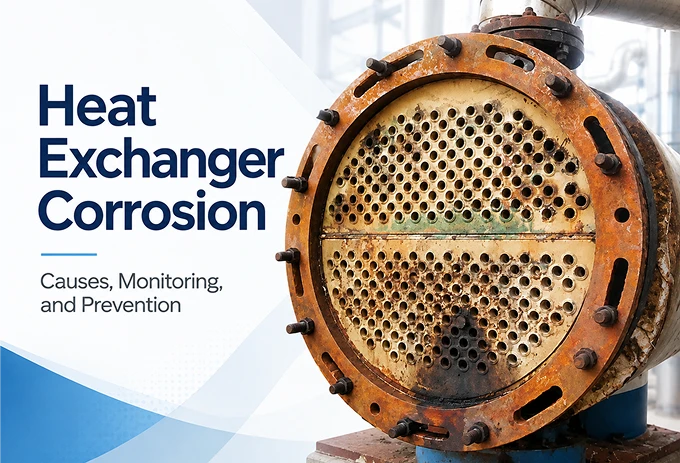
Heat exchanger corrosion is a common problem in refinery, petrochemical, and chemical plants. It can shorten equipment life, cause leakage, and lead to unplanned repair.
In discussions with customers, we often see corrosion concentrated around tubes, tube sheets, and tube-to-tubesheet joints. The visible damage is only the starting point. The real question is why it happened and how to avoid it again. This guide focuses on those two points.
CONTENT:
- What Causes Heat Exchanger Corrosion?
- Where Does Corrosion Usually Occur?
- Common Types of Heat Exchanger Corrosion
- How Is Heat Exchanger Corrosion Monitored?
- How to Prevent Heat Exchanger Corrosion
- FAQ About Heat Exchanger Corrosion
- Conclusion
What Causes Heat Exchanger Corrosion?
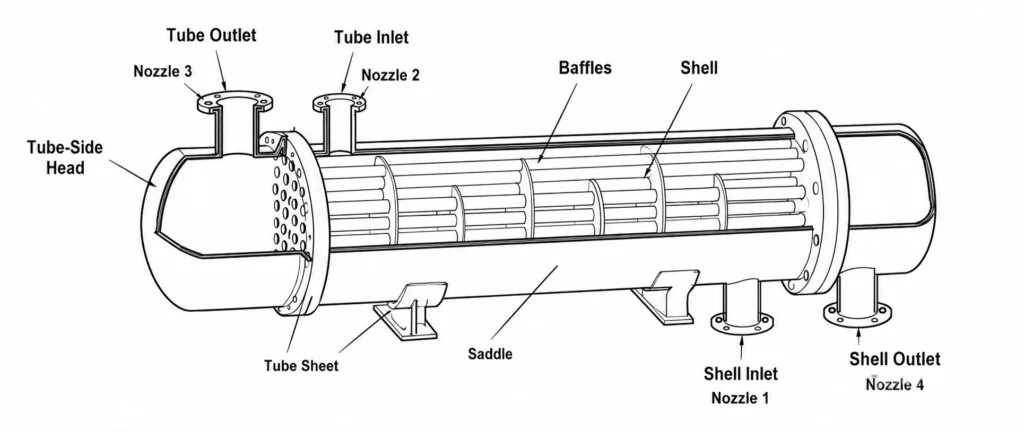
A shell-and-tube heat exchanger keeps two fluids separated by the tube wall. One flows inside the tubes. The other flows around the tubes on the shell side. This creates different conditions at tube entrances, tube sheets, joints, and other local areas. Corrosion often starts where the fluid, material, deposits, or flow becomes more aggressive.
Corrosive Media
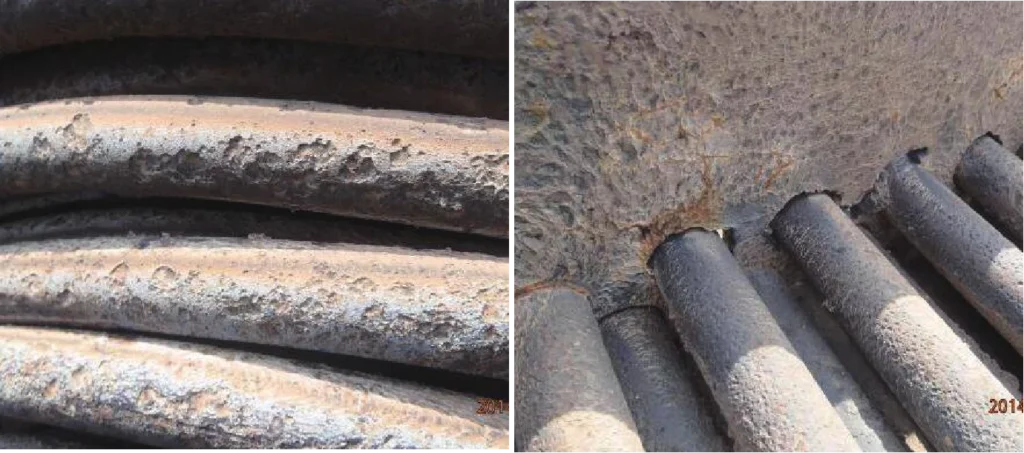
The tube side and shell side stay in contact with metal during operation. Changes in chlorides, salts, acids, dissolved oxygen, or pH can increase the attack on that metal. Stainless steel also has limits. Chloride-rich water and process fluids can cause pitting corrosion and crevice corrosion.
When a customer reports corrosion after several years of stable operation, fluid chemistry is one of the first conditions we compare with the original design basis.
Materials
A heat exchanger may use different materials for the tubes, tube sheet, shell, and channel. Each part sees a different fluid and operating condition. A material that works on one side may not be suitable on the other.
This is why material selection should follow the actual service. Carbon steel, stainless steel, duplex, CuNi, titanium, and nickel alloys offer different levels of corrosion resistance.
Galvanic Corrosion
Tubes and tube sheets are connected and may contact the same cooling water or process fluid. If they use different metals, the fluid can complete an electrical path between them. The less resistant metal may then corrode faster. This is galvanic corrosion.
So when corrosion is concentrated around a tube sheet, we do not check the tube sheet material alone. We also check the tube material and the fluid between them.
Deposits
Cooling water and process fluids may carry suspended solids or substances that form scale. As the fluid moves through the tube bundle, some deposits can build up on tubes or around local low-flow areas. The fluid trapped below the deposit no longer has the same chemistry as the main flow.
This can create under-deposit corrosion. It also explains why a tube can look normal in one area but show deep local damage beneath scale or deposits.
Flow
The fluid does not move at the same speed everywhere. It enters small tubes, changes direction, and passes through restricted areas. Tube entrances can therefore see much stronger local flow than other surfaces.
If the actual velocity exceeds the design condition, tube erosion and vibration can occur. Suspended solids can make the surface loss faster. This is why erosion damage is often checked together with operating flow rate and tube inlet condition.
Joints
The tube-to-tubesheet area is more complex than a flat metal surface. The tube enters the tube sheet and is fixed by welding, expansion, or both. Small gaps, weld areas, material changes, and local flow can all exist in the same location.
Where Does Corrosion Usually Occur?
| Area | Typical Signs | Importance |
|---|---|---|
| Tubes | Pitting, wall thinning, pinhole leaks | Tube walls are thin. Small local damage can quickly lead to leakage between the tube side and shell side. |
| Tube Sheets | Local pits, surface loss, corrosion around tube openings | One tube sheet may connect hundreds of tubes. Local damage can affect sealing and multiple tube connections. |
| Tube-to-Tubesheet Joints | Corrosion around welds, tube entrances, or expanded joints | These areas combine joints, narrow gaps, and material transitions. Damage here can lead directly to leakage. |
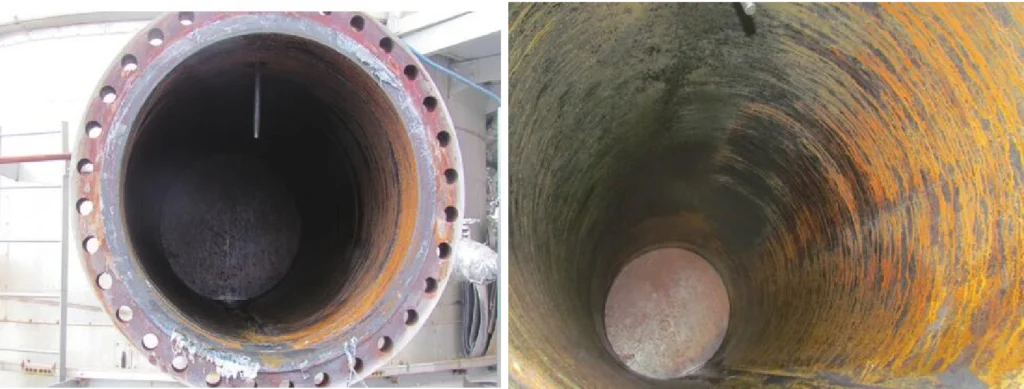
| Shell and Channel | General wall loss, local pits, coating damage | These pressure-containing parts may require replacement when corrosion becomes severe. |
For customers, the corrosion location is useful because it helps define what should be changed in the next exchanger design. If tubes fail repeatedly, the tube material or operating conditions may need to change. If corrosion is concentrated around the tube sheet or joints, the material combination and protection method should be reviewed.
Common Types of Heat Exchanger Corrosion
The main types of corrosion in heat exchangers differ in both appearance and risk. Some develop slowly over a wide area. Others can penetrate a tube wall while most of the surface still looks normal.
| Corrosion Type | What You May See | Typical Severity | Possible Operating Impact |
|---|---|---|---|
| Pitting | Small but deep pits or pinholes | High local risk. A small affected area can penetrate a thin tube wall. | Tube leakage, cross-contamination between fluids, or shutdown for tube plugging or replacement |
| Galvanic corrosion | Faster attack near the contact between different metals | Moderate to high. Damage can progress quickly on the less resistant metal. | Repeated damage around tubes or tube sheets and shorter equipment life |
| Crevice corrosion | Local attack inside narrow gaps, joints, or gasket areas | High hidden risk. Surface inspection may underestimate the damage. | Leakage at joints and unexpected failure after apparently normal operation |
| Erosion-corrosion | Grooves, thinning, or strong damage near tube entrances and high-flow areas | Can progress quickly if velocity or solids remain unchanged. | Reduced tube wall thickness, tube failure, and loss of heat-transfer capacity |
| Under-deposit corrosion | Pitting or wall loss beneath scale, sludge, or deposits | Often hidden until cleaning or inspection. | Leakage, more frequent cleaning, lower heat-transfer efficiency, and unplanned downtime |
A useful way to judge the risk is by the damage pattern. Deep isolated pits usually need more attention than broad light surface rust. Damage around dissimilar-metal connections points toward galvanic effects. Damage inside joints suggests crevice corrosion. Strong thinning near tube inlets usually points to flow-related attack. Corrosion found only after removing scale is more likely linked to deposits.
For an operating plant, the most serious cases are those that can open a leak path between the tube side and shell side, because they can contaminate product, reduce exchanger duty, or force an unplanned shutdown.
How Is Heat Exchanger Corrosion Monitored?
Heat exchanger corrosion often develops before leakage or obvious performance loss occurs. Refineries therefore combine corrosion monitoring, operating data, and periodic inspection to identify metal loss, fouling, and abnormal changes as early as possible. AMPP lists methods such as corrosion coupons, electrical resistance probes, and ultrasonic thickness measurements among commonly used corrosion-monitoring tools.
Test Heat Exchanger Monitoring
A test heat exchanger can be installed in a cooling-water circuit under conditions close to the actual equipment. After a period of operation, the tubes can be inspected for deposits, fouling, and corrosion.
This gives operators a useful picture of the overall cooling-water condition. However, it cannot fully represent every process exchanger because temperature, flow velocity, materials, and process media may differ.
Corrosion Coupons
Corrosion coupons are small metal samples exposed to the same environment as the equipment. After a known exposure period, their weight loss is used to estimate the average corrosion rate.
The method is simple and useful for confirming long-term corrosion trends. Its main limitation is response time. It cannot quickly show sudden changes in operating conditions, so coupons are usually used together with faster monitoring methods.
Online Corrosion Probes
Online probes provide corrosion information while the system is operating. Common methods include electrical resistance (ER), inductive resistance, and electrochemical probes.
For an electrical resistance probe, the basic relationship is:
R = ρL / A
- R = electrical resistance
- ρ = material resistivity
- L = length of the sensing element
- A = cross-sectional area
As corrosion reduces the cross-sectional area, electrical resistance increases. This change can be converted into metal loss and corrosion-rate trends. ER monitoring can be applied in a wide range of corrosion environments.
Some systems also use inductive resistance probes for continuous metal-loss monitoring. These probes use an AC measurement signal and temperature compensation to improve the stability of the measurement.
For conductive water systems, linear polarization resistance (LPR) monitoring can provide faster feedback. It is based on the Stern–Geary relationship:
icorr = B / Rp
Where icorr is the corrosion current density, B is the Stern–Geary constant, and Rp is the polarization resistance. A lower polarization resistance generally indicates a higher corrosion rate. ASTM G59 covers polarization resistance measurements, while ASTM G102 covers corrosion-rate calculations based on electrochemical measurements.
Ultrasonic Thickness Testing
Ultrasonic thickness testing (UT) measures the remaining wall thickness of exchanger tubes, shells, and other components. It gives direct information about actual metal loss and is widely used during inspection and maintenance.
However, measurement location is important. A few fixed points may miss localized pitting or erosion-corrosion. Inspection should focus on known high-risk areas such as tube inlets, outlets, high-velocity zones, and locations with previous corrosion history.
Process and Performance Monitoring
Heat exchanger performance can also provide early warning signs. Operators may monitor heat-transfer efficiency, fouling resistance, pressure drop, cooling-water quality, and contamination in the cooling-water system.
For example, increasing fouling resistance may indicate deposit buildup, while oil or process-fluid contamination in cooling water may indicate tube leakage.
No single monitoring method can show the complete condition of a heat exchanger.
For critical equipment, Gelan recommends combining operating data, online corrosion monitoring, and periodic inspection. Extra attention should be given to tube inlets, stagnant zones, high-velocity areas, material transitions, and other locations where corrosion is more likely to develop.
The goal is not simply to measure corrosion. It is to detect changes early enough to adjust operating conditions, plan cleaning or inspection, and reduce the risk of unexpected tube failure.
How to Prevent Heat Exchanger Corrosion
Good heat exchanger corrosion prevention starts before fabrication. The material, fluid, flow, fouling risk, and surface protection should be considered together. One measure alone rarely covers every corrosion risk.
Select the Right Material
Heat exchangers in corrosive environments need materials that match the actual fluid, temperature, and corrosion mechanism.
The best material depends on the actual medium and temperature. Carbon steel may work well in mild service. Chloride-rich or more aggressive fluids may require stainless steel, duplex, CuNi, titanium, or nickel alloys. Higher alloy content does not automatically mean a better choice. The material still has to match the corrosion mechanism.
A good example is chloride service. Higher chloride concentration, lower pH, and higher temperature all increase the risk of localized corrosion in stainless steel. In these conditions, corrosion resistant materials for heat exchangers should be selected from the actual process data, not from the material name alone.
Control Water and Process Conditions
Material selection cannot compensate for uncontrolled fluid chemistry. Changes in chloride level, pH, dissolved oxygen, contaminants, or temperature can move an exchanger outside its original design condition. Cooling-water quality should therefore be checked when corrosion appears after a period of stable operation.
Control Fouling
Deposits do more than reduce heat transfer. They can trap corrosive fluid against the metal and create local conditions that differ from the main flow. Cleaning before heavy fouling develops helps protect both heat-transfer performance and the metal surface. Tube arrangement also affects cleaning access.
Control Flow
More velocity is not always better. Excessive flow can damage protective films and accelerate erosion-corrosion. The safe range also changes with material.
For example, published guidance for heat exchanger tubing gives typical seawater velocities of about 2.0–3.0 m/s for 90/10 CuNi and 2.5–3.5 m/s for 70/30 CuNi. These are material-specific reference values, not universal limits.
Heat Exchanger Coatings for Tube Sheets and Joints
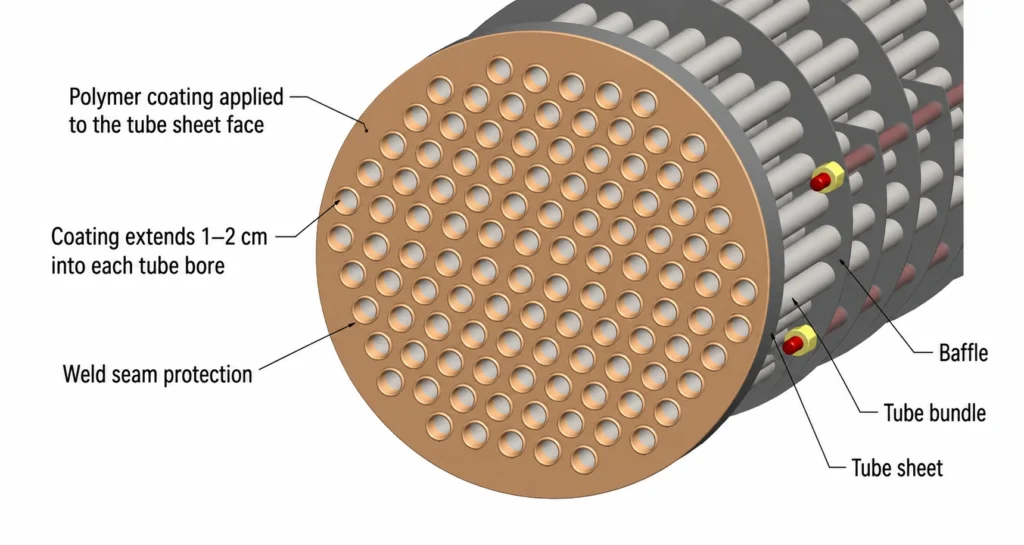
A tube sheet coating can isolate the metal from a corrosive fluid when coating is suitable for the service. Protection may also cover the tube entrances because corrosion often concentrates around the tube-to-tubesheet area. Industry guidance for galvanic protection has used coatings on the head, tube sheet, and the first section of the tubes rather than coating the tube sheet alone.
For suitable projects, Gelan can apply heat exchanger coating to the tube sheet and extend the protection about 10–20 mm into the tube entrance. The surface is prepared before coating. Coating thickness and discontinuities can then be checked before final testing. Gelan also supports pickling, passivation, coating, and project-specified surface treatment for new and replacement tube bundles.
Coating is not the default answer for every corrosion-resistant heat exchanger. If the main problem is the wrong material, excessive velocity, or unstable process chemistry, these conditions should be corrected first. The coating system should then be matched to the fluid, temperature, substrate, and project specification.
FAQ About Heat Exchanger Corrosion
Can Stainless Steel Heat Exchangers Still Corrode?
Yes. Stainless steel can still suffer pitting, crevice corrosion, and stress corrosion cracking. Chlorides, low pH, and higher temperatures increase the risk. For this reason, 304L or 316L is not automatically suitable for every corrosive service.
Can a Heat Exchanger Coating Stop Corrosion?
A coating can reduce corrosion by separating the metal from water, oxygen, and electrolytes. But it must match the fluid, temperature, substrate, and operating conditions. Damage or discontinuities in the coating can expose the metal again.
How Do You Choose a Corrosion-Resistant Heat Exchanger?
There is no single best material. Super duplex performs well in many chloride environments. CuNi is widely used with seawater. Nickel alloys can handle more aggressive chemical service. The right choice depends on the actual fluid and temperature.
When Should a Tube Sheet Be Coated?
A tube sheet may need coating when the base metal requires additional isolation from the process or cooling fluid. It is especially relevant when corrosion is concentrated around the tube sheet and tube entrances. A suitable heat exchanger internal coating must also tolerate the actual chemical and temperature conditions.
Should a Corroded Heat Exchanger Be Repaired or Replaced?
It depends on the damage. Local tube damage may sometimes be managed by plugging or replacing tubes. Wider corrosion, repeated leakage, unsuitable materials, or major tube-sheet damage can make replacement more practical. Gelan does not provide field repair services. We support new exchangers and replacement tube bundles when equipment replacement or material upgrading is required.
What Information Helps Identify the Corrosion Cause?
Start with the damaged location, exchanger materials, process fluid, cooling-water data, temperature, pressure, and operating history. Inspection photos are also useful. If the problem appeared after years of stable operation, compare current fluid and operating conditions with the original design data first.
Conclusion
Heat exchanger corrosion is easier to control when the cause is considered during design. Material, fluid chemistry, flow, fouling, and local protection all matter. A coating may solve one problem, while another service may require a different alloy or tube bundle design. API 660 also treats material selection as part of shell-and-tube exchanger engineering for refinery and petrochemical service.
For a new or replacement exchanger, previous corrosion records are useful design inputs. Gelan can review the operating conditions, drawings, materials, and inspection requirements to support a new shell-and-tube heat exchanger or replacement tube bundle.