

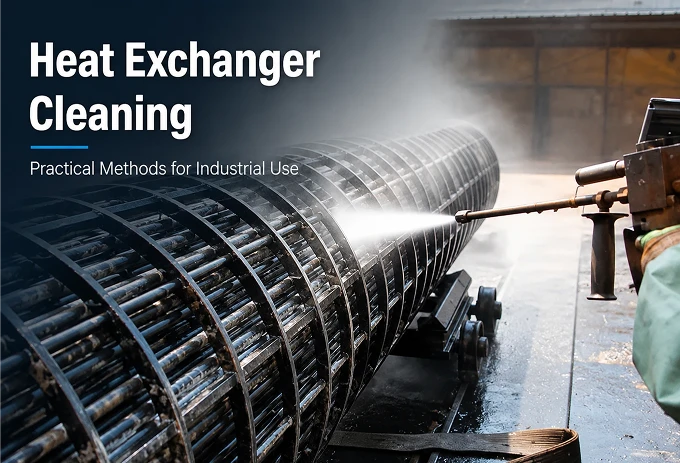
Heat exchangers can lose efficiency after long-term operation. Scale, solids, corrosion products, and process residues build up on heat-transfer surfaces. This increases thermal resistance, pressure drop, and energy use. In one U.S. Department of Energy refinery study, fouling caused an energy loss of about 12,300 Btu per barrel of crude. Regular heat exchanger cleaning helps restore stable heat-transfer performance.
This article explains the main cleaning methods, how to choose cleaning chemicals, and how cleaning differs for shell-and-tube and plate heat exchangers.
CONTENT:
- What Causes Heat Exchanger Fouling?
- Which Heat Exchanger Cleaning Methods Should You Use?
- How Do You Choose Heat Exchanger Cleaning Chemicals?
- How Does Shell and Tube Heat Exchanger Cleaning Work?
- How Does Plate Heat Exchanger Cleaning Work?
- Conclusion
What Causes Heat Exchanger Fouling?
Most heat exchanger fouling starts from three sources. First, dissolved salts in water can precipitate as temperature or concentration rises. The scale becomes thicker and harder over time. Second, process fluids can form solid deposits on tube surfaces. Third, suspended solids and organic matter can settle when fluid velocity is low. These deposits are often loose, porous, or gel-like.
In practice, fouling is usually grouped into six types:
- Crystallization fouling: Salts such as calcium and magnesium compounds form scale on heat-transfer surfaces.
- Particulate fouling: Suspended particles collect on the surface.
- Chemical reaction fouling: Reactions in the process fluid create solid deposits.
- Corrosion fouling: Corrosion products build up on the heat-transfer surface.
- Biological fouling: Microorganisms, sludge, and organic matter form deposits.
- Solidification fouling: Part of the fluid solidifies on a colder surface.
From our experience, actual deposits are often a mixture of several types. This is why the deposit should be understood before the cleaning method is selected. The same six fouling mechanisms are also commonly used in heat exchanger research.
If fouling is not removed, heat-transfer efficiency falls and energy use increases. Heavy deposits can also cause local overheating and tube damage. They may promote under-deposit corrosion, leakage, unstable operation, and shorter equipment life. For more detail on pitting, crevice corrosion, erosion-corrosion, and other common types of heat exchanger corrosion, see our related guide. Process stability and product quality can also be affected.
Once the fouling condition is clear, the next step is to choose a suitable cleaning method.
Pillar Guide
What Is a Heat Exchanger and How Does It Work?
Learn the working principle, main types, key components, and design factors before exploring heat exchanger cleaning in more detail.
Explore the Heat Exchanger Guide →Which Heat Exchanger Cleaning Methods Should You Use?
The main heat exchanger cleaning methods are chemical cleaning and physical cleaning. Each has its own advantages. Chemical cleaning works well when deposits can be dissolved or loosened. Physical cleaning is more direct for hard or attached deposits. In our experience, the two methods are often used together when one method alone cannot remove all fouling.
Chemical Cleaning Procedures for Heat Exchangers
Chemical cleaning uses a cleaning solution to dissolve, loosen, or separate scale and other deposits from heat-transfer surfaces. One advantage is that the exchanger may not need to be fully dismantled. This can simplify the work. However, the wrong chemical can attack tubes, plates, welds, or other materials. CIP cleaning is also widely used because it can clean an exchanger without dismantling it.
Three common chemical cleaning methods are used:
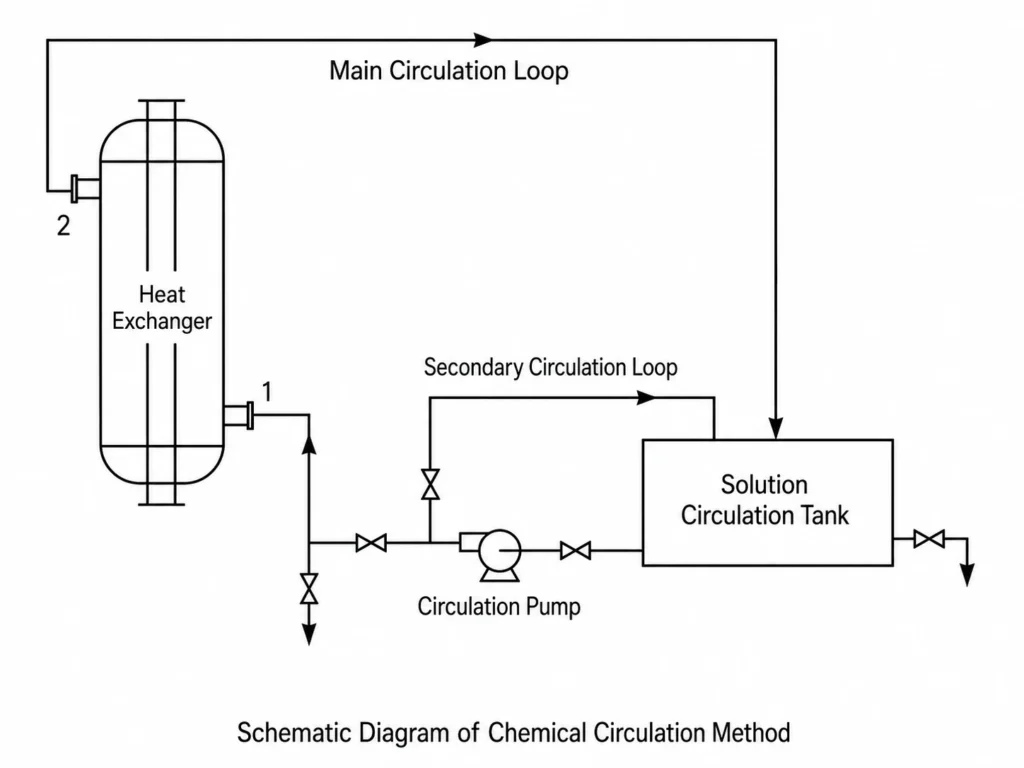
- Circulation cleaning: A pump continuously circulates the cleaning solution through the exchanger.
- Soaking: The exchanger is filled with cleaning solution and left for a set period.
- Surge cleaning: Part of the solution is periodically drained and returned. This creates movement and helps loosen deposits.
A typical chemical cleaning procedure for heat exchangers follows seven steps:
- Isolate the exchanger and drain the remaining liquid.
- Flush out loose solids and other debris.
- Connect the pump and hoses. Feed the solution from the bottom and return it from the top.
- Add the selected cleaning solution and circulate it repeatedly.
- Vent gas during cleaning and add water when needed.
- Check the condition of the cleaning solution. For acid cleaning, pH can be used as one simple field check.
- Recover the cleaning solution. Rinse the exchanger with clean water until the required final pH is reached.
From our experience, the cleaning solution should not be selected only by deposit type. The exchanger material also matters. A cleaner that removes scale quickly may also damage the base material if concentration, temperature, or contact time is wrong.
Physical and Mechanical Cleaning
Physical cleaning uses force or energy to break, loosen, and remove deposits from the heat-transfer surface. It avoids the chemical corrosion risk associated with aggressive cleaning solutions. However, cleaning force may not reach every area inside a complex exchanger. Dead zones can remain.
High-Pressure Water Jetting
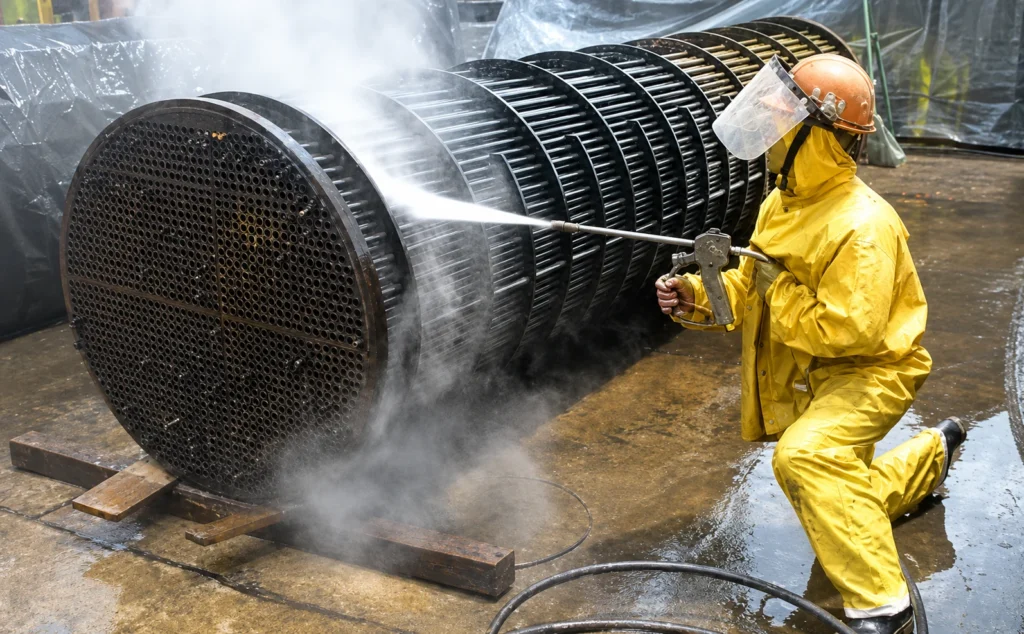
High-pressure water jetting uses a pump and special nozzle to direct high-pressure water at the deposit. It can remove hard fouling quickly, but water use can be high. The jetting force must also match the tube or plate condition. High-pressure water cleaning is commonly used where heat-transfer surfaces are accessible.
Ultrasonic Descaling
Ultrasonic descaling uses an ultrasonic field to disturb and loosen deposits. The vibration can help break the bond between fouling and the surface. Research has also shown that ultrasound can reduce fouling on heat-transfer surfaces, although its performance depends strongly on operating conditions.
For internal tubes, projectile or pigging-type tools can also be used in suitable designs. A projectile moves through the tube and removes deposits from the wall. Similar systems are used for heat exchanger and condenser tubes. Electric, hydraulic, compressed-air, or water-powered systems may be used depending on the equipment.
Mechanical Heat Exchanger Tube Cleaning
Mechanical heat exchanger tube cleaning applies a force greater than the adhesion of the deposit. It is useful for hard scale and carbonized deposits that are difficult to dissolve. In Gelan's existing cleaning reference, a heavily fouled tube may require about 5–6 cleaning passes, and difficult cases can require up to 10 passes. This also shows one limitation of mechanical cleaning: it can become slow when deposits are hard or widespread.
Ultrasonic and electric-field methods can also be used in some fouling-control applications. Research on electromagnetic and electric-field treatment has shown potential for reducing mineral or biological fouling, but these methods are more application-specific than conventional chemical or mechanical cleaning.
Microbial Cleaning
Microbial cleaning is another specialized method. Microorganisms can break down oils and other organic contaminants into simpler products. This principle is widely used in bioremediation, but its use for exchanger cleaning is much more specialized than chemical circulation or mechanical cleaning.
For most industrial exchangers, chemical and physical cleaning should not be treated as competing methods. They are complementary. A hard deposit may need mechanical removal first, while remaining scale can be treated chemically. The next question is therefore not only how to clean the exchanger, but also which cleaning chemical is safe for its material.
How Do You Choose Heat Exchanger Cleaning Chemicals?
Choosing heat exchanger cleaning chemicals starts with three checks: where the fouling is, what the deposit contains, and what material the exchanger uses. A good cleaner should remove deposits effectively without damaging the equipment. Stability and cleaning cost also matter.
Common cleaners can be divided into three groups:
- Solvents: Use water or organic solvents to dissolve deposits.
- Surfactants: Help loosen oils, sludge, and other deposits from the surface.
- Chemical cleaners: Use acids, alkalis, salts, or oxidizing agents to react with the deposit.
Material is especially important when acids are used. Based on Gelan's existing cleaning reference:
- Carbon steel: Hydrochloric acid can be effective for carbonate scale and rust. Sulfamic acid is a milder alternative in suitable cases.
- Stainless steel: Nitric acid or milder sulfamic acid may be considered depending on the deposit and alloy. Chloride-containing cleaners need extra care. For example, Alfa Laval states that hydrochloric acid must not be used on the stainless-steel plates covered by its maintenance manual.
- Copper and brass: First confirm the exact alloy. Brass contains copper and zinc, so dezincification is an important concern. Gelan's reference recommends a gentler approach: lower concentration, shorter cleaning time, lower flow velocity, and moderate temperature. Copper industry data also distinguish brass alloys by their resistance to dezincification.
Gelan's existing reference also lists LAN-826 as one corrosion inhibitor for acid cleaning. Surfactants, sludge removers, and other additives can be added when needed. But we would not select them by name alone. The acid, alloy, deposit, and cleaning conditions should be checked together.
Extra care is needed for thin, aged, or already damaged tubes and plates. In these cases, a stronger cleaner is not always a better choice. The goal is to remove the deposit without creating new corrosion or material loss.
The same principle becomes even more important when cleaning shell-and-tube and plate heat exchangers, because their structures and cleaning access are different.
How Does Shell and Tube Heat Exchanger Cleaning Work?
Shell and tube heat exchanger cleaning should treat the tube side and shell side separately. The two sides often have different deposits and different access conditions. In practice, we first confirm where the fouling is. Then we choose mechanical cleaning, water jetting, or chemical circulation.
Tube-side cleaning is usually more direct.
Straight tubes can be cleaned with brushes, flexible tools, water jets, or chemical circulation. U-tubes are harder to clean mechanically because tools must pass through the bend.
Spirax Sarco also notes that U-tube bundles are more difficult to clean than straight-tube designs.
Shell-side cleaning depends more on the exchanger structure. If the bundle can be removed, the outside of the tubes and baffle areas are easier to inspect and clean. For fixed tube-sheet designs, access is more limited, so chemical washing may be more practical. Spirax Sarco lists chemical washing as one option for shell-side cleaning on fixed tube-sheet exchangers.
From our experience, cleaning access should also be considered when the exchanger is designed. If the service is likely to foul, space for tube cleaning, bundle removal, flushing, and chemical circulation can make future maintenance much easier.
How Does Plate Heat Exchanger Cleaning Work?
Plate heat exchanger cleaning usually uses three methods: backflushing, manual cleaning, and chemical cleaning. Backflushing can remove loose deposits without opening the exchanger. Manual cleaning requires opening the plate pack. Chemical cleaning can remove deposits without full disassembly when the cleaning solution is suitable.
For light deposits, manual cleaning is often enough. In Gelan's existing cleaning reference, individual plates can be rinsed with water at about 0.1–0.2 MPa. A soft fiber or bristle brush can be used when water alone cannot remove the deposit. Hard tools should be avoided because they may damage the plate surface or gasket. Soft brushing and water cleaning are also recommended in plate heat exchanger maintenance guidance.
Chemical cleaning is more useful for hard deposits in narrow channels or dead zones. Acids are commonly used for mineral scale and metal oxides, while alkaline cleaners are more suitable for oils and some organic deposits. The chemical must match the plate and gasket materials. For stainless steel plates, chloride-containing acids need particular care. Hydrochloric acid, for example, should not be used on the stainless steel plates covered by the referenced maintenance guidance.
In our existing cleaning reference, a typical acid-cleaning sequence is:
- Flush the exchanger first to remove loose mud, scale, and other debris.
- Add the selected cleaning solution.
- Let the acid solution soak for about 2 hours.
- Circulate it for about 3–4 hours.
- Reverse the flow every 0.5 hour to improve cleaning in the plate channels.
- Neutralize the remaining acid when required.
- Rinse with clean softened water for about 0.5 hour.
- Record the cleaning time and check the result before restart.
These values should be treated as working references, not fixed rules. Deposit type, plate material, chemical concentration, and plate condition can change the required cleaning time.
After cleaning, the exchanger should be checked before it returns to service. If plates or gaskets have been removed, a hydrostatic leakage test can help confirm the sealing condition. The referenced maintenance guidance recommends testing each media side separately for about 10 minutes after this type of maintenance.
From our experience, the key is not to use the strongest chemical or the highest cleaning pressure. The better approach is to match the cleaning method to the deposit, plate material, and gasket condition.
Conclusion
Good heat exchanger cleaning starts with the fouling type, equipment material, and exchanger structure. No single method fits every case.
From our experience, the right cleaning method can restore heat-transfer performance while reducing the risk of tube, plate, or gasket damage.