

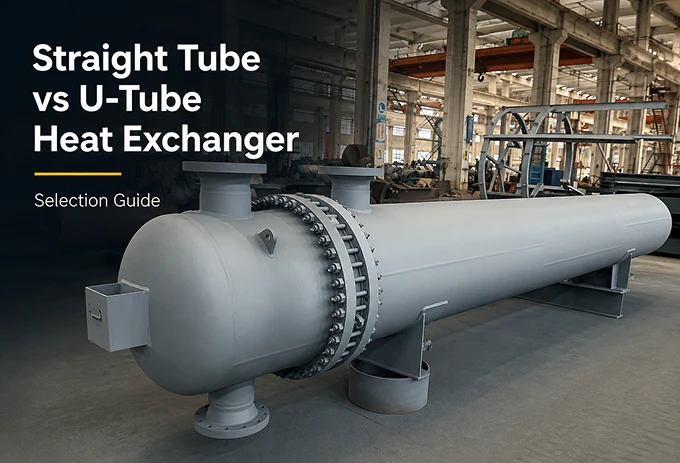
TL;DR
- • Learn how straight-tube and U-tube heat exchangers are built and how they work.
- • Compare their differences in thermal expansion, cleaning, inspection, tube repair, and maintenance space.
- • See how fixed-tubesheet and floating-head designs affect straight-tube performance.
- • Review five key selection factors, including fouling, temperature changes, pressure drop, maintenance, and lifecycle cost.
A straight tube heat exchanger and a U-tube heat exchanger can perform similar process duties. However, their mechanical structures are different. Tube geometry affects thermal expansion, cleaning access, inspection, and tube replacement.
For refinery, petrochemical, chemical, and energy projects, this choice affects long-term operation. It can change the shutdown workload, required maintenance space, and repair method. A lower initial price may not reduce the total lifecycle cost.
This guide first explains how each design is built. It then compares their advantages, limits, maintenance needs, and suitable operating conditions.
CONTENT:
- What Is a Straight Tube Heat Exchanger?
- What Is a U-Tube Heat Exchanger?
- Straight Tube vs U-Tube Heat Exchanger
- How to Choose the Right Straight Tube or U-Tube Heat Exchanger
- Straight Tube and U-Tube Heat Exchanger Maintenance
- FAQs About Straight Tube and U-Tube Heat Exchangers
- Conclusion
What Is a Straight Tube Heat Exchanger?
A straight tube heat exchanger usually has a long cylindrical shell. A bundle of parallel tubes runs from one end of the shell to the other. The tubes remain straight along their full length. They do not bend back inside the exchanger.
The term “straight tube” only describes the tube shape. It does not describe the complete exchanger configuration. One fluid flows inside the tubes. The second fluid flows around the outside of the tubes inside the shell. Tubesheets hold the tube ends in position. They also keep the two fluids separate. Baffles are support plates inside the shell. They hold the tubes and guide the shell-side fluid across the tube bundle.
- In a fixed tubesheet heat exchanger, both tubesheets remain attached to the shell. The tube bundle cannot move freely inside the shell. It is also normally not removable as a complete bundle. Different expansion rates between the shell and tubes can therefore create thermal stress.
- A floating head heat exchanger also uses straight tubes. One tubesheet remains fixed. The tubesheet at the other end can move with the tube bundle. This movement allows the tubes to expand and contract. Many floating-head designs also allow the complete bundle to be removed from the shell.
The front-head and rear-head arrangement may vary between projects. For a full explanation of these configurations, see our guide to TEMA heat exchanger types.
Advantages and Disadvantages of a Straight Tube Heat Exchanger
The main advantages of a straight tube heat exchanger appear during cleaning, inspection, and tube repair. Straight passages allow tools to reach the full tube length. This is useful when the tube-side fluid may foul or form solid deposits.
| Project Condition | Advantage | Limitation |
|---|---|---|
| Tube-side fouling is expected | Brushes, rods, and water-cleaning tools can pass through the full tube length. | Cleaning access does not solve shell-side fouling. |
| Tubes need regular inspection | Both tube ends are normally accessible. | Rear-head removal needs enough maintenance space. |
| Individual tubes may need repair | Damaged tubes are easier to locate, plug, or replace. | Repair access depends on the channel and rear-head design. |
| The project needs a simple structure | A fixed-tubesheet design uses fewer parts and seals. | It provides limited thermal movement. |
| Shell and tube temperatures differ greatly | A floating head allows the tube bundle to expand. | The rear-head structure is more complex. |
| Shell-side access is required | A floating-head design can provide a removable tube bundle. | Initial and maintenance costs are usually higher. |
For the project, the key question is where fouling will occur. Straight tubes are a strong option when the tube side needs frequent mechanical tube cleaning. When thermal expansion and shell-side access are also important, a floating-head configuration may be required.
What Is a U-Tube Heat Exchanger?
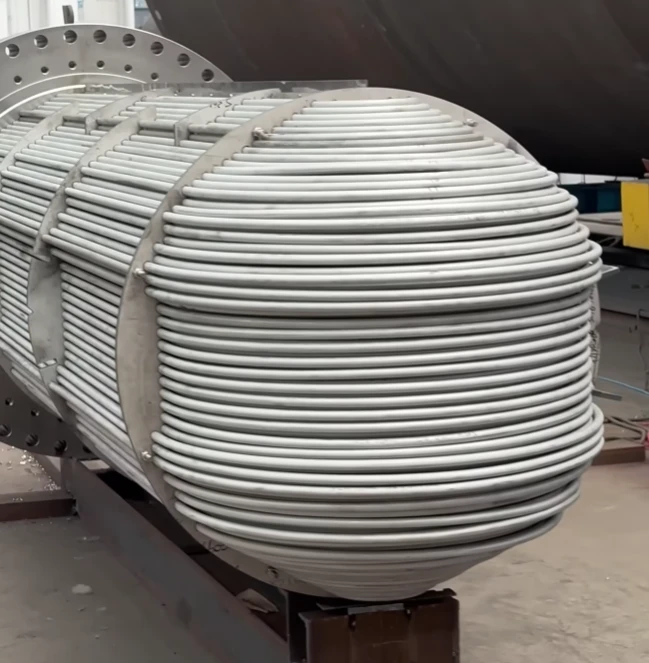
A U-tube heat exchanger has a cylindrical shell and a bundle of curved tubes inside it. Each tube extends from the front of the exchanger, bends through 180 degrees, and returns to the same end. Viewed from the side, each tube looks like a long letter U.
Because both ends return to the front, they connect to the same tubesheet. The tubesheet is a thick plate with holes for the tube ends. It holds the tubes in place and keeps the tube-side fluid separate from the shell-side fluid.
(1)This layout creates a clear flow path. The tube-side fluid enters through the front channel. It travels along one half of the U-shaped tubes. It turns at the bends and flows back toward the front. A partition inside the channel separates the inlet flow from the returning flow.
(2)The second fluid flows through the shell and around the outside of the tubes. Baffles support the U-tube bundle heat exchanger and guide the shell-side fluid across the tube surfaces. Heat passes through the tube walls without mixing the two fluids.
Only the tube ends are fixed at the front tubesheet. The curved ends remain free inside the shell. The tubes can therefore expand and contract as their temperature changes. In many designs, the complete tube bundle can also be removed from the shell.
Advantages and Disadvantages of a U-Tube Heat Exchanger
A U-tube design is worth considering when the shell and tubes operate at different temperatures. The U-bends allow the tubes to expand toward the curved end. This helps control differential thermal expansion without a floating rear head.
| Project Condition | Advantage | Limitation |
|---|---|---|
| Shell and tube temperatures differ greatly | U-bends allow the tubes to expand without a floating rear tubesheet. | The bend area still requires suitable material and stress evaluation. |
| Frequent startup and shutdown are expected | The tubes can follow repeated temperature changes with less restraint. | Repeated thermal cycling may still increase fatigue risk. |
| Shell-side cleaning is required | The complete tube bundle can normally be removed. | The layout needs enough bundle-pulling and lifting space. |
| Tube-side fouling is expected | Soft deposits may be removed by flushing or chemical circulation. | Straight brushes and rods cannot pass through the U-bends. |
| Individual tubes may need repair | Leaking tubes can be located and plugged at the tubesheet. | Inner U-tubes are difficult to access and replace. |
| Rear-end piping space is limited | Tube-side inlet and outlet connections can remain at one end. | Front-head piping and maintenance access must be planned together. |
For the project, the key trade-off is clear. U-tubes simplify thermal expansion and shell-side access. However, they limit full-length tube-side cleaning and individual tube replacement. A U-tube design is therefore more suitable when the tube-side fluid is relatively clean.
If heavy tube-side fouling is expected, the project should review the planned U-tube heat exchanger cleaning method before fixing the design. A removable bundle improves access to the tube exterior. It does not make the inside of the U-bends easier to clean.
Straight Tube vs U-Tube Heat Exchanger
The choice between a straight tube vs U-tube heat exchanger depends on how the equipment will operate and be maintained. Neither design is suitable for every service.
| What Matters to the Project | Straight Tube Heat Exchanger | U-Tube Heat Exchanger |
|---|---|---|
| Fluid inside the tubes is easy to foul | Better choice. The full tube length is easier to clean. | Less suitable. The bends limit mechanical cleaning. |
| Large temperature changes are expected | Requires a suitable fixed or floating-head design. | Better choice. The curved tubes can expand more freely. |
| Frequent startup and shutdown are expected | A floating-head design may be needed. | Usually more suitable for repeated temperature changes. |
| The outside of the tubes needs cleaning | A removable floating-head bundle may be required. | The tube bundle can normally be removed. |
| Individual tubes may need repair | Tubes are easier to inspect, plug, or replace. | Inner U-tubes are harder to reach and replace. |
| Maintenance time must be reduced | Better for tube-side cleaning and local tube repair. | Better for shell-side access, but tube-side work may take longer. |
| Space is limited at one end | Access may be needed at both ends. | Tube-side connections can be placed at the same end. |
| A simple, lower-cost structure is preferred | A fixed-tubesheet design is often simpler. | The U-bends require more specialized fabrication. |
| Long-term operating cost is the priority | Suitable when tube cleaning and repair are frequent. | Suitable when thermal movement is the main operating risk. |
Sources: Heat Exchange Institute — Basics of Shell and Tube Heat Exchangers; Xylem — Shell-and-Tube Heat Exchanger Selection Guide
Choose a straight-tube design when tube-side fouling, inspection, and local tube repair are the main concerns. Choose a U-tube design when large temperature changes, thermal cycling, and shell-side access are more important.
Heat Exchanger Design & Selection
Looking Beyond Straight-Tube and U-Tube Configurations?
Tube layout is only one part of heat exchanger selection. See how exchanger type, process conditions, fouling risk, temperature, pressure, and maintenance needs shape the overall design choice.
Explore Heat Exchanger Types & Selection →How to Choose the Right Straight Tube or U-Tube Heat Exchanger
Start with the main project risk. The correct U-tube heat exchanger design or straight-tube design depends on fouling, thermal movement, maintenance, and lifecycle cost.
1. Identify the Fouling Location
Straight tubes are better when deposits form inside the tubes. They support full-length mechanical cleaning. U-tubes are more suitable when the tube-side fluid is relatively clean and shell-side access is more important.
2. Check Thermal Movement
Large temperature differences often favor U-tubes or floating-head straight tubes. Also review startup, shutdown, and load changes. Frequent thermal cycling can be more critical than normal operating temperature.
3. Confirm Heat Duty and Pressure Drop
Provide the flow rates, inlet and outlet temperatures, and allowable pressure loss. Tube size, length, velocity, and pass arrangement all affect performance. Tube shape alone does not decide efficiency.
4. Plan Maintenance Before Selection
Confirm the cleaning method and available maintenance space. Straight tubes support brushing and rodding. U-tube bundles provide better access to the tube exterior. The layout must also allow channel, head, or bundle removal.
5. Compare Lifecycle Cost
Include the purchase price, cleaning time, shutdown duration, inspection, tube repair, and future bundle replacement. The cheapest unit at purchase may not be the lowest-cost option over its service life.
In project reviews, three answers usually narrow the choice quickly: where deposits will form, how the unit will be cleaned, and how much thermal movement is expected.
Straight Tube and U-Tube Heat Exchanger Maintenance
Maintenance should start from actual operating changes. A higher pressure drop, lower heat-transfer performance, or leakage may indicate fouling or tube damage. Cleaning should begin before deposits become thick and difficult to remove.
| Maintenance Focus | Straight Tube Heat Exchanger | U-Tube Heat Exchanger | Project Action |
|---|---|---|---|
| Tube-side cleaning | Straight tubes allow full-length rodding and mechanical cleaning. | Straight tools cannot pass through the bends. Circulation cleaning may be more practical. | Select the method from the deposit type and tube material. |
| Shell-side cleaning | Access depends on whether the bundle is fixed or removable. | The bundle can normally be removed for external cleaning. | Reserve bundle-pulling and lifting space. |
| Seals and joints | Check gasketed heads and tube-to-tubesheet joints for leakage. | Check the front-head gasket and tube joints at the tubesheet. | Replace opened or damaged gaskets as required by the equipment manual. |
| Tube inspection | Both tube ends are normally accessible. | The bend area needs additional attention. | Select NDT methods from the expected damage mechanism. |
| Tube repair | Individual tubes are easier to locate, plug, or replace. | Inner U-tubes are more difficult to access and replace. | Compare local repair with complete bundle replacement. |
For straight tubes, use tools that will not cut or scratch the tube wall. Hard deposits may require mechanical cleaning. Soft deposits may be removed by circulating hot water, wash fluid, or a compatible cleaning agent.
For U-tube heat exchanger maintenance, include the bends in the inspection plan. Bending can leave residual stress in some tube materials. The actual cracking risk depends on the alloy, fluid chemistry, temperature, and fabrication method. Inspection frequency should follow service history and the identified damage mechanism, not a fixed five-year rule.
There is also no universal two- or three-year gasket interval. Check gasketed joints for leakage after startup and whenever the equipment is opened. Use new gaskets during reassembly when required by the manufacturer.
Set the final maintenance interval from fouling rate, corrosion data, operating performance, and previous inspection results. This gives the project a more reliable plan than using one fixed interval for every exchanger.
FAQs About Straight Tube and U-Tube Heat Exchangers
Is a U-Tube Heat Exchanger Always Two-Pass?
No. A 2-pass U-tube heat exchanger is common, but it is not the only option. Xylem also lists 4-pass U-tube heat exchanger models. Some product ranges include six-pass arrangements. The pass count depends on the required flow velocity and pressure drop.
Is a Straight-Tube Heat Exchanger Always a Fixed-Tubesheet Design?
No. Straight tubes can use a fixed rear tubesheet or a floating rear tubesheet. The floating design allows the tube bundle to move as its temperature changes.
What Is the Difference Between a U-Tube and Fixed Tubesheet Heat Exchanger?
The difference between a U-tube and fixed tubesheet heat exchanger is how the tubes are held. A fixed-tubesheet unit holds straight tubes at both ends. A U-tube unit connects both ends of each curved tube to one tubesheet. The U-bends allow more thermal movement.
Which Design Is Easier to Clean?
Straight tubes are easier to clean when deposits form inside the tubes. Tools can pass through the full tube length. U-tube bundles are often easier to remove for cleaning the tube exterior and shell side. The correct choice depends on where fouling occurs.
Is a U-Tube Heat Exchanger More Efficient?
Not automatically. Tube shape alone does not determine heat-transfer efficiency. Tube count, diameter, velocity, pressure drop, fouling, and baffle design also affect performance.
Is a U-Tube Heat Exchanger Better for High-Pressure Service?
Not in every case. A high-pressure U-tube heat exchanger still requires suitable materials, wall thickness, tubesheet design, fabrication, inspection, and testing. Pressure alone should not decide the tube structure.
What Are Common U-Tube Heat Exchanger Applications?
Common U-tube heat exchanger applications include heating, cooling, condensing, and reboiling duties. In refinery and petrochemical projects, the final structure must match the process data, maintenance plan, and applicable project standards.
Conclusion
The choice between a straight tube heat exchanger and a U-tube heat exchanger should be based on process conditions, maintenance needs, and long-term operating cost. Gelan can support the project with thermal review, mechanical design, material selection, and custom fabrication.