

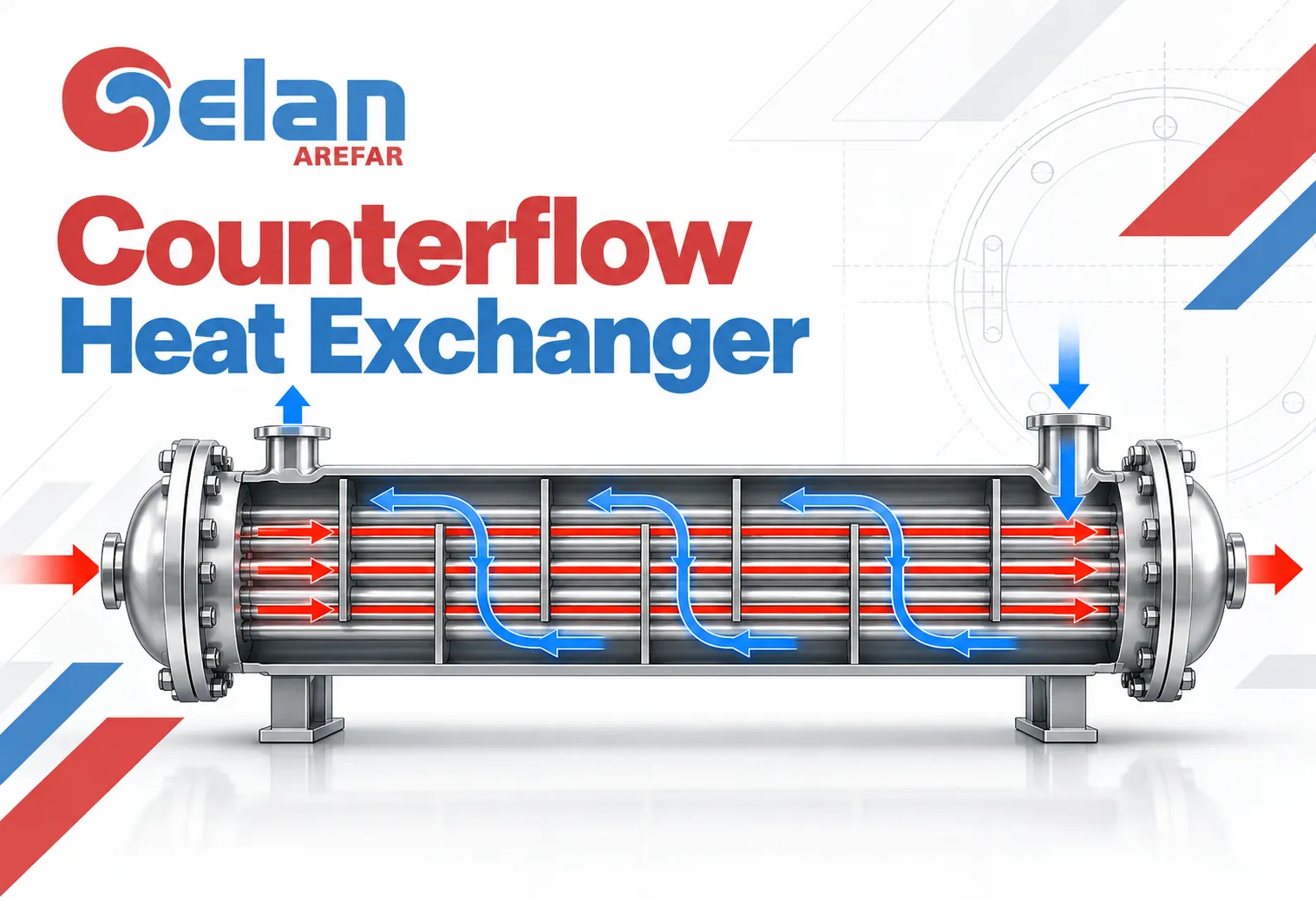
A counterflow heat exchanger is a common heat exchanger flow arrangement. You may already have a general idea of what it is from the term “counterflow.”
But what are its advantages and limitations? What are the main types and applications? How is it different from parallel-flow and crossflow heat exchangers? How do you determine whether it is suitable for your application?
You cannot get the answers to all these questions from the name alone.
In this article, I will explain these points to help you better understand counterflow heat exchangers and determine whether this flow arrangement is suitable for your application.
After understanding them, if you need to purchase a shell and tube heat exchanger with a counterflow arrangement, you can contact Gelan. With its own factory and large production capacity, Gelan has manufactured shell and tube heat exchangers since 2016. With ASME qualifications, ISO 14001 certification, and its own engineering and design capabilities, Gelan can design and manufacture a customized counterflow shell and tube heat exchanger for your application.
Part 1. What is a Counterflow Heat Exchanger?
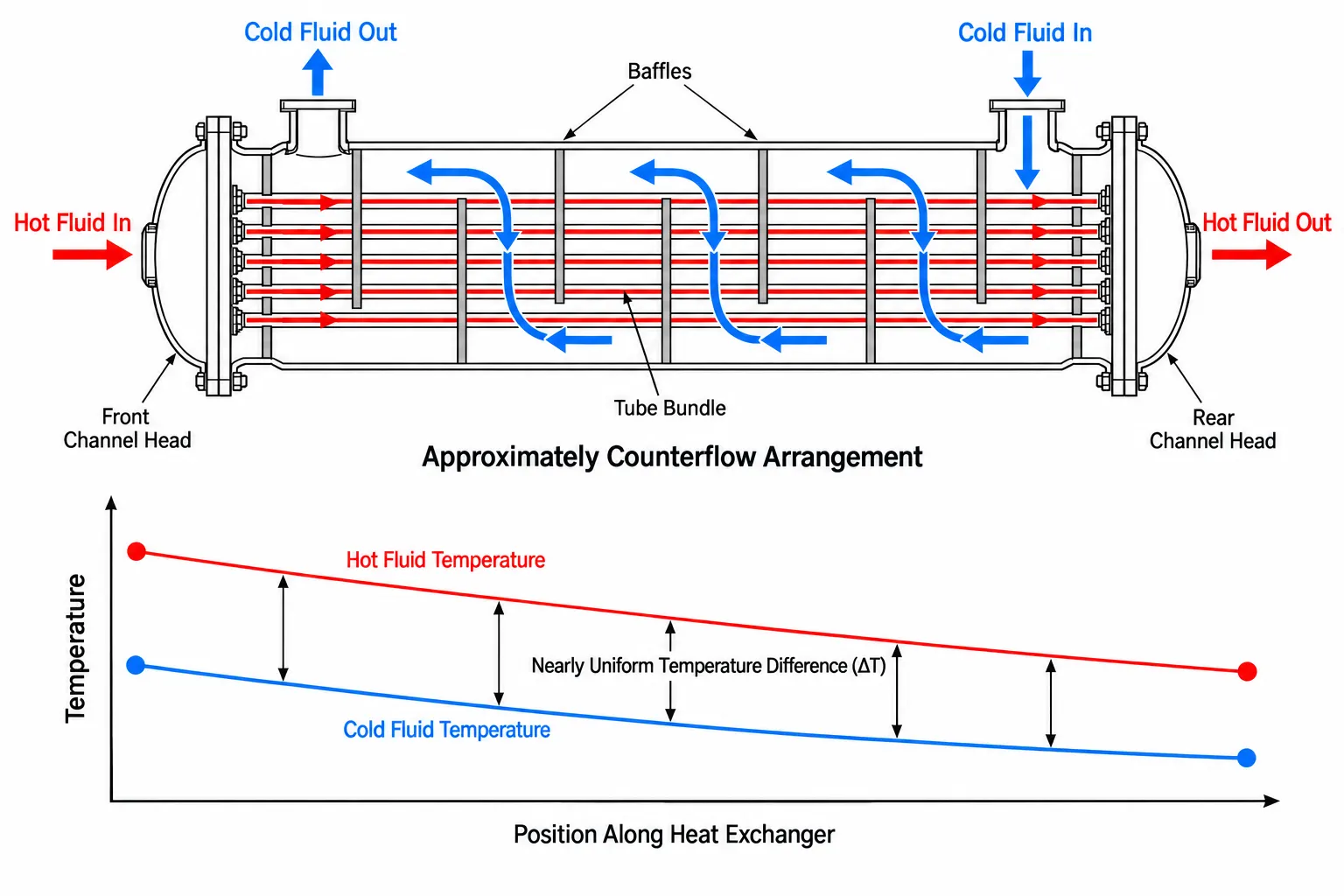
To understand what a counterflow heat exchanger is, you first need to understand what counterflow means. Counterflow means that the hot fluid and cold fluid enter the heat exchanger from opposite ends and flow in opposite directions to exchange heat.
For example, a shell and tube heat exchanger can be designed with an approximately counterflow arrangement. One fluid flows through the tube side, while the other flows through the shell side in an overall opposite direction. During this process, heat is transferred from the hot fluid to the cold fluid through the tube walls. As a result, the hot fluid is cooled and the cold fluid is heated toward their required outlet temperatures.
Also Read: Heat Exchanger Materials: Types, How to Select and Where to Source
Advantages
The counterflow heat exchanger has several advantages. Here are the key ones:
1. Higher Heat-Transfer Effectiveness: As the hot and cold fluids flow in opposite directions, they maintain a more effective and relatively uniform temperature difference along the heat exchanger. Therefore, heat can be transferred effectively from one end of the heat exchanger to the other.
2. Closer Outlet Temperatures: The hot-fluid outlet temperature can approach the cold-fluid inlet temperature. In some applications, the cold-fluid outlet temperature can also be higher than the hot-fluid outlet temperature, although it cannot exceed the hot-fluid inlet temperature.
3. Potential Savings in Equipment Space and Cost: A counterflow arrangement may require a smaller heat-transfer area than a parallel-flow arrangement for the same heat-transfer duty. Therefore, it may reduce the equipment size, installation space and cost.
4. Greater Ability to Achieve the Required Outlet Temperatures: By controlling the fluid flow rates, inlet temperatures and heat-transfer capacity, a counterflow heat exchanger can provide greater flexibility in achieving the required outlet temperatures.
Limitations
Although counterflow heat exchanger has many advantages, it has the following limitations.
1. Potentially More Complex Piping Arrangement: Because the two fluids enter the heat exchanger from opposite ends, some installations may require longer piping, additional elbows or more complex pipeline routing.
2. Potentially Higher Manufacturing or Installation Cost: When achieving the counterflow arrangement requires more complex piping, flow channels or equipment construction, it may increase manufacturing or installation costs.
Applications
Based on its advantages and limitations, a counterflow arrangement is commonly used in the following applications:
- Process-to-Process Heat Recovery
- Feed and Process-Fluid Preheating
- Product and Process-Fluid Cooling
- Waste Heat Recovery
- Boiler Feedwater Heating
- Combustion-Air Preheating
- Heating and Cooling Systems
- Ventilation Heat Recovery
- Refrigeration and Heat-Pump Systems
- Cryogenic Heat Recovery
What Types of Heat Exchangers Use Counterflow?
Many types of heat exchangers can use a counterflow arrangement. The main types include:
- Shell and Tube Heat Exchangers
- Double-Pipe Heat Exchangers
- Plate Heat Exchangers
- Spiral Heat Exchangers
- Plate-and-Shell Heat Exchangers
- Plate-Fin Heat Exchangers
Part 2. Counterflow vs. Parallel Flow vs. Crossflow Heat Exchangers: Key Differences
Now that you have a general understanding of counterflow heat exchangers, you may want to know how counterflow differs from parallel flow and crossflow. The table below compares their key differences.
| Comparison | Counterflow | Parallel Flow | Crossflow |
|---|---|---|---|
| Fluid directions | Opposite directions | Same direction | Approximately perpendicular |
| Fluid inlet locations | Opposite ends | Same end | Different sides |
| Temperature difference | More uniform along the exchanger | Largest at inlet and decreases rapidly | Varies across the exchanger |
| General heat-transfer effectiveness | Usually highest | Usually lowest | Usually between counterflow and parallel flow |
| Cold-fluid outlet above hot-fluid outlet | Possible | Not possible in an ideal single-pass sensible-heat exchanger | May be possible in some designs |
| Heat-recovery potential | High | Low to moderate | Moderate to high |
| Outlet-temperature flexibility | High | Limited | Depends on whether fluids are mixed or unmixed |
From the table above, you can see that the main differences among counterflow, parallel flow and crossflow lie in their fluid directions, inlet arrangements, temperature distributions, heat-transfer effectiveness and ability to achieve close outlet temperatures. In general, counterflow provides the highest heat-transfer effectiveness under comparable conditions, while parallel flow usually provides the lowest.
Part 3. How to Judge Whether Counterflow Heat Exchanger is for Your Application
Now that you understand how counterflow works, you may wonder whether it is suitable for your application. You can make an initial assessment through the following steps.
1. Define Your Heat-Transfer Requirements
First, define what the heat exchanger needs to achieve, such as:
- Required heat-transfer duty
- Hot- and cold-fluid inlet temperatures
- Required outlet temperatures
- Required heat-recovery level
- Minimum approach temperature
- Maximum allowable pressure drop
- Available installation space
These conditions determine the thermal performance required from the heat exchanger.
2. Compare the Available Flow Arrangements
Compare counterflow with parallel flow and crossflow based on:
- Ability to achieve the required outlet temperatures
- Heat-transfer effectiveness
- Required heat-transfer area
- Pressure drop
- Equipment size and structural complexity
Counterflow is generally more suitable when deep cooling, a small approach temperature or a high level of heat recovery is required. It may also be necessary when the cold-fluid outlet temperature needs to be higher than the hot-fluid outlet temperature.
3. Check the Heat Exchanger Structure
Confirm whether the selected heat exchanger can provide counterflow.
Double-pipe and plate heat exchangers can usually provide strong counterflow. Shell and tube heat exchangers may provide ideal, approximate or mixed flow, depending on their shell passes, tube passes and internal structure. Air-cooled heat exchangers primarily operate as crossflow.
Therefore, the actual exchanger structure must be checked instead of assuming that every heat exchanger can provide ideal counterflow.
4. Check the Operating Conditions
Confirm that the counterflow design can meet:
- Allowable pressure-drop limits
- Fluid-property and phase requirements
- Fouling and cleaning requirements
- Corrosion and material requirements
- Operating pressure and temperature
- Thermal-expansion and safety requirements
Counterflow may provide better thermal performance, but it is not suitable if it causes excessive pressure drop, creates unacceptable local temperatures or makes cleaning and maintenance difficult.
5. Compare the Overall Cost
Finally, compare the available arrangements based on:
- Equipment cost
- Installation space
- Pumping energy
- Heat-recovery savings
- Cleaning and maintenance
- Expected service life
Counterflow is a suitable option when its higher heat-transfer effectiveness and heat-recovery benefits justify the equipment and operating costs.
Part 4. Where to Buy Counterflow Heat Exchanger?
If you have completed the preliminary design and want to purchase a shell and tube heat exchanger with an approximately counterflow arrangement, you can contact Gelan.
Here are the main reasons to choose Gelan:
1. Professional Thermal and Mechanical Design Gelan provides heat-transfer calculations, pressure vessel calculations, 3D modelling and structural analysis according to your operating conditions and required flow arrangement.
2. Strong Manufacturing Capacity With 28,994 m² of manufacturing space, Gelan can manufacture shell and tube heat exchangers with material thicknesses up to 200 mm and equipment diameters up to 6 meters in its workshop.
3. Qualified Heat Exchanger Manufacturing Gelan holds A1/A2 pressure vessel manufacturing licenses and ASME “U” Stamp qualification, supporting the fabrication of shell and tube heat exchangers for different industrial requirements.
4. In-House Quality Inspection Gelan has in-house RT, UT, MT and PT inspection capabilities to control the quality of welds and pressure-retaining components.
5. Experience in Demanding Industrial Applications Gelan has international project experience supplying heat exchangers and related process equipment for refining, petrochemical and hydrogen production applications.
Gelan can design and manufacture the heat exchanger according to your process data, required heat-transfer duty, inlet and outlet temperatures, allowable pressure drop, material requirements and applicable standards.
Part 5. FAQS About Counterflow Heat Exchanger
Q1. Why Is Counterflow More Efficient?
Counterflow maintains a larger and more uniform temperature difference between the hot and cold fluids. This provides a stronger driving force for heat transfer, allowing more heat to be transferred under the same or similar operating conditions.
Q2. What Is a Counterflow Heat Exchanger Calculator?
A counterflow heat exchanger calculator is an online tool used to calculate key parameters such as heat duty and LMTD. It can provide preliminary results based on the temperatures, flow rates and fluid properties you enter.
Ending Note
From this article, you now understand what a counterflow heat exchanger is, how it works, and how it differs from parallel-flow and crossflow heat exchangers. You also know its advantages, limitations, main types, applications, and how to determine whether it is suitable for your application.
If you plan to purchase a shell and tube heat exchanger with a counterflow arrangement, contact Gelan directly. With its own factory and engineering team, Gelan can design and manufacture a customized shell and tube heat exchanger based on your operating conditions and project requirements.