

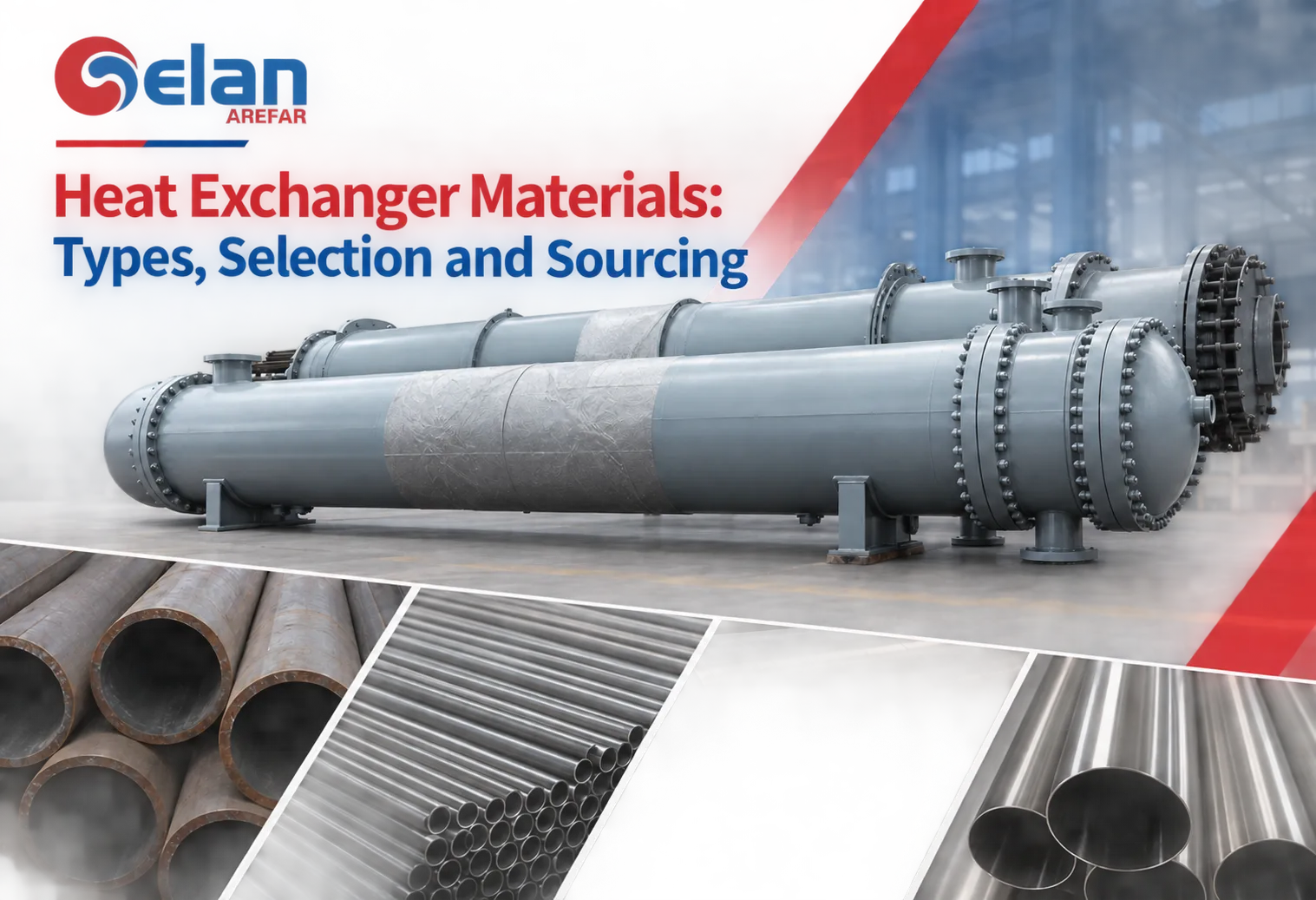
Whether you are new to heat exchangers, an engineer, an EPC contractor, or a purchasing manager, it is crucial to understand heat exchanger materials because they directly affect heat exchanger performance and service life.
With over 14 years of experience working in the global oil, gas, and petrochemical sectors, I would like to explain everything you need to know about heat exchanger materials. This includes the materials commonly used in heat exchangers, the factors you should consider when selecting materials, suitable material options for different types of heat exchangers and operating conditions, and materials used for different heat exchanger components. I will also show you some heat exchanger material selection examples from Gelan’s previous projects for your reference.
After reading this guide, if you are planning to purchase heat exchanger materials, you can contact Gelan. With long-term experience in heat exchanger manufacturing and established relationships with material suppliers, Gelan can supply complete material packages based on your BOM and application requirements, helping you reduce sourcing time and costs.
Part 1. What Materials are Commonly Used in Heat Exchangers?
So, what materials are commonly used in heat exchangers? Before listing them, I need to answer one question clearly: Do all heat exchangers use the same materials?
The answer is no. Different heat exchangers may use different materials depending on their type, application, operating conditions, component requirements, applicable design codes, and project specifications. Even the same type of heat exchanger may require different materials when used with different process fluids, temperatures, pressures, or corrosive conditions.
Here, I will introduce the materials commonly used in heat exchangers. Some materials can be used for several heat exchanger types and components, while others are selected only for specific operating conditions or applications.
Comparison of Common Heat Exchanger Materials
If you do not have time to read the detailed introduction to every material, the following table can help you quickly compare the most common heat exchanger materials based on their heat-transfer performance, corrosion resistance, temperature performance, cost, advantages, limitations and typical uses.
| Material | Relative Thermal Conductivity | Corrosion Resistance | Temperature Performance | Relative Cost | Main Advantages | Main Limitations | Typical Uses in Heat Exchangers |
|---|---|---|---|---|---|---|---|
| Carbon Steel | Moderate | Generally low | Suitable for many general services; ordinary grades have limited elevated-temperature strength and may require toughness controls at low temperatures | Low | Cost-effective, good mechanical strength and easy fabrication | Susceptible to corrosion in acidic, wet, oxygenated and chloride-containing environments | Shells, channels, bonnets, tube sheets, baffles, piping, supports and carbon-steel tubes |
| Low-Alloy Steel | Moderate | Generally low; depends on the grade and environment | Selected grades provide improved strength, low-temperature toughness or elevated-temperature performance | Low to medium | Higher strength and improved performance under specific temperature conditions | More expensive than carbon steel; may require more complex welding and heat treatment | Shells, channels, thick pressure-retaining plates and fabricated tube sheets |
| Cr-Mo Alloy Steel | Moderate | Service-dependent; not a general corrosion-resistant material | Suitable for selected elevated-temperature, high-pressure and hydrogen-containing services | Medium to high | Good elevated-temperature strength and creep resistance | Higher material and fabrication costs; controlled welding and post-weld heat treatment may be required | Refinery, hydrogen, hydrotreating, feed/effluent and other high-temperature process heat exchangers |
| Stainless Steel | Low | Good, depending on the grade and medium | Suitable across a wide temperature range, subject to grade-specific limits | Medium | Good general corrosion resistance, good fabrication performance and a clean surface | Lower thermal conductivity than carbon steel, copper and aluminum; common grades may suffer chloride-related corrosion | Tubes, plates, shells, channels, tube sheets, baffles, headers, nozzles and fasteners |
| Copper | Very high | Good in suitable water conditions | Mainly used in moderate-temperature services | Medium | Excellent thermal conductivity, good formability and easy joining | Sensitive to ammonia, sulfides, certain acids, excessive velocity and polluted water | Heat-transfer tubes, coils, fins and HVAC or refrigeration components |
| Brass | High | Good in selected freshwater, brackish-water and condenser services | Mainly used in moderate-temperature services | Medium | Good thermal conductivity and tube-forming performance | May suffer dezincification, ammonia stress-corrosion cracking and corrosion in polluted or sulfide-containing water | Condenser tubes, heat exchanger tubes, tube sheets, fittings and connections |
| Copper-Nickel | Low to moderate, depending on the grade | Very good in suitable seawater and marine cooling-water conditions | Suitable for many marine and industrial cooling services | Medium to high | Good seawater-corrosion resistance and resistance to erosion-corrosion; can reduce marine biofouling | More expensive than carbon steel and brass; sensitive to heavily polluted or sulfide-containing water | Marine heat exchanger tubes, condenser tubes, tube sheets, water boxes, headers and cooling-water piping |
| Aluminum | High | Moderate and environment-dependent | Suitable for many air-side, refrigeration and low-temperature applications; strength decreases at elevated temperatures | Low to medium | Lightweight, good thermal conductivity and easy formation into thin fins and compact passages | Sensitive to strong acids, alkalis, galvanic corrosion, localized corrosion and mechanical damage | Fins, plate-fin passages, brazed heat exchanger cores, headers and HVAC or refrigeration tubes |
| Titanium | Low | Excellent in seawater and many chloride-containing fluids | Suitable across a wide temperature range, subject to grade and service limits | High | Excellent seawater resistance, high resistance to chloride-induced pitting and stress-corrosion cracking, and good strength-to-weight ratio | High initial cost, low thermal conductivity and limited resistance to certain reducing acids; crevice corrosion remains possible | Heat-transfer tubes, plates, tube sheets, clad tube sheets, shells, channels and nozzles |
| Nickel Alloys | Generally low | Excellent in selected severe environments | Excellent for selected high-temperature or highly corrosive services, depending on the grade | Very high | Different grades are available for aggressive chemicals, chlorides and high-temperature gases | Very expensive; strict fabrication requirements; grades are not interchangeable | Tubes, plates, tube sheets, shells, channels, headers, nozzles and expansion bellows |
| Impervious Graphite | Moderate to high, depending on the grade and impregnation system | Excellent against many selected corrosive acids | Depends on the graphite grade, impregnation system and operating conditions | High | Good thermal conductivity for a non-metallic material and excellent resistance to many acids | Brittle, sensitive to impact and generally has lower mechanical strength and pressure capability than metallic materials | Graphite blocks, tubes, plates, discs, headers and nozzles |
| Plastics | Very low | Excellent against compatible chemicals | Generally limited to lower-temperature and lower-pressure services, depending on the polymer | Varies by material | Lightweight, good chemical resistance and suitable for services where metallic contamination must be avoided | Low thermal conductivity, lower mechanical strength, creep and relatively large thermal expansion | Tubes, coils, shells, plates, headers, nozzles and linings |
| Ceramics | Varies significantly; silicon carbide is relatively high | Excellent against many compatible corrosive fluids | Suitable for selected high-temperature services, depending on the ceramic | High | Excellent chemical resistance, hardness, wear resistance and high-temperature capability | Brittle, potentially sensitive to thermal shock and difficult to machine, join and repair | Silicon carbide tubes, blocks and plates; ceramic recuperator cores and specialized wear-resistant heat-transfer components |
From the table, you can see that there is no single material that is suitable for all heat exchangers.
Carbon steel is commonly selected when cost, mechanical strength and fabrication are the main considerations. Low-alloy steel and Cr-Mo alloy steel may be selected when higher strength, low-temperature toughness or high-temperature performance is required. Stainless steel is widely used when better general corrosion resistance and cleanliness are important.
Copper, brass, copper-nickel and aluminum provide good heat-transfer performance, but each material is suitable for different fluids and operating conditions. Titanium, nickel alloys, graphite, plastics and ceramics are generally considered for more corrosive or specialized services, but they also have higher costs, fabrication limitations or mechanical restrictions.
Now, let’s look at the most common heat exchanger materials in detail, together with their representative grades, advantages, limitations, which types of heat exchangers they are commonly seen and which components in heat exchanger they are used in.
Carbon Steel
Carbon steel is one of the most commonly used materials in industrial heat exchangers. When you look at a shell and tube heat exchanger or an air-cooled heat exchanger, you can usually find carbon steel used for the shell, channel, bonnet, tube sheet, baffles, piping or supporting structures.
The main reasons for using carbon steel are its good mechanical strength, mature fabrication process and relatively low cost. However, you should understand that carbon steel does not provide strong corrosion resistance. Therefore, it is mainly used for non-corrosive or mildly corrosive services. When corrosion is expected, a suitable corrosion allowance, coating, lining or another corrosion-control measure may be required.
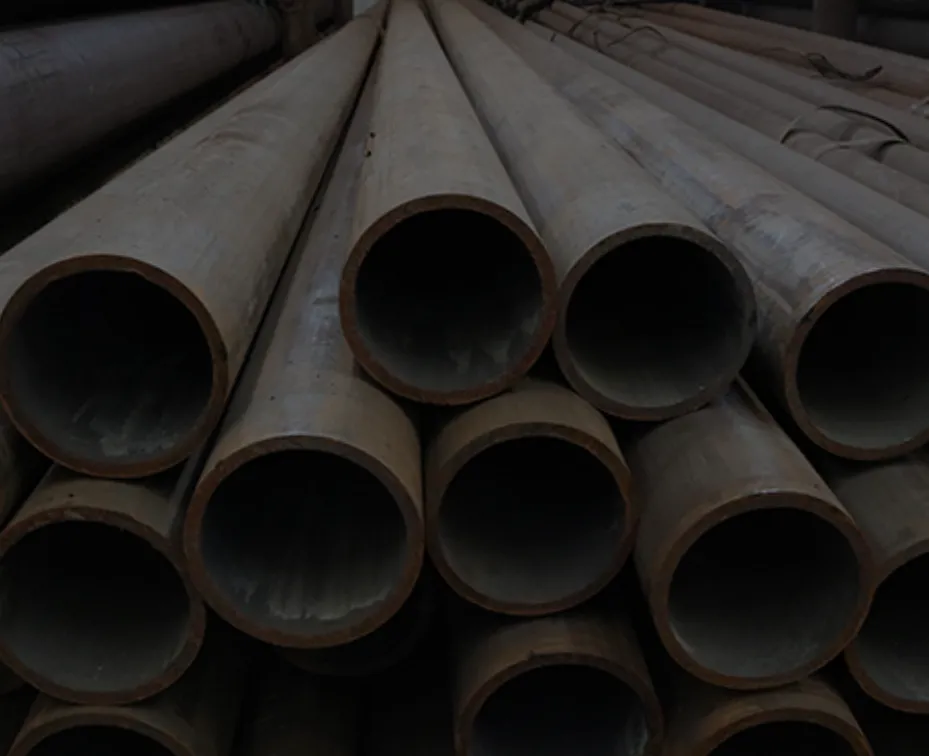
Common Grades Used in Heat Exchangers:
SA-516 Gr. 60, SA-516 Gr. 60N, SA-516 Gr. 65, SA-516 Gr. 70, SA-266 Gr. 4, SA-179, SA-214, SA-53, SA-36, SA-106 Gr. B, SA-105, SA-216 WCB, SA-285 Gr. C and Q235B.
Advantages:
● Cost-Effective: Carbon steel is generally more affordable than stainless steel, titanium and nickel alloys.
● Good Mechanical Strength: It provides sufficient strength for many common industrial heat exchanger applications.
● Easy to Fabricate: Carbon steel can be formed, welded and machined using mature and widely available fabrication processes.
● Suitable for Many Common Services: It can be used for many water, steam, hydrocarbon and utility services when corrosion is properly controlled.
Limitations:
● Limited Corrosion Resistance: Carbon steel can corrode rapidly in acidic, continuously wet, oxygenated or chloride-containing environments.
● Limited Use under Extreme Temperatures: Ordinary carbon steel grades may not be suitable for extremely high- or low-temperature conditions.
Types of Heat Exchangers It Is Used In:
Double-Pipe Heat Exchangers
Spiral Heat Exchangers
Finned-Tube Heat Exchangers
Waste Heat Exchangers
Components It Is Used for in Heat Exchangers:
Shell plates
Channel and bonnet plates
Tube sheets
Baffles and support plates
Carbon-steel heat exchanger tubes
Nozzles and connected piping
Forged flanges, rings and nozzles
Cast channels and covers
Saddles, supports, frames and other structural parts
Low-Alloy Steel
When carbon steel cannot provide the required strength, toughness or temperature performance, low-alloy steel may be selected for the heat exchanger.
Low-alloy steel contains controlled additions of alloying elements such as manganese, nickel, chromium or molybdenum. These elements can improve specific material properties.
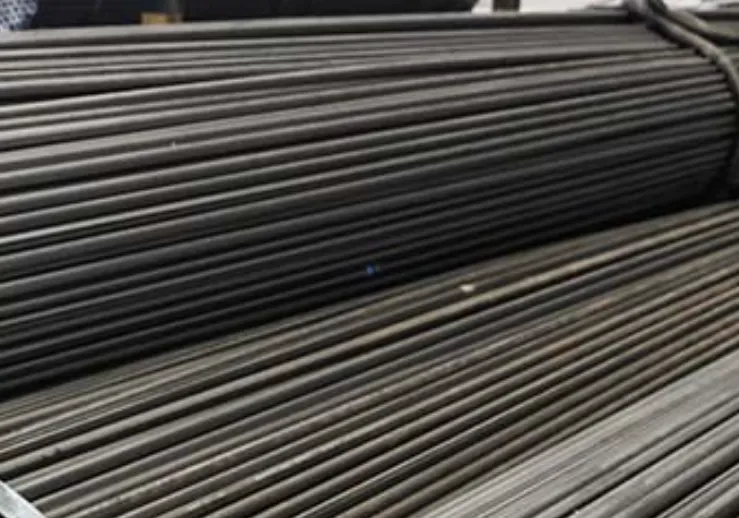
Common Grades Used in Heat Exchangers:
SA-533 Gr. B, Q345R, SA-203 Gr. E, SA-203 Gr. D and SA-302.
Advantages:
● Higher Strength: Low-alloy steel generally provides higher strength than many ordinary carbon steels.
● Improved Low-Temperature Toughness: Selected grades can provide better toughness for low-temperature applications.
● Potentially Reduced Material Thickness: Its higher strength may help reduce the required thickness of some heat exchanger components, depending on the design.
Limitations:
● Higher Cost: Low-alloy steel is generally more expensive than ordinary carbon steel.
● More Complex Welding Requirements: Fabrication may require preheating, controlled heat input or post-weld heat treatment.
● Limited Improvement in Corrosion Resistance: Its corrosion resistance may not be significantly better than that of carbon steel.
Types of Heat Exchangers It Is Used In:
Shell and Tube Heat Exchangers
High-Pressure Feedwater Heaters
Waste Heat Exchangers
Process Gas Heat Exchangers
Air-Cooled Heat Exchangers
Double-Pipe Heat Exchangers
Components It Is Used for in Heat Exchangers:
Shells
Channels and bonnets
Thick pressure-retaining plates
Fabricated tube sheets
Cr-Mo Alloy Steel
Cr-Mo alloy steel, also called chromium-molybdenum steel, is a specific family of low-alloy steel. It is mainly used when a heat exchanger operates under elevated-temperature, high-pressure or hydrogen-containing conditions.
Compared with ordinary carbon steel, Cr-Mo alloy steel provides better strength and creep resistance at high temperatures. This makes it an important material for heat exchangers used in refineries, hydrogen production units, hydrotreating units and other demanding process applications.
Common Grades Used in Heat Exchangers:
SA-387 Gr. 12 Cl. 2, SA-182 F12 Cl. 2, SA-213 T12, SA-387 Gr. 11 Cl. 2, SA-387 Gr. 22 Cl. 2, SA-387 Gr. 5, SA-387 Gr. 9, SA-213 T11, SA-213 T22, SA-213 T5, SA-213 T9, SA-335 P11, SA-335 P12, SA-335 P22, SA-335 P5, SA-335 P9, SA-182 F11, SA-182 F22, SA-182 F5 and SA-182 F9.
Advantages:
1. Better High-Temperature Strength: Cr-Mo alloy steel provides better elevated-temperature strength than ordinary carbon steel.
2. Improved Creep Resistance: It can better resist slow and permanent deformation caused by long-term exposure to high temperatures and stress.
Limitations:
1. Higher Material and Fabrication Costs: Cr-Mo alloy steel is generally more expensive and more difficult to fabricate than carbon steel.
2. Additional Heat Treatment May Be Required: Post-weld heat treatment may be required depending on the material grade, thickness, welding procedure and applicable standard.
Types of Heat Exchangers It Is Used In:
Shell and Tube Heat Exchangers
Feed/Effluent Heat Exchangers
High-Pressure Process Heat Exchangers
Waste Heat Exchangers
Air-Cooled Heat Exchangers for high-temperature process service
Heat exchangers used in refinery, hydrogen and hydrotreating units
Components It Is Used for in Heat Exchangers:
Shells
Channels
Tube sheets
Heat-transfer tubes
Headers
Nozzles
Flanges and other forgings
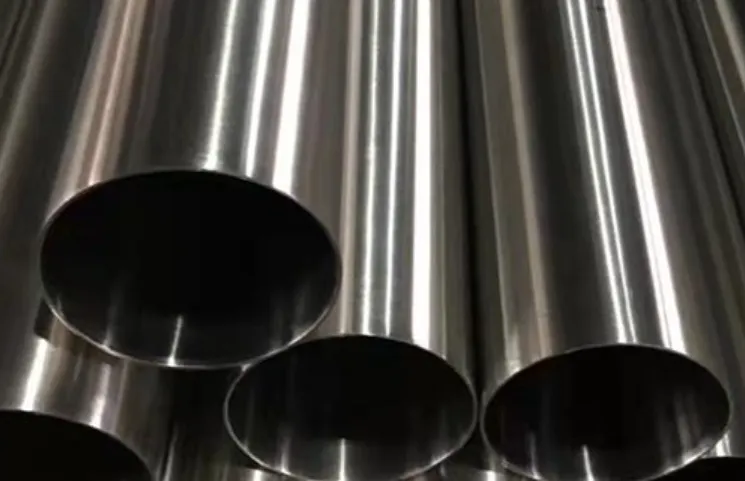
Stainless Steel
Stainless steel is another commonly used material in heat exchangers. When greater corrosion resistance, cleanliness or temperature resistance is required, stainless steel may be selected instead of carbon steel.
However, you should understand that stainless steel is a broad material family. It includes many different grades, and each grade has its own corrosion resistance, mechanical properties and suitable operating conditions. Therefore, you cannot assume that every stainless steel grade is suitable for every heat exchanger application.
For example, common 304- and 316-series stainless steels provide good general corrosion resistance, but they may still suffer pitting, crevice corrosion or stress-corrosion cracking under certain chloride-containing conditions.
Common Grades Used in Heat Exchangers:
304, 304L, 316, 316L, 317L, 321, 347, 904L, 254 SMO (UNS S31254), TP304, TP304L, TP316, TP316L, TP321 and TP347
Advantages:
● Good General Corrosion Resistance: Stainless steel generally provides better corrosion resistance than carbon steel.
● Good Fabrication Performance: Common austenitic grades provide good forming, fabrication and welding characteristics.
● Suitable for Different Industries: Stainless steel can be used in many chemical, food, pharmaceutical, water and industrial process applications.
● Clean and Easy to Maintain: Its smooth and clean surface makes it suitable for applications with cleanliness requirements.
Limitations:
● Higher Cost: Stainless steel is generally more expensive than carbon steel.
● Lower Thermal Conductivity: It provides lower thermal conductivity than carbon steel, copper and aluminum.
● Risk of Localized Corrosion: 304- and 316-series stainless steels may suffer chloride pitting and crevice corrosion.
● Risk of Stress-Corrosion Cracking: Austenitic stainless steels may suffer chloride stress-corrosion cracking at elevated temperatures.
Types of Heat Exchangers It Is Used In:
Shell and Tube Heat Exchangers
Gasketed Plate Heat Exchangers
Brazed Plate Heat Exchangers
Welded Plate Heat Exchangers
Spiral Heat Exchangers
Air-Cooled Heat Exchangers
Double-Pipe Heat Exchangers
Finned-Tube Heat Exchangers
Plate-Fin Heat Exchangers
Scraped-Surface Heat Exchangers
Jacketed and Coil Heat Exchangers
Components It Is Used for in Heat Exchangers:
Heat-transfer plates
Tubes
Shells
Channels and bonnets
Tube sheets
Baffles
Headers
Nozzles
Cladding and weld overlay
Fasteners
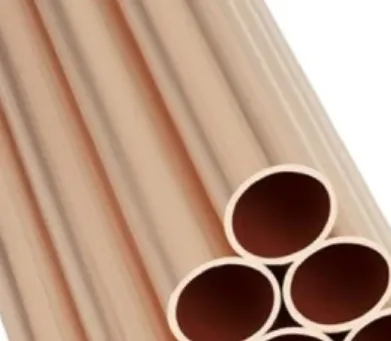
Copper
Copper is mainly used for heat-transfer tubes and fins in heat exchangers because of its excellent thermal conductivity. It can transfer heat efficiently and is also easy to form, braze and join.
Common Grades Used in Heat Exchangers:
C11000, C12000, C12200, C10200, C10100 and C10300.
Advantages:
1. Excellent Thermal Conductivity: Copper transfers heat more efficiently than many commonly used heat exchanger materials.
2. Good Formability: It can be easily formed into tubes, coils and fins.
3. Easy to Join: Copper can be brazed and joined using established manufacturing processes.
Limitations:
1. Sensitive to Certain Chemicals: Copper can be attacked by ammonia, ammonium compounds, sulfides and certain acids.
2. Risk of Erosion-Corrosion: Excessive fluid velocity may damage the protective surface film and cause erosion-corrosion.
3. Risk of Fluid Contamination: Copper contamination may be unacceptable for certain process fluids.
4. Risk of Galvanic Corrosion: Connecting copper to dissimilar metals may create galvanic-corrosion risks.
5. Lower Mechanical Strength: Copper has lower mechanical strength than many steels.
6. Sensitive to Water Quality: Its performance can deteriorate in polluted or poorly controlled cooling water.
Types of Heat Exchangers It Is Used In:
Shell and Tube Heat Exchangers
Tube-in-Tube Heat Exchangers
Fin-and-Tube Heat Exchangers
Coil Heat Exchangers
HVAC Heat Exchangers
Refrigeration Evaporators
Refrigeration Condensers
Domestic Water Heat Exchangers
Components It Is Used for in Heat Exchangers:
Heat-transfer tubes
Coils
Fins
Brazed components
Headers and connections in HVAC and refrigeration equipment
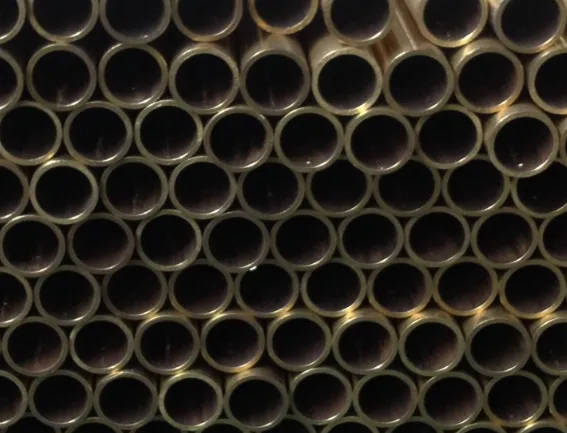
Brass
Brass is a copper-zinc alloy mainly used for condenser and heat exchanger tubes. In industrial heat exchangers, admiralty brass and aluminum brass are generally more important than ordinary plumbing brass. Brass provides good thermal conductivity and tube-forming performance. Selected brass grades can be used in freshwater, brackish-water and condenser services.
Common Grades Used in Heat Exchangers:
C44300, C44500, C68700, C44400, C41100, C6870, CZ110, CZ111, CuZn20Al2, CuZn20Al2As, CuZn28Sn1 and CuZn28Sn1As.
Advantages:
● High Thermal Conductivity: Brass provides good heat-transfer performance.
● Good Fabrication Performance: It provides good tube-forming and general fabrication characteristics.
● Suitable for Selected Water Services: Some brass grades provide good resistance in freshwater, brackish-water and condenser services.
● Improved Resistance to Dezincification: Admiralty brass contains alloying additions intended to improve its resistance to dezincification.
● Improved Water-Side Corrosion Resistance: Aluminum brass provides improved resistance to some types of water-side corrosion.
Limitations:
● Risk of Dezincification: Brass may suffer dezincification under unsuitable water conditions.
● Sensitive to Ammonia: It is susceptible to ammonia stress-corrosion cracking.
● Sensitive to Polluted Water: Polluted water, sulfides and stagnant operating conditions may damage brass heat exchanger tubes.
Types of Heat Exchangers It Is Used In:
Shell and Tube Heat Exchangers
Surface Condensers
Marine Condensers
Water-Cooled Condensers
Oil Coolers
Tube-Bundle Heat Exchangers
Industrial Water Cooling Heat Exchangers
Components It Is Used for in Heat Exchangers:
Heat exchanger tubes
Condenser tubes
Tube sheets
Fittings and connections
Copper-nickel
Copper-nickel alloys are commonly selected for heat exchanger tubes and piping exposed to seawater, brackish water and marine cooling water.
Compared with many ordinary copper alloys, copper-nickel alloys provide better resistance to seawater corrosion, marine biofouling and erosion-corrosion. Therefore, they are widely used in marine heat exchangers, surface condensers, seawater cooling systems and desalination equipment.
Common Grades Used in Heat Exchangers:
C70600, C70610, C71500, C71640, CN102, CN106, CN107, CuNi10Fe1Mn, CuNi30Fe, CuNi30Mn1Fe, CuNi30Fe2Mn2 and C7150.
Advantages:
1. Good Seawater Corrosion Resistance: Copper-nickel alloys provide good resistance to seawater and marine cooling water.
2. Good Resistance to Marine Biofouling: They can help reduce biological growth on heat-transfer surfaces.
3. Better Erosion-Corrosion Resistance: They provide better resistance to erosion-corrosion than many ordinary copper alloys.
4. Good Thermal Conductivity: Copper-nickel alloys provide good heat-transfer performance for many cooling applications.
Limitations:
1. Higher Cost: Copper-nickel alloys are more expensive than carbon steel and many brass alloys.
2. Sensitive to Polluted Water: They may suffer corrosion in heavily polluted or sulfide-containing water.
Types of Heat Exchangers It Is Used In:
Shell and Tube Heat Exchangers
Surface Condensers
Marine Heat Exchangers
Seawater-Cooled Heat Exchangers
Desalination Heat Exchangers
Oil Coolers
Charge-Air Coolers
Tube-Bundle Heat Exchangers
Industrial Water Cooling Heat Exchangers
Components It Is Used for in Heat Exchangers:
Heat exchanger tubes
Condenser tubes
Tube sheets
Water boxes
Headers
Piping and equipment connections
Heating and cooling coils
Aluminum
Aluminum is primarily used for fins, plate-fin heat exchangers and compact heat exchangers. Its low density and high thermal conductivity allow manufacturers to produce lightweight heat exchangers with thin fins and complex heat-transfer passages.
You can commonly find aluminum in air-cooled equipment, HVAC systems, refrigeration equipment, automotive radiators and compact cryogenic heat exchangers.
However, aluminum has limited strength at elevated temperatures and may be attacked by strong acids or alkaline solutions. When aluminum is connected to more noble metals, galvanic corrosion should also be considered.
Common Grades Used in Heat Exchangers:
3003, 3004, 5052, 5083 and 6061. Brazing-sheet constructions may use 4343 or 4045 as cladding or filler alloys.
Advantages:
1. High Thermal Conductivity: Aluminum provides good heat-transfer performance.
2. Lightweight: Its low density makes it suitable for lightweight heat exchanger construction.
3. Easy to Form: Aluminum can be formed into thin fins and complex compact passages.
4. Cost-Effective for Air-Side Surfaces: It is a cost-effective choice for many fins and other air-side heat-transfer surfaces.
5. Natural Protective Film: Aluminum naturally develops a protective oxide film in many environments.
Limitations:
1. Limited High-Temperature Strength: Aluminum loses strength as the operating temperature increases.
2. Sensitive to Strong Acids and Alkalis: Strong acids and alkaline solutions may attack aluminum.
3. Risk of Galvanic Corrosion: Galvanic corrosion may occur when aluminum is connected to more noble metals.
4. Risk of Mechanical Damage: Thin aluminum fins can be easily bent or damaged.
5. Risk of Localized Corrosion: Chloride-containing deposits may cause localized corrosion.
Types of Heat Exchangers It Is Used In:
Plate-Fin Heat Exchangers
Fin-and-Tube Heat Exchangers
Air-Cooled Heat Exchangers
Brazed Aluminum Heat Exchangers
Automotive Radiators
Refrigeration Evaporators
Refrigeration Condensers
HVAC Coils
Compact Cryogenic Heat Exchangers
Air-to-Air Heat Exchangers
Components It Is Used for in Heat Exchangers:
Fins
Plate-fin passages
Brazed plates
Headers
Tubes in HVAC and refrigeration systems
Air-cooled heat exchanger fins
Titanium
Titanium is commonly used for heat exchanger tubes and plates exposed to seawater, chloride-containing water and many aggressive chemicals.
One of the main reasons for selecting titanium is its excellent resistance to seawater and many chloride-containing fluids. It also provides good resistance to pitting and chloride stress-corrosion cracking under many relevant operating conditions.
Common Grades Used in Heat Exchangers:
Grade 1, Grade 2, Grade 7 and Grade 12. Grade 16.
Advantages:
1. Excellent Seawater Resistance: Titanium provides excellent resistance to seawater and many chloride-containing fluids.
2. Resistance to Localized Corrosion: It provides high resistance to pitting and chloride stress-corrosion cracking under many relevant conditions.
3. Good Strength-to-Weight Ratio: Titanium provides good mechanical strength without adding excessive equipment weight.
Limitations:
1. High Initial Cost: Titanium is more expensive than carbon steel, stainless steel and many copper alloys.
2. Limited Resistance to Certain Chemicals: It may suffer corrosion in certain reducing acids and specialized chemical environments.
3. Risk of Crevice Corrosion: Crevice corrosion can occur under severe temperature, acidity and chloride conditions.
4. Risk of Galvanic Corrosion: Titanium may accelerate the galvanic corrosion of less noble connected metals.
5. Lower Thermal Conductivity: Its thermal conductivity is lower than that of copper and aluminum.
Types of Heat Exchangers It Is Used In:
Shell and Tube Heat Exchangers
Gasketed Plate Heat Exchangers
Welded Plate Heat Exchangers
Plate-and-Shell Heat Exchangers
Surface Condensers
Seawater-Cooled Heat Exchangers
Desalination Heat Exchangers
Chemical Process Heat Exchangers
Swimming-Pool Heat Exchangers
Components It Is Used for in Heat Exchangers:
Heat-transfer tubes
Plate heat exchanger plates
Tube sheets
Clad tube sheets
Shells and channels in severe service
Nozzles
Welded plate packs
Nickel Alloys
When carbon steel and common stainless steels cannot meet the corrosion, temperature or pressure requirements of a heat exchanger, nickel or nickel-based alloys may be selected.
Nickel alloys are a large family of materials designed for different severe operating environments. Some grades provide good resistance to reducing acids, while others are more suitable for oxidizing acids, alkalis, chlorides or high-temperature gases.
Common Grades Used in Heat Exchangers:
N02200, N04400, N06600, N06625, N08800, N08810, N08811, N08825, N06022, N10276, N10665 and N10675.
Advantages:
1. Excellent Corrosion Resistance: Nickel alloys provide excellent resistance to selected severe corrosive environments.
2. Good High-Temperature Performance: Certain grades provide high strength and oxidation resistance at elevated temperatures.
3. Different Grades for Different Conditions: Suitable grades are available for reducing acids, oxidizing acids, alkalis, chlorides and high-temperature gases.
4. Long Service Life: Properly selected nickel alloys can provide a long service life when stainless steel is inadequate.
5. Different Product Forms Available: Nickel alloys are available as plates, tubes, pipes, forgings, cladding and weld overlay.
6. Suitable for Critical Services: They can be used in critical chemical, refinery and high-temperature process applications.
Limitations:
1. High Cost: Nickel alloys have very high material and fabrication costs.
2. Grades Are Not Interchangeable: Each grade has a different corrosion-resistance range and suitable application.
3. Strict Welding Requirements: Welding requires qualified procedures and compatible filler metals.
4. Limited Availability: Some grades may have limited availability and longer delivery times.
5. Strict Traceability Requirements: Material identification and traceability are especially important.
6. Relatively Low Thermal Conductivity: Some nickel alloy grades provide relatively low thermal conductivity.
7. Risk of Incorrect Selection: Selecting the wrong grade may result in rapid corrosion despite its high alloy content.
Types of Heat Exchangers It Is Used In:
Shell and Tube Heat Exchangers
Welded Plate Heat Exchangers
Gasketed Plate Heat Exchangers
Plate-and-Shell Heat Exchangers
Air-Cooled Heat Exchangers
High-Temperature Gas Heat Exchangers
Feed/Effluent Heat Exchangers
Waste Heat Exchangers
Chemical Process Heat Exchangers
Evaporators and Condensers
Components It Is Used for in Heat Exchangers:
Heat-transfer tubes
Plates
Tube sheets
Clad or weld-overlaid tube sheets
Shells and channels
Headers
Nozzles
Expansion bellows
Graphite Composite Materials
Industrial graphite heat exchangers normally use impervious resin-impregnated graphite as the heat-transfer material. Graphite is mainly selected for its excellent resistance to many highly corrosive acids and its relatively high thermal conductivity among non-metallic materials. However, graphite is brittle and has lower mechanical strength than metallic materials.
Common Materials Used in Heat Exchangers:
Impervious resin-impregnated graphite. Carbon steel with graphite and stainless steel with graphite are common construction combinations.
Advantages:
1. Excellent Acid Resistance: Impervious graphite provides excellent resistance to many highly corrosive acids.
2. Good Thermal Conductivity: Graphite provides higher thermal conductivity than most other non-metallic materials.
Limitations:
1. Brittle Material: Graphite is brittle and sensitive to mechanical impact.
2. Lower Mechanical Strength: It has lower mechanical strength than metallic materials.
3. Lower Pressure Capability: Its pressure capability is generally lower than that of comparable metallic heat exchangers.
Types of Heat Exchangers It Is Used In:
Graphite Block Heat Exchangers
Graphite Shell and Tube Heat Exchangers
Graphite Plate Heat Exchangers
Annular-Groove Heat Exchangers
Falling-Film Absorbers and Evaporators
Components It Is Used for in Heat Exchangers:
Impervious graphite blocks
Graphite tubes
Graphite plates and discs
Graphite headers and nozzles
Carbon-steel or stainless-steel shells
Steel pressure plates and tie rods
Plastics
Plastic heat exchangers are mainly used in highly corrosive, ultrapure or relatively low-pressure services where metallic contamination must be avoided.
Common Materials Used in Heat Exchangers:
PTFE, PFA, FEP, PVDF, PP, PE, PVC, CPVC, ETFE, and ECTFE
Advantages:
1. Excellent Chemical Resistance: Plastic materials provide excellent resistance to many corrosive chemicals.
2. Lightweight: Plastic heat exchanger components are generally lighter than comparable metallic components.
3. Resistance to Acids and Chlorides: Selected plastic materials are resistant to many acids and chloride-containing fluids.
4. Resistance to Electrochemical Corrosion: Plastics are generally not affected by electrochemical corrosion in the same way as metals.
5. Reduced Maintenance: Plastic heat exchangers may reduce maintenance requirements in aggressive chemical baths.
Limitations:
1. Low Thermal Conductivity: Plastics provide much lower thermal conductivity than metals.
2. Limited Pressure and Temperature Capability: Their pressure and temperature limits are generally lower than those of metallic materials.
3. Lower Mechanical Strength: Plastics provide lower mechanical strength and stiffness than metals.
4. Risk of Creep: They may suffer creep and long-term deformation under continuous loads.
5. Larger Heat-Transfer Area: A larger heat-transfer area may be required because of their lower thermal conductivity.
Types of Heat Exchangers It Is Used In:
Immersion-Coil Heat Exchangers
Shell and Tube Heat Exchangers
Laboratory and Sampling Heat Exchangers
Semiconductor and Ultrapure-Fluid Heat Exchangers
Components It Is Used for in Heat Exchangers:
Tubes
Coils
Shells
Plates
Frames
Headers
Nozzles
Linings
Gaskets and seals
Ceramics
Ceramic materials are used in specialized heat exchangers exposed to severe corrosion, abrasion or high temperatures.
Common Materials Used in Heat Exchangers:
SSiC, Al₂O₃ and Si₃N₄.
Advantages:
1. Excellent Chemical Resistance: Ceramic materials provide excellent resistance to many corrosive chemicals.
2. High Hardness: They provide high hardness and good wear resistance.
3. Good Thermal Conductivity: Silicon carbide provides high thermal conductivity.
4. High-Temperature Capability: Suitable ceramic materials can operate at high temperatures.
5. Resistance to Aggressive Fluids: Selected ceramics are resistant to many acids and aggressive process fluids.
Limitations:
1. Brittle Material: Ceramics are brittle and sensitive to mechanical impact.
2. Risk of Thermal Shock: Some ceramic materials may be damaged by rapid temperature changes.
3. Difficult Fabrication and Repair: Ceramics are more difficult to machine, join and repair than common metallic materials.
4. Higher Initial Cost: Ceramic heat exchanger components may have a higher initial cost.
5. Complex Sealing and Connection Design: Sealing and connecting ceramic components can be challenging.
Types of Heat Exchangers It Is Used In:
Silicon Carbide Block Heat Exchangers
Silicon Carbide Shell and Tube Heat Exchangers
Ceramic Recuperators
High-Temperature Gas-to-Gas Heat Exchangers
Heat Exchangers for Corrosive or Abrasive Fluids
Components It Is Used for in Heat Exchangers:
Tubes
Blocks
Plates
Heat-transfer cores
Recuperator elements
Wear-resistant inserts
Part 2. What to Consider for Heat Exchanger Material Selection
After reviewing the comparison table and detailed information about commonly used heat exchanger materials, you may already have a general idea of the available material options. However, you should not select a material based only on information mentioned before like its general advantages, limitations or thermal conductivity.
So, what should you consider when selecting materials for a heat exchanger? Here are the key factors you should take into consideration.
1. Operating Conditions
The first thing you should consider is the actual operating conditions of the heat exchanger. This is because a material may work well under one operating condition but may not be suitable when the temperature, pressure, process fluid or flow conditions change.
The main operating conditions you should consider include:
Required heat-transfer performance
Operating and design temperatures
Operating and design pressures
Hot-side and cold-side fluids
Fluid velocity and fouling tendency
Required mechanical strength and toughness
Start-up, shutdown, cyclic and upset conditions
2. Process Fluid and Material Compatibility
The next factor you should consider is whether the selected material is compatible with the process fluids. This includes the fluids on both the hot side and the cold side of the heat exchanger.
When checking the compatibility between a material and a process fluid, you should consider:
Chemical composition
Concentration
pH value
Chloride content
Dissolved gases
Contaminants
Operating temperature
Flow velocity
Cleaning chemicals
Possible upset conditions
If the material is not compatible with the process fluid, chemical or electrochemical reactions may occur. These reactions may cause general corrosion, pitting, crevice corrosion, stress-corrosion cracking or erosion-corrosion. The material may also contaminate the process fluid.
3. Compatibility Between Different Component Materials
A heat exchanger is normally made from more than one material. For example, the shell, tubes, tube sheet, channels, baffles, gaskets, bolts and cladding may use different materials.
Therefore, when selecting materials for these components, you also need to make sure that they are compatible with one another. Particular attention should be paid to the joints and connections between different materials.
The main factors you should consider include:
Weldability and brazing compatibility
Differences in thermal expansion
Galvanic corrosion between dissimilar metals
Tube-to-tube-sheet compatibility
Compatibility with gaskets and sealing materials
Ability to form reliable mechanical or welded joints
4. Fabrication Ability
Another factor you need to consider is whether the selected material can be fabricated into the required heat exchanger components.
Some materials are relatively easy to form, weld, machine or braze. However, other materials may require specialized equipment, controlled environments or qualified fabrication procedures.
Therefore, you need to consider which component the material will be used for, what shape it needs to be formed into and whether the manufacturer has the ability to fabricate it according to the heat exchanger design.
The main fabrication factors include:
Formability
Weldability
Machinability
Brazability
Tube expansion capability
Heat-treatment requirements
Availability of qualified welding procedures
Inspection and repair requirements
5. Applicable Codes, Standards and Project Specifications
You should also confirm whether the selected material meets the applicable design codes, standards and project specifications.
Not every material or product form is permitted by every heat exchanger design code. Therefore, you need to confirm whether the material is covered by the applicable code and whether it is available in the required product form, such as plate, tube, pipe, forging or casting.
6. Cost
Some materials may provide excellent performance but have very high material, fabrication and inspection costs. Therefore, the below cost should also be considered during material selection.
Fabrication cost
Inspection and testing cost
Material availability
Delivery time
Maintenance and cleaning cost
Expected service life
Replacement cost
Losses caused by leakage or unplanned shutdowns
Part 3. Heat Exchanger Material Selection Examples
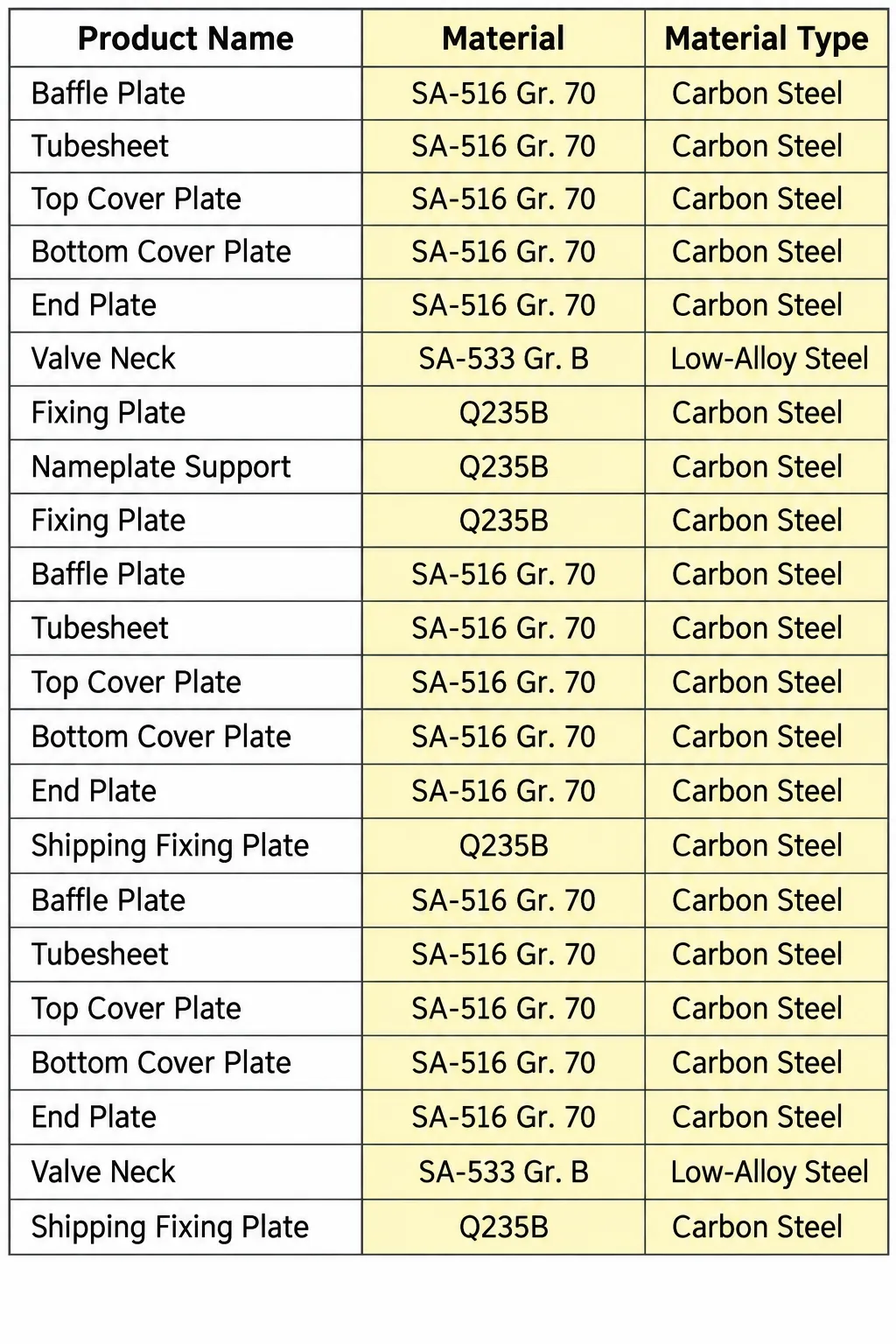
Now, you understand the main materials used in heat exchangers and the key factors to consider during material selection. Here, I will show you some heat exchanger material selection examples from projects Gelan has worked on with its customers. These examples can help you understand how different materials were specified for different heat exchanger components and project requirements.
Shell and Tube Heat Exchanger Material
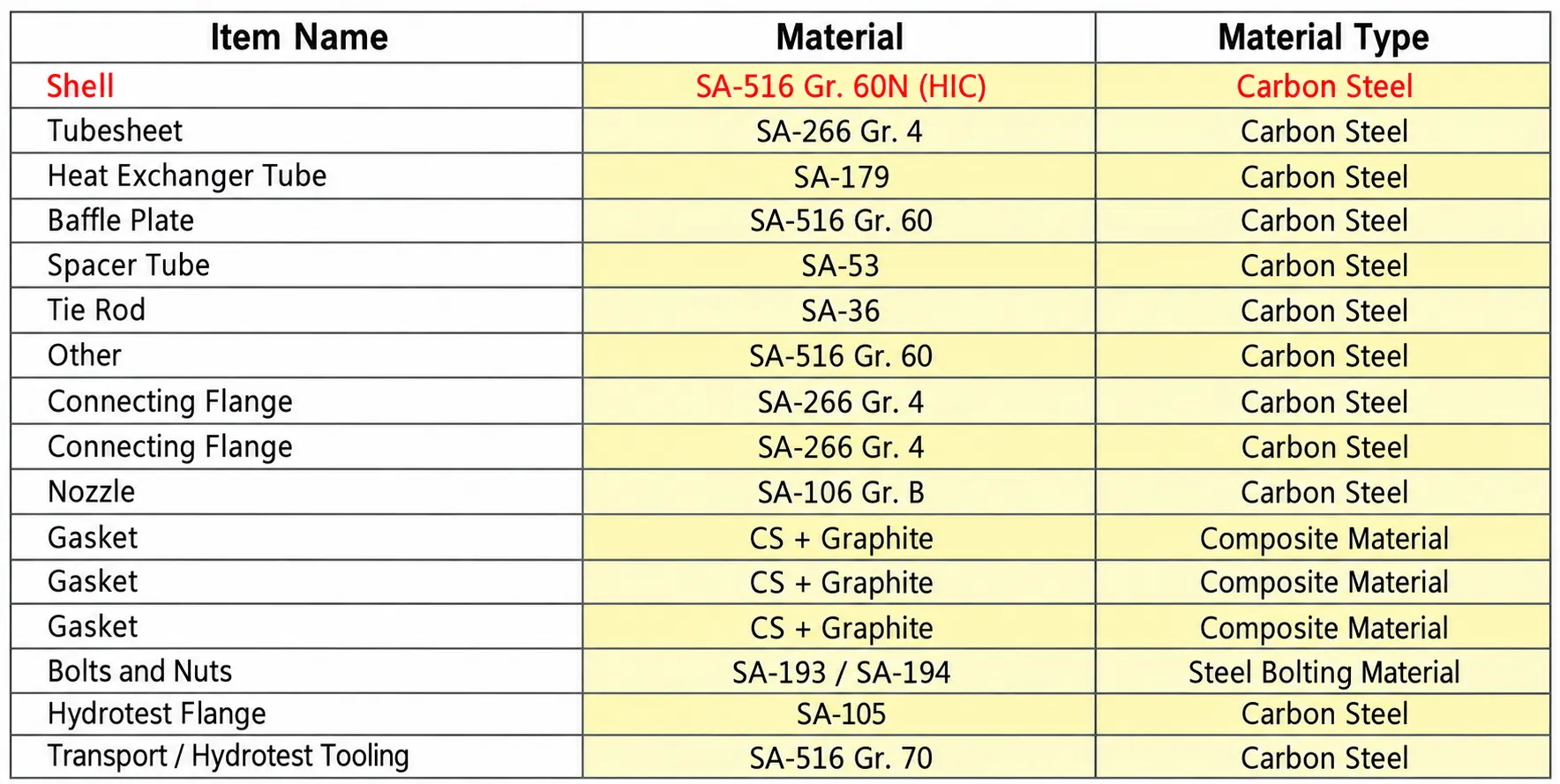
Heat Exchanger Material Sample
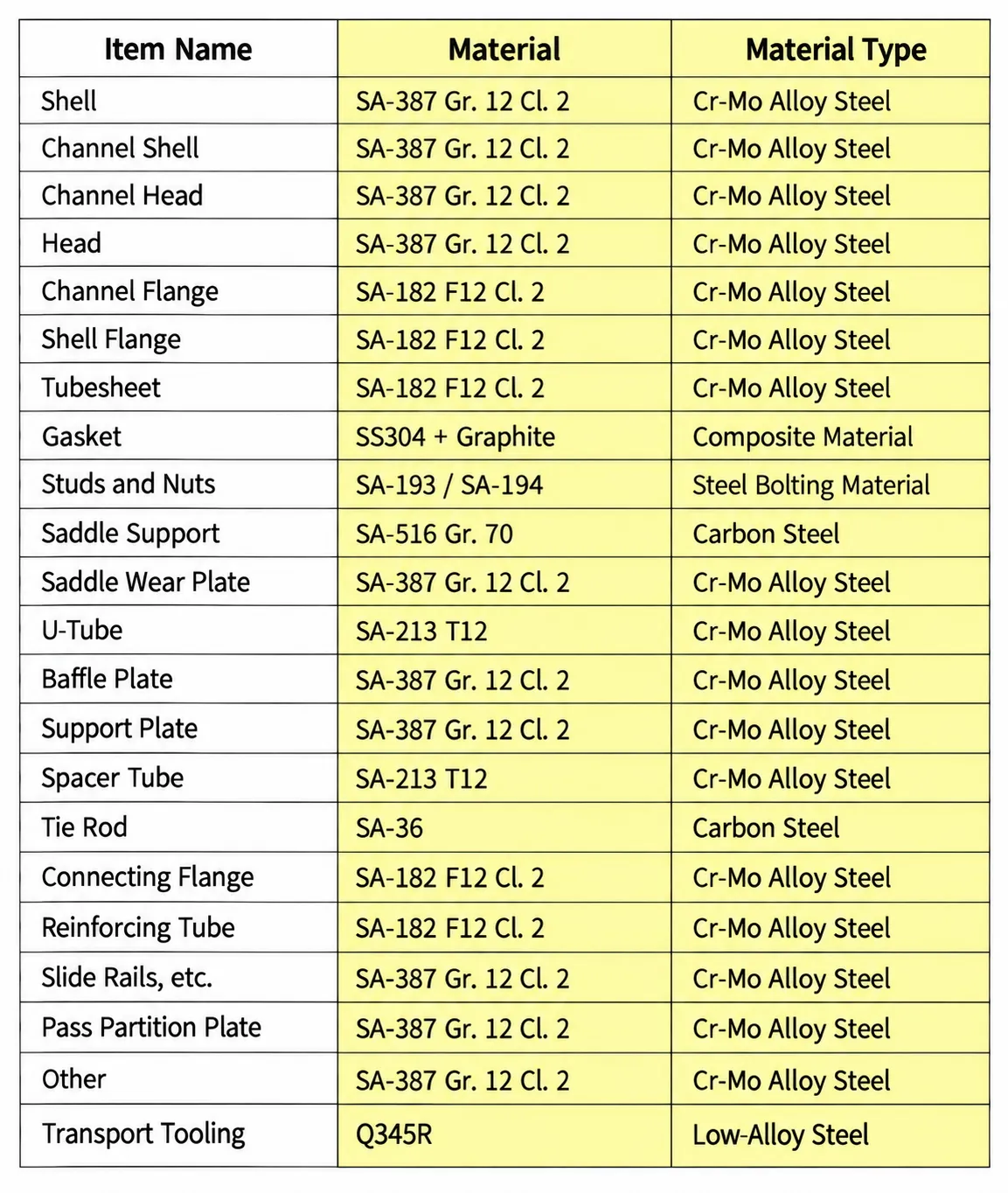
Air Cooled Heat Exchanger Material Sample
Part 4. Where to Source Heat Exchanger Materials and Fabricated Components?
After selecting the materials for your heat exchanger, you may need to purchase the required materials and fabricated components or order a complete heat exchanger directly. In this case, you can contact Gelan, which has been manufacturing industrial heat exchangers since 2016.
Gelan can manufacture heat exchangers according to your required materials, operating conditions, drawings and project specifications. With its established supplier network in China, Gelan can also supply individual materials, fabricated components or complete BOM-based material packages for heat exchanger projects.
Here are the main reasons to choose Gelan:
1. Experienced Heat Exchanger Manufacturer in China With its own manufacturing facility and professional engineering team, Gelan manufactures different types of heat exchangers and related components, including shell and tube heat exchangers, air-cooled heat exchangers, tube bundles and finned tubes.
2. Qualified Manufacturing and Project Support Gelan provides ASME-certified manufacturing and holds A1 and A2 pressure vessel manufacturing licenses, as well as the GC2 industrial piping qualification, to support different equipment and project requirements.
3. Established Supplier Network in China Gelan works with long-term material manufacturers and qualified suppliers across China. This makes it easier to source different materials and coordinate technical specifications, inspection, documentation and delivery.
4. Professional Engineering and Design Capabilities Gelan uses professional engineering software for pressure vessel calculations, 3D modelling, engineering drawings and structural analysis. Its engineering team can support customized heat exchanger design based on operating conditions, material requirements, applicable standards and project specifications.
Final Words
From this guide, you now understand the major materials used in heat exchangers, their advantages and limitations, and the key factors you should consider when selecting a suitable material. With the material selection samples provided, you can also have a better understanding of how different materials are selected for actual heat exchanger projects.
After understanding this information, if you are planning to purchase a complete heat exchanger, individual heat exchanger materials, fabricated components or a complete BOM-based material package, you can contact Gelan directly. Gelan can provide suitable heat exchangers and materials based on your operating conditions, drawings, BOM and project specifications.