

TL;DR
- •A steam drum separates steam from water and supports circulation in drum-type boilers and HRSGs.
- •Its reliability depends on correct design, suitable internals, level control, water chemistry, and regular maintenance.
- •It is widely used in refining, petrochemical, hydrogen, power, and waste heat recovery projects.
A steam drum is a core pressure part in many water-tube boilers and drum-type HRSGs. It separates steam from water. It also supports stable circulation and steam quality. Its design and condition can affect the reliability of the entire steam system.
Over more than 14 years in oil, gas, and petrochemical projects, I have worked with project owners and engineers on many steam equipment requirements. In this guide, I will explain the steam boiler drum in simple terms. You will learn how it works, where it is used, and how to maintain it.
CONTENT:
- What Is a Steam Drum in a Boiler?
- What Is the Function of a Steam Drum?
- How Does a Steam Drum Work?
- What Are the Main Steam Drum Parts and Internals?
- What Are the Key Steam Drum Maintenance Practices?
- Where Are Steam Drums Used in Industrial Boiler Systems?
- FAQ About Steam Drums
- Conclusion
What Is a Steam Drum in a Boiler?
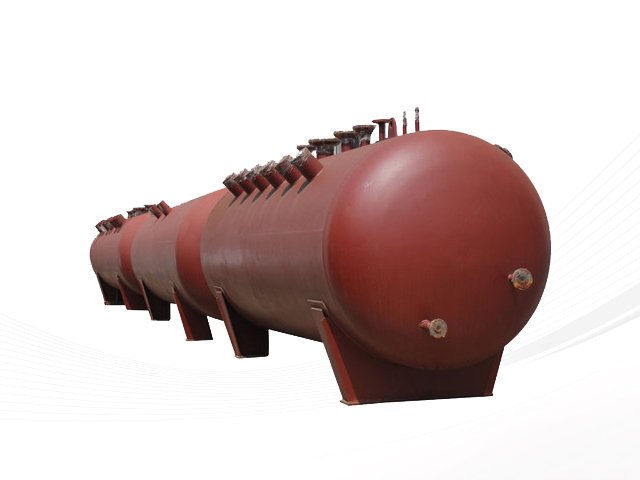
A steam drum in a boiler is a cylindrical pressure part. It is usually made from welded steel plate. Its main body includes a shell and two formed heads. The drum contains hot water and steam at the same operating pressure. It is therefore an important part of the boiler pressure boundary.
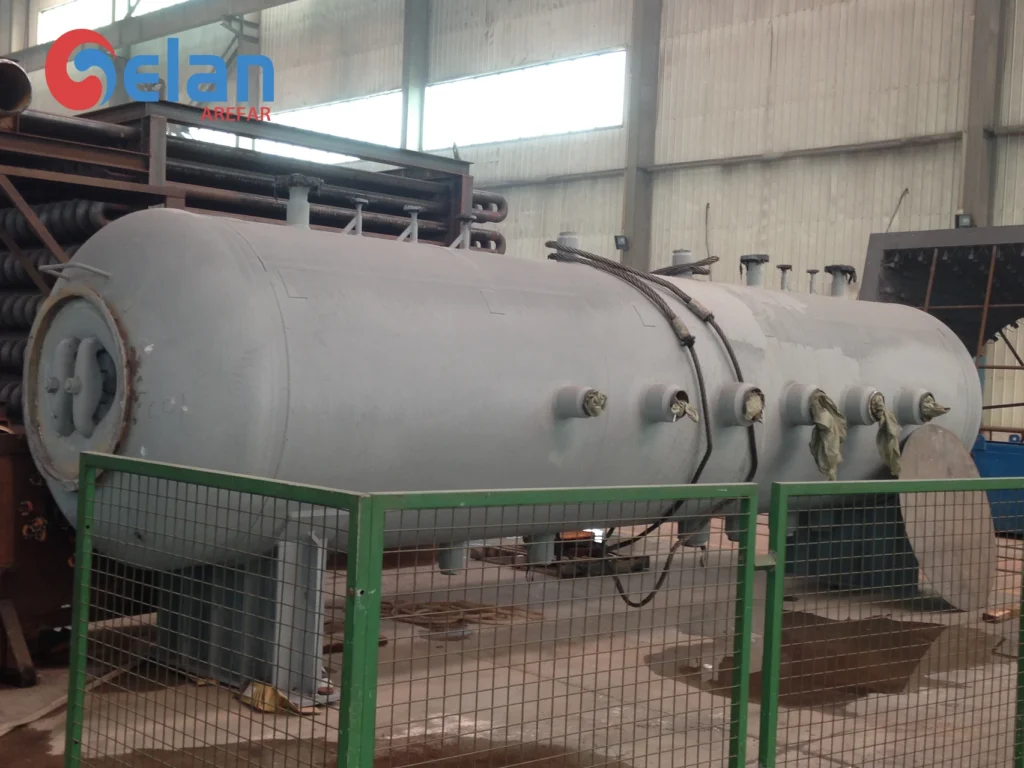
A boiler steam drum is the collection and separation center of a drum-type boiler. It receives the steam-water mixture from the evaporator tubes. Internal devices separate the two phases. Steam leaves from the top. Water returns to the circulation loop. This arrangement is common in natural-circulation boilers and many forced-circulation systems.
You can think of the drum as a traffic hub. It receives a mixed flow of steam and water. It sends the steam forward for use or further heating. It sends the water back for another circulation cycle. Unlike a simple storage vessel, this work continues under high temperature and pressure.
Steam-water mixture enters → Steam is separated → Steam leaves from the top → Water returns to the circulation loop
What Is the Function of a Steam Drum?
It Connects the Main Steam-Generation Stages
Feedwater first passes through the economizer. It then enters the drum and evaporator circuit. The evaporator changes part of the water into saturated steam. The drum sends this steam to the superheater.
The drum therefore connects three stages:
Water heating → Evaporation → Steam superheating
It is both a connection point and a process boundary.
It Provides Water Reserve and Thermal Buffering
The drum holds a controlled amount of boiler water. This reserve gives the feedwater control system more time to respond during short operating changes.
The hot water also stores thermal energy. A pressure drop can cause a small amount of saturated water to form more steam. This adds thermal inertia. It can slow short-term changes in steam pressure.
Note: A larger drum may provide more reserve. However, drum size must match the full boiler design. A larger vessel alone cannot solve poor circulation or weak control.
It Protects Steam Quality
The steam-water mixture contains liquid droplets. Drum internals remove these droplets before the steam leaves.
Some systems use more than one separation stage. They may combine baffles, cyclone separators, scrubbers, or dryers. Chemical dosing and blowdown also help control boiler-water impurities.
These measures reduce water carryover. They also protect superheaters, turbines, and process equipment from wet or contaminated steam.
It Supports Safe Boiler Operation
A power boiler steam drum provides key points for pressure and water-level protection. Common devices include level gauges, level transmitters, pressure instruments, alarms, and safety valves.
Low water can reduce circulation and damage heated pressure parts. High water can send moisture into the steam line. Overpressure can threaten the drum and other pressure components.
These devices allow operators and control systems to detect unsafe conditions early.
How Does a Steam Drum Work?
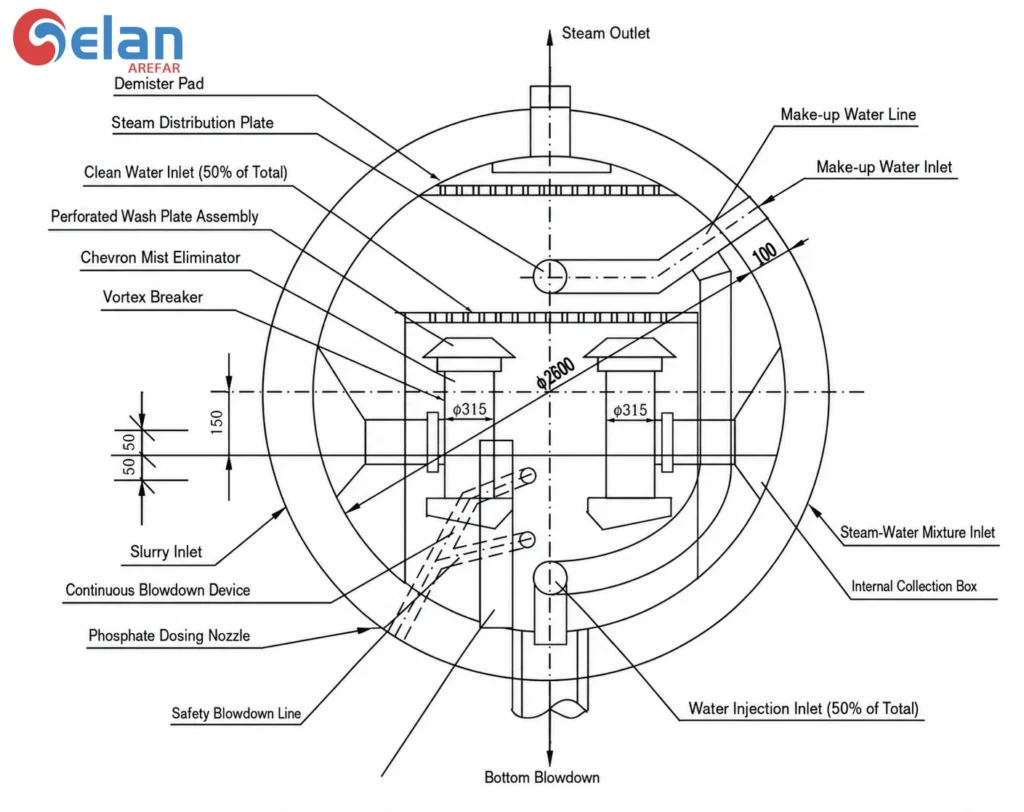
The steam drum working principle combines water circulation with staged steam-water separation. The exact internal arrangement varies by boiler design. Many modern drums use two main separation stages. Some high-purity systems add a water-washing stage.
Step 1: The Steam-Water Mixture Enters the Drum
Riser tubes carry the steam-water mixture from the evaporator into the drum. Inlet baffles or shrouds guide the incoming flow. They spread it across the drum and direct it toward the separation devices.
This flow control also reduces local turbulence. It helps keep the water level more stable across the drum. Even heating is also important during startup. Large temperature differences between the upper and lower drum walls can create thermal stress.
Step 2: Primary Separators Remove Most of the Water
The mixture then enters cyclone separators or similar primary devices. The flow changes direction at high speed. Steam follows the new flow path. Heavier water droplets move toward the separator wall and fall back into the drum water.
This is the main separation stage. It removes most of the liquid water before the steam moves upward.
Step 3: Secondary Devices Remove Fine Droplets
The steam may still carry fine water droplets after primary separation. It then passes through secondary scrubbers or dryers. The remaining droplets collect on the internal surfaces and drain back into the drum.
This stage reduces mechanical carryover and improves steam purity.
Step 4: Some Systems Add a Steam-Washing Stage
High-purity systems may use water-wash troughs or similar devices. This stage helps reduce impurities carried with the steam. It is an optional design feature. It is not used in every boiler.
The required arrangement depends on the feedwater quality, boiler pressure, steam purity target, and downstream equipment.
Step 5: Steam Leaves and Water Returns to the Loop
The separated saturated steam collects in the upper part of the drum. It leaves through the steam outlet and flows to the superheater.
The separated water remains in the lower part. Downcomers return it to the evaporator circuit. In a natural-circulation boiler, the density difference between water and the steam-water mixture drives this flow. The cycle then repeats.
What Are the Main Steam Drum Parts and Internals?
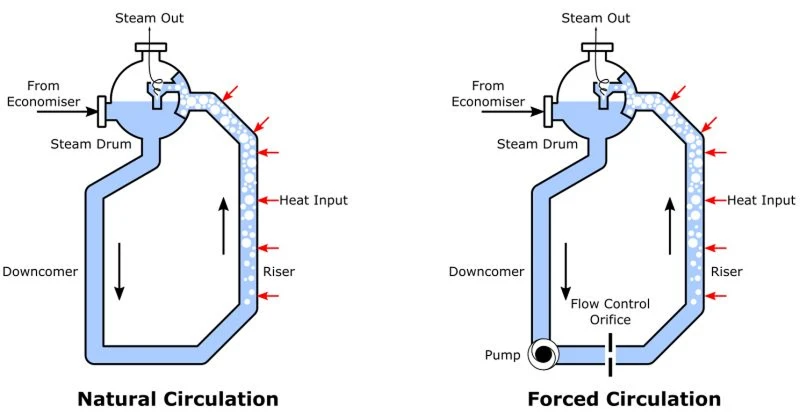
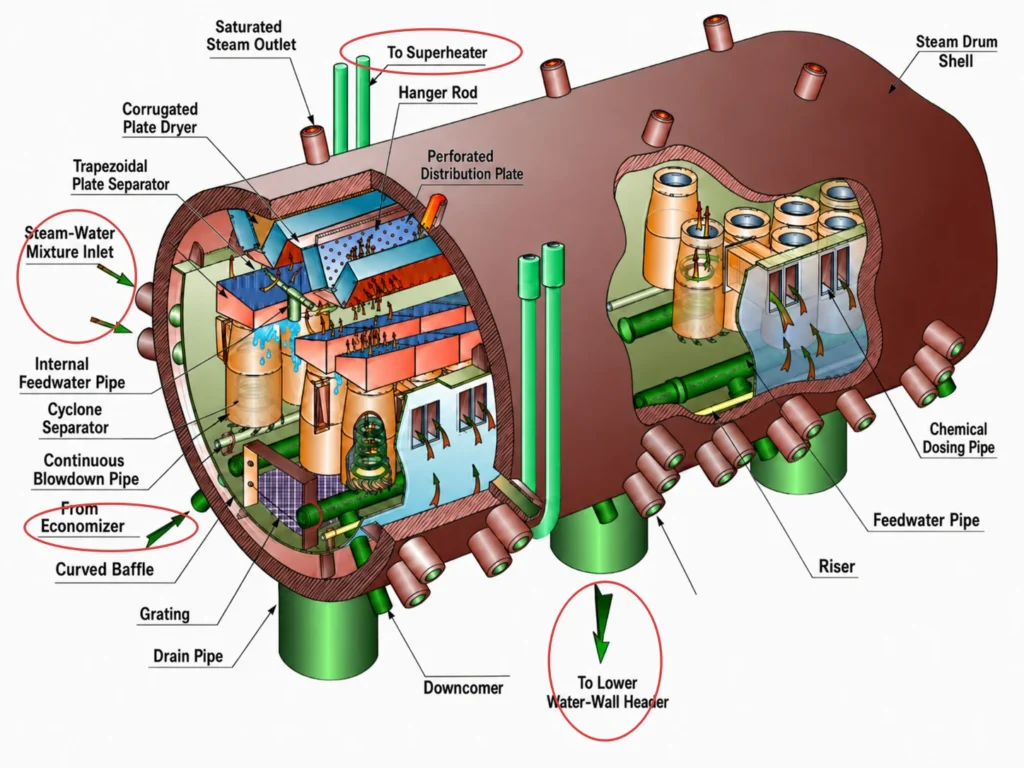
The steam drum parts include the shell, heads, nozzles, supports, and manhole. These parts form the pressure-retaining body. Inside the drum, the main devices can be grouped into four functional systems:
- Steam-water separation devices
- Steam-washing devices
- Chemical dosing and blowdown devices
- Emergency drain and safety connections
Together, these steam drum internals separate steam from water, improve steam purity, control boiler-water quality, and support safe operation. The exact arrangement depends on the boiler type and project requirements.
| Functional System | Main Components | Main Purpose |
|---|---|---|
| Steam-water separation | Baffles, cyclone separators, scrubbers, louver plates, dryers | Remove water droplets from steam |
| Steam washing | Perforated wash trays or wash troughs | Reduce impurities carried with steam |
| Chemical dosing and blowdown | Dosing lines, continuous blowdown, intermittent blowdown | Control boiler-water chemistry and solids |
| Safety and monitoring | Level connections, pressure gauges, alarms, safety valves, emergency drain | Monitor and protect drum operation |
Steam-Water Separation Devices
Inlet steam drum baffles guide the mixture from the riser tubes. They spread the flow and direct it toward the separators.
A steam drum cyclone separator removes most of the water. Secondary scrubbers, louver plates, or dryers then collect smaller droplets. Some designs also use a demister pad in the steam drum. These components form the main steam drum separator system.
Good separation reduces moisture carryover. Its performance also depends on boiler load, drum pressure, and water level.
Steam-Washing Devices
Some high-purity systems add perforated wash trays. Steam passes through a clean water layer. Part of the carried salt transfers into the wash water.
This stage can improve steam purity before the steam leaves the drum. It is optional. Many industrial drums rely only on mechanical separators and dryers.
Chemical Dosing and Blowdown Devices
A chemical dosing line adds approved treatment chemicals to the boiler water. The treatment program depends on the boiler pressure, materials, and cycle chemistry.
A continuous blowdown line removes a small flow of drum water. This helps control dissolved solids and chemical concentration. Intermittent blowdown removes sludge from the lowest parts of the boiler water circuit. The exact discharge point depends on the system layout.
Emergency Drain and Safety Connections
Some drum designs include an emergency water drain. It can help lower the water level during a serious high-water condition. This feature is not standard in every boiler. Its use must follow the plant operating procedure.
The drum also has connections for level instruments, pressure gauges, alarms, and safety valves. These devices monitor the pressure and water level. They do not perform steam separation, but they are essential to safe drum operation.
What Are the Key Steam Drum Maintenance Practices?
Steam drum maintenance is essential because high pressure, heat, water chemistry, and repeated load changes can damage the drum over time. Maintenance should cover fabrication, operation, shutdown inspection, and storage.
Control Quality During Fabrication
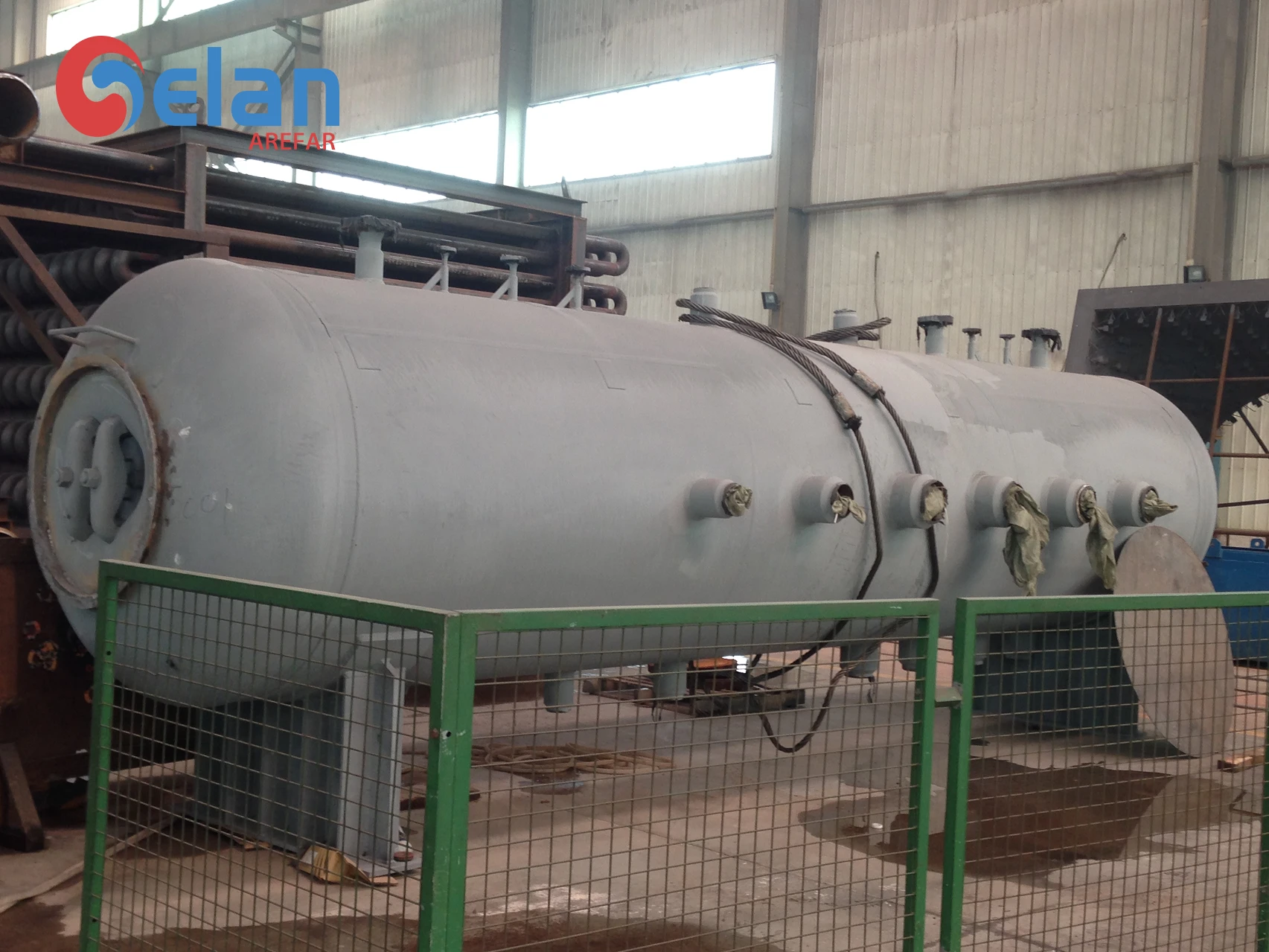
Materials, welding, heat treatment, and inspection must follow the approved boiler code and project specifications. NDE scope should match the drawing and code requirements.
Gelan holds Class A boiler manufacturing qualifications and ASME U and S certifications. Its in-house capabilities include RT, UT, PT, MT, hydrostatic testing, and material inspection.
Monitor Water Level and Pressure
Reliable steam drum level control is essential. Low water can damage heated pressure parts. High water can cause steam carryover.
Operators should check the local steam drum level gauge, the steam drum level transmitter, alarms, and trips. Larger systems may use 3 element steam drum level control. It compares water level, steam flow, and feedwater flow.
The steam drum safety valve must also remain correctly set and ready to operate.
Control Water Chemistry and Blowdown
Proper steam drum blowdown controls dissolved solids and boiler-water concentration. Too little blowdown can increase deposits and carryover. Too much wastes water and heat.
A stable magnetite layer in the steam drum can protect carbon steel. Loose deposits or red corrosion products may show abnormal water chemistry.
Inspect the Drum During Shutdown
After safe isolation and cooling, inspectors can enter through the steam drum manhole.
They should check:
- Shells, heads, welds, and nozzles
- Separators, baffles, and internal supports
- Corrosion, cracks, deposits, and loose parts
- Manhole sealing surfaces and gaskets
Common corrosion monitoring technologies for boilers and steam drums include visual inspection, UT, PT, and MT.
Protect the Drum During Long Shutdowns
Idle drums can still corrode. Dry layup keeps the internal surfaces dry. Wet layup keeps the system full of treated water.
The method should match the shutdown period, climate, and restart plan.
Where Are Steam Drums Used in Industrial Boiler Systems?
For most project owners, a steam drum appears when the plant needs stable steam from fired heat or recovered waste heat. It is most common in refining, petrochemical, hydrogen, and power projects.
Oil Refining
Refineries need steam for stripping, heating, utilities, and power support. A water tube boiler steam drum may be used in the refinery utility boiler or a process waste heat boiler.
It can also recover heat from fired heaters, coking units, and other hot gas streams. This turns unused heat into useful plant steam.
See how Gelan supports oil refining applications and custom waste heat boiler projects.
Petrochemical and Chemical Plants
Petrochemical plants use steam for heating, distillation, stripping, reaction support, and plant utilities. Steam demand is often continuous. Steam quality must also remain stable.
A drum-type boiler may recover heat from cracking furnaces, process heaters, thermal oxidizers, or incinerators. The steam drum helps separate the steam before it enters the plant steam network.
Hydrogen Production
Steam methane reforming requires high-temperature steam. The process also produces hot flue gas with recoverable energy.
An HRSG steam drum or waste heat boiler drum can help recover this heat and generate more steam for the hydrogen unit. This reduces heat loss and supports the wider steam balance of the plant.
Gelan supports industrial hydrogen production projects, including reforming and waste heat recovery equipment.
Power Generation and Plant Utilities
Combined-cycle plants use gas turbine exhaust to produce steam in an HRSG. Drum-type systems may include HP, IP, and LP pressure levels.
The HP steam drum handles the highest-pressure steam circuit. The steam then flows to the steam turbine. Industrial plants may also use a power boiler steam drum to supply utility and process steam.
From my project experience, the first question is not simply whether a plant needs a steam drum. The real question is where the heat comes from and how the steam will be used. These two points define the boiler arrangement, pressure level, and steam quality requirement.
FAQ About Steam Drums
Steam Drum and Mud Drum: What Is the Difference?
A steam drum separates steam from water, while a mud drum collects water and deposits at the bottom of the boiler.The steam drum is installed above the evaporator circuit. In a mud drum boiler, the lower drum also supports water circulation and bottom blowdown.
How Does Steam Drum Level Control Work?
Steam drum level control adjusts feedwater flow to keep the water level within a safe range.
Three-element control uses drum level, steam flow, and feedwater flow. It is often selected for boilers with frequent load changes.
What Steam Drum Blowdown Is Required?
Steam drum blowdown normally includes continuous blowdown and intermittent bottom blowdown.
Continuous blowdown controls dissolved solids. Intermittent blowdown removes sludge from lower parts of the boiler. The frequency should follow water analysis and plant procedures.
Why Are Chemicals Added to a Steam Drum?
Chemicals are added to control pH, reduce scale, and limit corrosion.
Some drum boilers use phosphate treatment. However, the chemical program must match the boiler pressure, feedwater quality, and operating conditions.
What Should Buyers Check in Steam Drum Design?
Buyers should check design pressure, temperature, steam capacity, materials, internals, nozzles, and inspection requirements.Steam drum sizing must also support water circulation, steam separation, and the required operating range. A larger drum is not always better.
What Should a Steam Drum Drawing Include?
A steam drum drawing should show the shell, heads, nozzles, supports, internals, welds, materials, and inspection requirements.For replacement projects, it should also confirm connection points and the original boiler layout. A clear steam drum diagram helps both sides review the internal flow before fabrication.
What Should Buyers Check During Steam Drum Fabrication?
Buyers should check material traceability, welding qualifications, NDE records, heat treatment, hydrotesting, and final documentation.
Gelan can support steam drum fabrication under its Class A Boiler qualification and ASME S authorization.
Is a Steam Drum the Same as a Steam Boiler?
No. A steam drum is only one pressure part within a drum-type boiler.
The complete boiler also includes heating surfaces, headers, piping, controls, safety devices, and supporting structures.
Is a Steam Drum a Pressure Vessel?
Yes, it is a pressure-retaining component, but it is normally part of the boiler pressure boundary.
For ASME power boilers, it is generally designed under Section I rather than treated as a separate Section VIII vessel.
Do All Steam Boilers Have a Steam Drum?
No. Among the main types of boilers , drum-type water-tube boilers use steam drums, but fire-tube and once-through boilers usually do not.The boiler type and circulation method determine whether a separate drum is required.
Does Every HRSG Have a Steam Drum?
No. Drum-type HRSGs use steam drums, while once-through HRSGs do not use a traditional high-pressure drum.
Multi-pressure HRSGs may include HP, IP, and LP drums.
Can Steam Drum Internals Be Replaced Separately?
Yes. Separators, baffles, scrubbers, and dryers can often be replaced without replacing the complete drum.
The replacement parts must match the original dimensions, materials, and attachment design.
Can a Steam Drum Be Purchased Separately?
Yes, but a replacement steam drum is normally custom-designed rather than purchased as a standard product.
Buyers should provide the original drawing, design data, nozzle layout, materials, internals, and inspection requirements.
Can a Steam Drum Explode?
Yes. A steam drum explosion can occur if the pressure boundary fails while the drum contains high-pressure steam and hot water.Common risks include overpressure, low water, corrosion, damaged safety valves, and improper operation. Regular inspection and reliable protection systems reduce these risks.
Conclusion
A steam drum supports steam-water separation, circulation, steam quality, and safe boiler operation. Reliable performance depends on correct design, qualified fabrication, and proper maintenance.
Gelan supports custom steam drums and boiler pressure parts for water-tube boilers, waste heat boilers, and drum-type HRSG projects. Send Gelan your boiler and operating data to review the drum design before fabrication.