

TL;DR
- •What an HRSG does: It recovers gas turbine exhaust heat and converts it into useful steam.
- •Where the steam goes: It can support a steam turbine, industrial production, heating or CHP.
- •Main parts: Economizer, evaporator, steam drum, superheater and optional reheater.
- •Design choices: Drum-type or once-through, horizontal or vertical, pressure levels and firing method.
- •Project inputs: Exhaust data, steam demand, operating profile and site limits.
- •Supplier check: Review engineering, fabrication, modular delivery, quality control and retrofit capability.
A heat recovery steam generator uses hot exhaust gas to produce steam. It is widely used after a gas turbine in combined-cycle power plants and industrial energy systems.
After more than a decade in overseas industrial projects, I have seen the same HRSG questions appear again and again. This guide explains its structure, working process, main components and design types. It also clears up common misunderstandings and gives practical tips for defining your project needs before contacting a supplier.
CONTENT:
- What Is an HRSG?
- How Does an HRSG Work in a Power Plant?
- What Are the Main Parts of an HRSG Boiler?
- How Can Modular HRSG Units Support New-Build and Retrofit Projects?
- Which HRSG Design Fits the Project?
- What Project Data Is Needed Before HRSG Design?
- How Should You Compare HRSG Manufacturers and Suppliers?
- FAQ About HRSG Systems
- Conclusion
What Is an HRSG?
HRSG stands for Heat Recovery Steam Generator. It captures hot exhaust from a gas turbine and uses that heat to produce steam. The steam can generate more electricity. It can also supply heating or industrial processes.
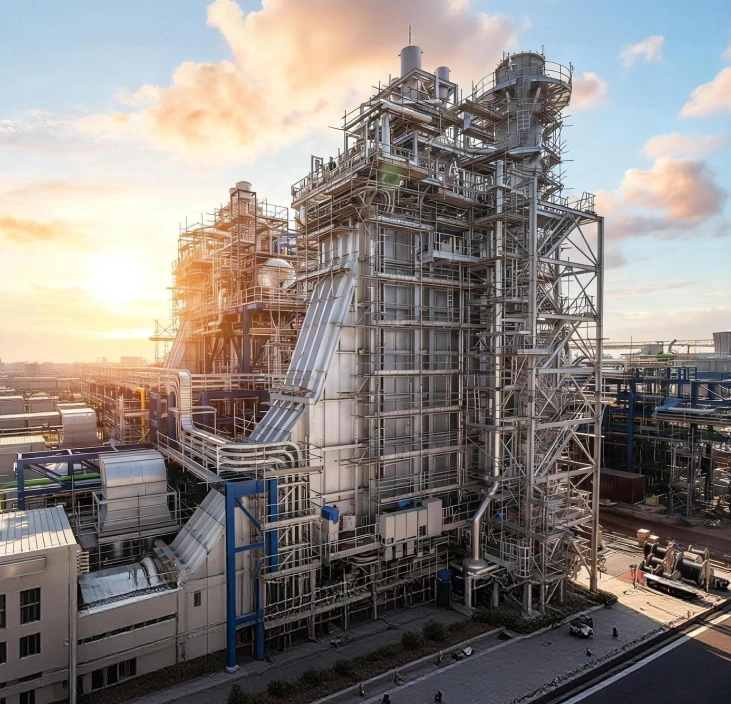
Think of it as giving the same fuel a second job. The gas turbine produces power first. The HRSG then recovers heat that would otherwise leave through the stack. This helps the plant produce more useful energy without burning the same amount of extra fuel. Modern combined-cycle plants can raise efficiency from about 40% to around 60% through this second steam cycle.
HRSGs are common in combined-cycle and combined heat and power plants. They are also used where sites need both electricity and steady steam or hot water. Typical applications include refineries, petrochemical and chemical plants, pulp and paper mills, food plants, and district heating systems. CHP systems can reach total efficiencies of 60% to 80% when the recovered heat is fully used.
How Does an HRSG Work in a Power Plant?
In an HRSG power plant, the gas turbine generates electricity first. The HRSG then recovers heat from the turbine exhaust. It uses this heat to produce steam.
Fuel and air → Gas turbine → Hot exhaust gas → HRSG → Steam → Steam turbine or process steam system
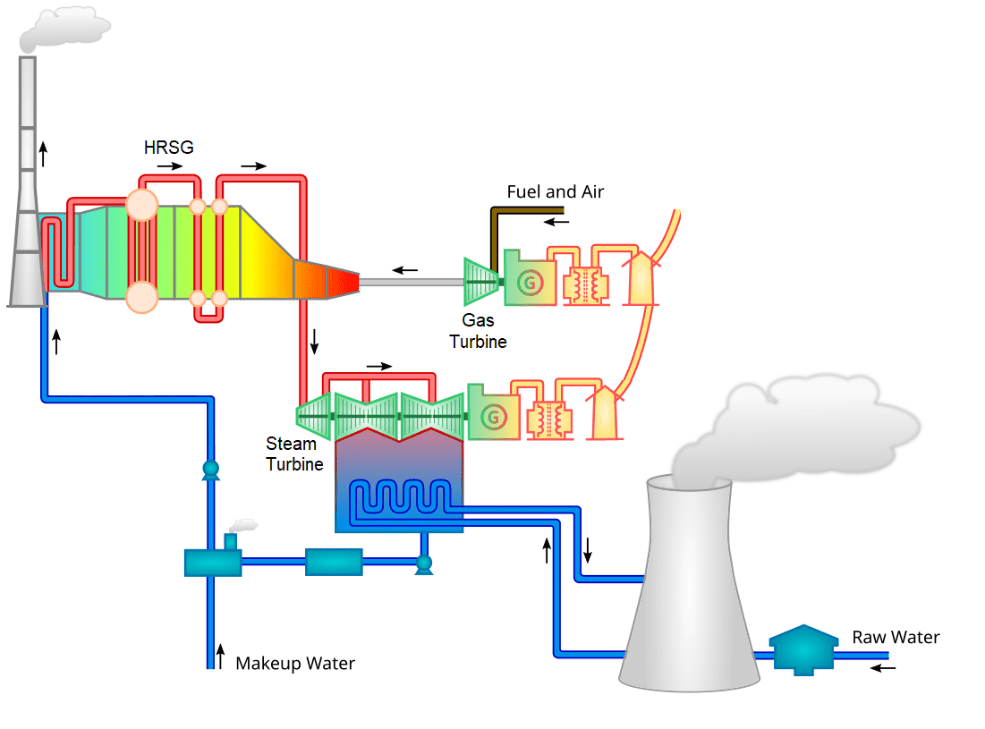
Process source: SAVREE
The process follows seven main steps:
- Fuel burns inside the gas turbine.
- The gas turbine drives a generator.
- Hot exhaust gas enters the HRSG.
- The gas passes across the heating surfaces.
- Feedwater is heated, evaporated and superheated.
- The steam enters a steam turbine or an industrial steam system.
- The cooled exhaust gas leaves through the stack.
The HRSG contains two separate flow paths:
| Flow Path | What Happens |
|---|---|
| Exhaust gas side | Hot gas flows around the heat-transfer tubes and releases heat. |
| Water and steam side | Feedwater flows inside the tubes and becomes steam. |
The two fluids do not mix. Heat passes through the tube walls. In a common layout, the hot gas reaches the superheater first, followed by the evaporator and economizer.
What Are the Main Parts of an HRSG Boiler?
An HRSG boiler mainly uses four heat-recovery sections. Drum-type systems also include a steam drum. Large combined-cycle units may add a reheater.
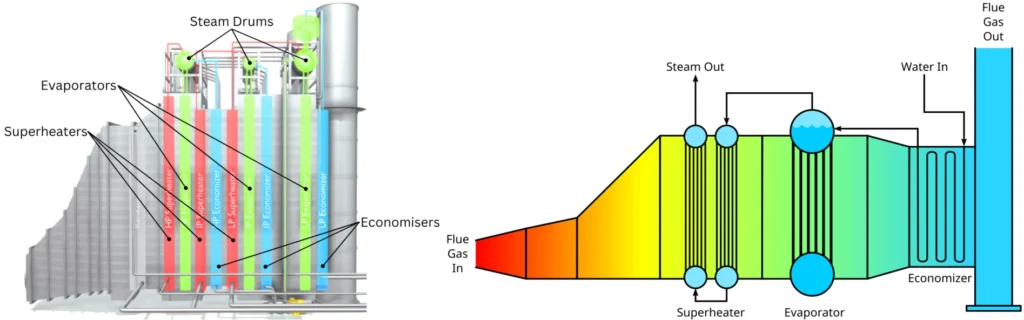
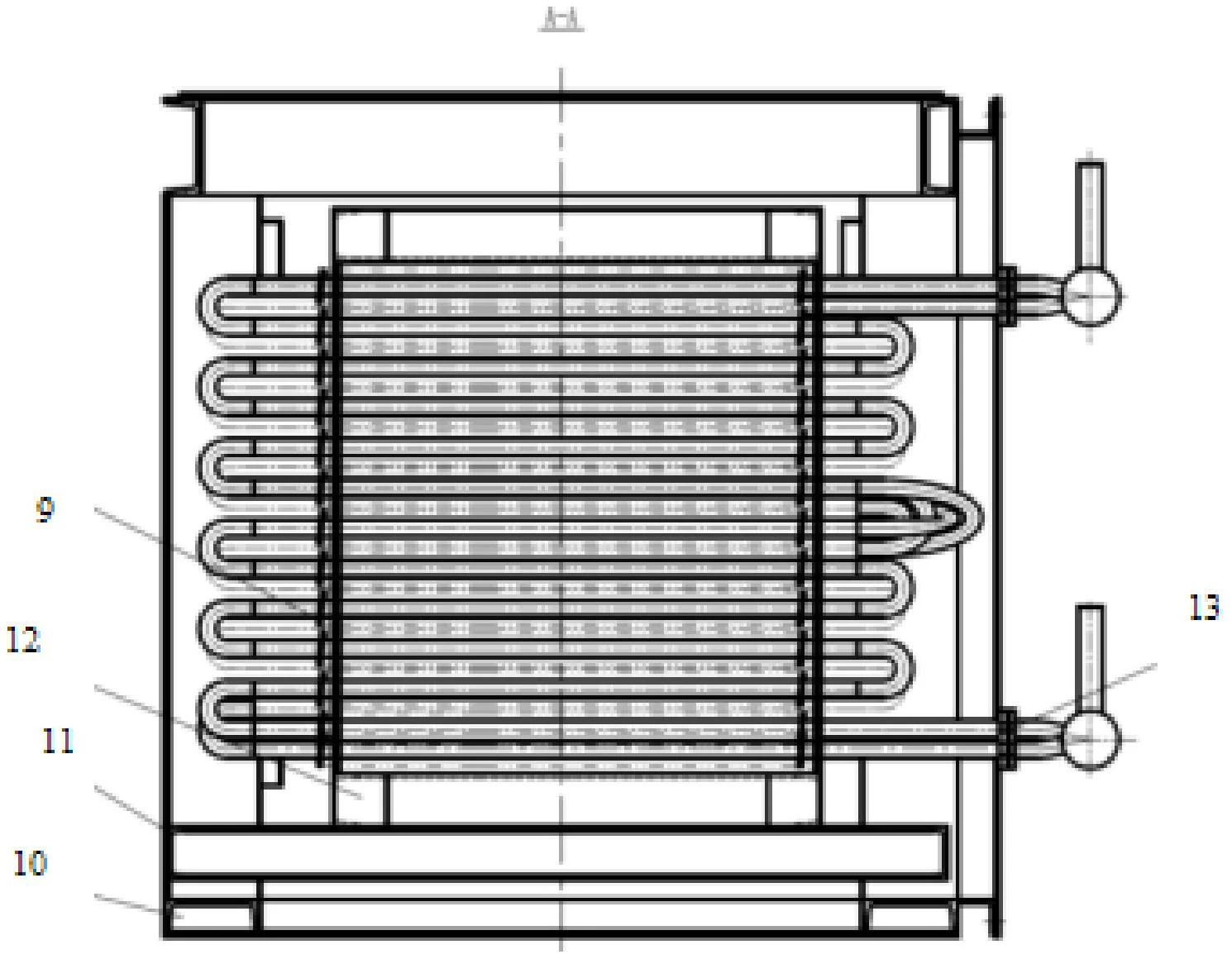
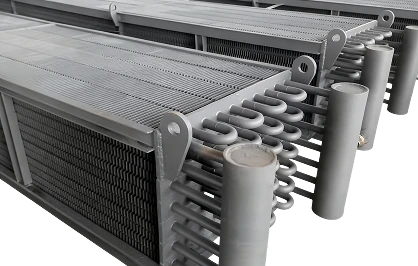
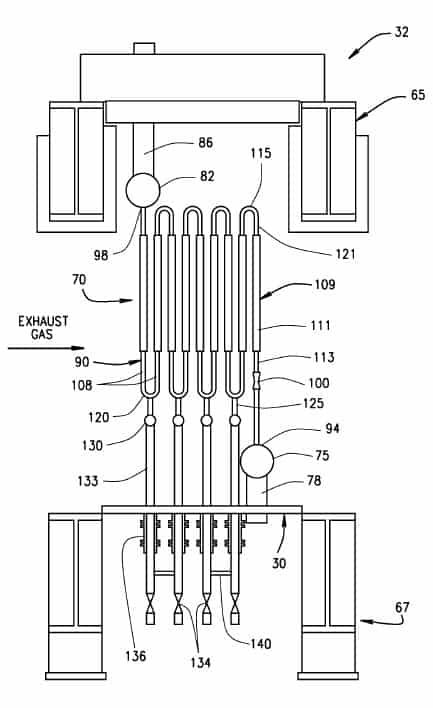
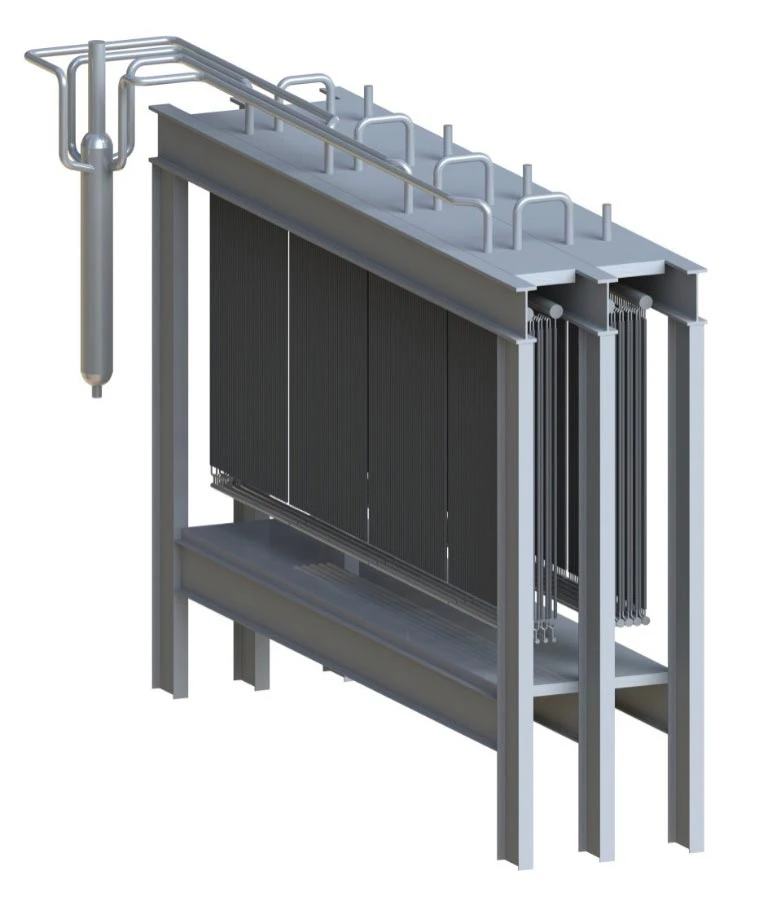
| Main Part | Function | Schematic Diagram | Actual Photo |
|---|---|---|---|
| Economizer | Preheats feedwater with lower-temperature exhaust heat. |
|
|
| Evaporator | Converts heated water into a steam-water mixture. |
|
|
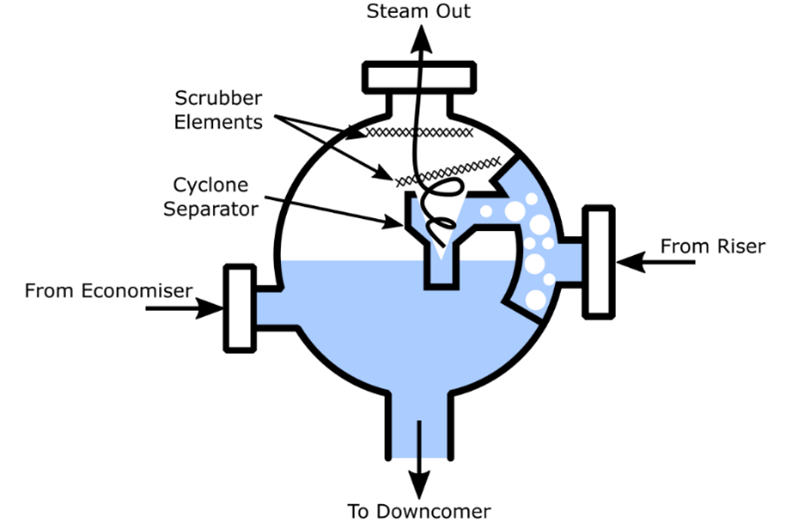
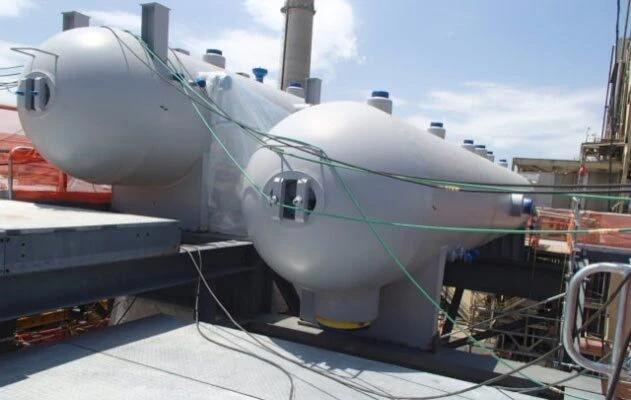
| Steam drum | Separates steam from water and supports water circulation. |
|
|
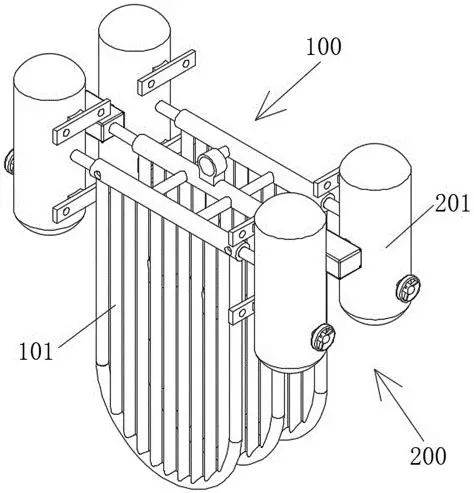
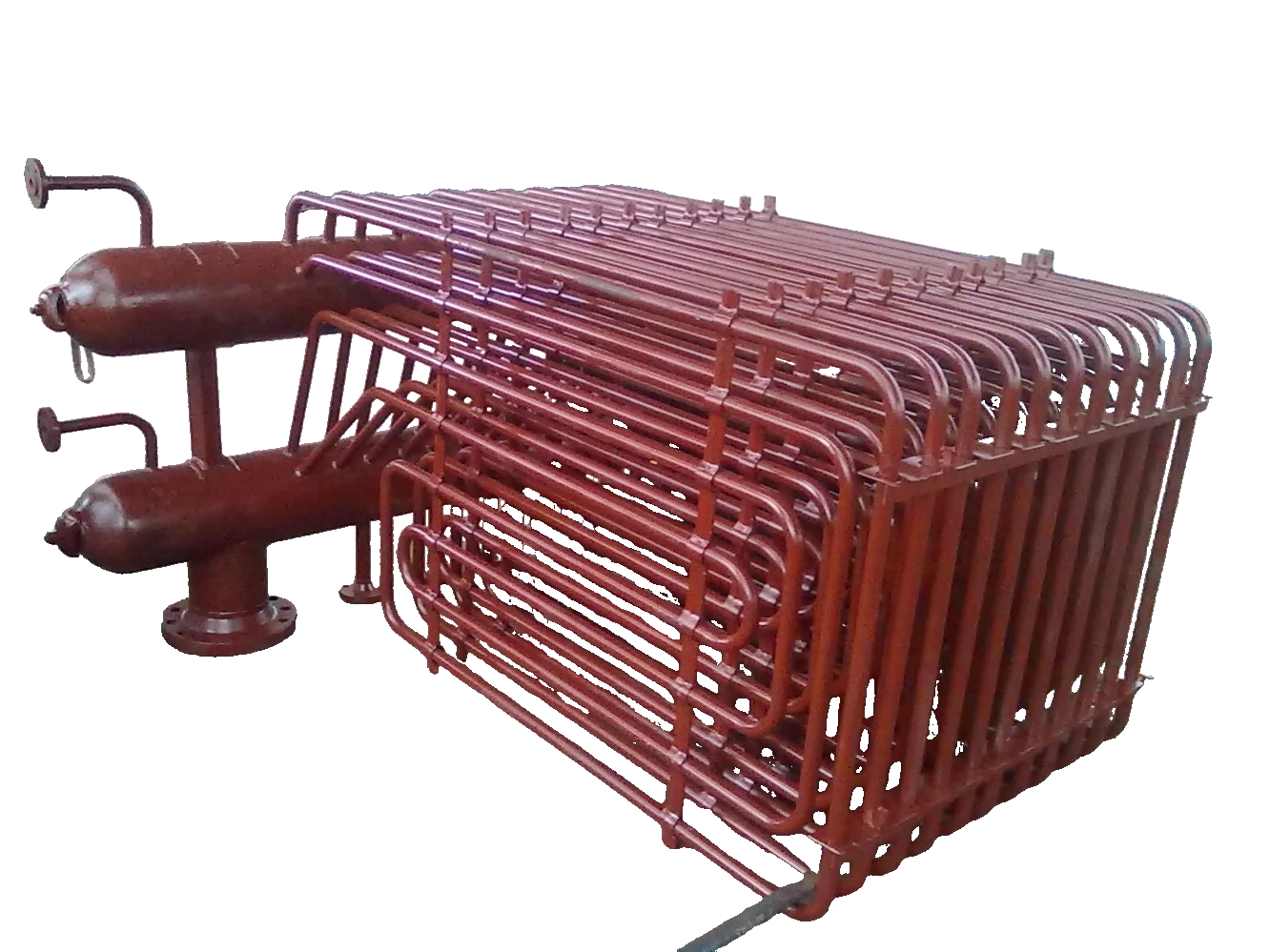
| Superheater | Raises the steam temperature before use. |
|
|
| Reheater | Reheats steam returning from the steam turbine. | Looks similar to a superheater | Looks similar to a superheater |
Note: The drawings and photos are for reference only. Actual component design varies by operating conditions, steam requirements and project layout.
How Can Modular HRSG Units Support New-Build and Retrofit Projects?
The main HRSG parts do not always need to be shipped and installed one by one. They can be assembled into factory-built modules. This reduces field welding and simplifies site installation.
A modular HRSG is a delivery and fabrication method. It is not a separate thermal design.
| Project Situation | Modular Solution | Main Benefit |
|---|---|---|
| Short construction schedule | Factory-assembled modules | Less site work |
| High local labor cost | More factory fabrication | Better cost control |
| Restricted transport route | Smaller divided modules | Easier delivery |
| Limited crane capacity | Lower module weight | Easier lifting |
| Remote project location | Preassembled pressure parts | Less field welding |
| Existing tube failure | Replacement coil or tube-bundle module | Shorter shutdown |
| Gas turbine upgrade | Redesigned heating-surface module | Matches new exhaust conditions |
| Original parts unavailable | Reverse-engineered replacement section | Extends equipment life |
New-build projects may use tube bundles, pressure-part modules, structural frames or fully assembled sections.
Retrofit projects may replace economizers, evaporators, superheaters, reheaters, headers or finned tubes. The whole HRSG does not always need to be replaced.
Larger modules reduce site work. However, they need suitable roads, cranes and lifting space. The final module size should match the transport and installation plan.
Which HRSG Design Fits the Project?
Knowing the main parts is only the first step. The next step is deciding how those parts should be arranged for your project.
Different operating goals lead to different HRSG designs. Your startup frequency, steam demand, site limits and output targets should guide the selection.
Use the table below to identify which design question matters most to your project.
| Your Project Need | Design Dimension | Decision Support | Compare |
|---|---|---|---|
| You need fast starts, frequent load changes or stable base-load operation | Water-steam circulation | Which design can better match your operating pattern | Drum-Type vs Once-Through HRSG |
| Your site has limited ground space, height limits or difficult maintenance access | Gas-flow arrangement | Which layout fits your available space and access needs | Horizontal vs Vertical HRSG |
| You need a certain steam output for power generation or process use | Steam pressure level | How to balance heat recovery, system complexity and cost | Single-, Dual- and Triple-Pressure HRSG |
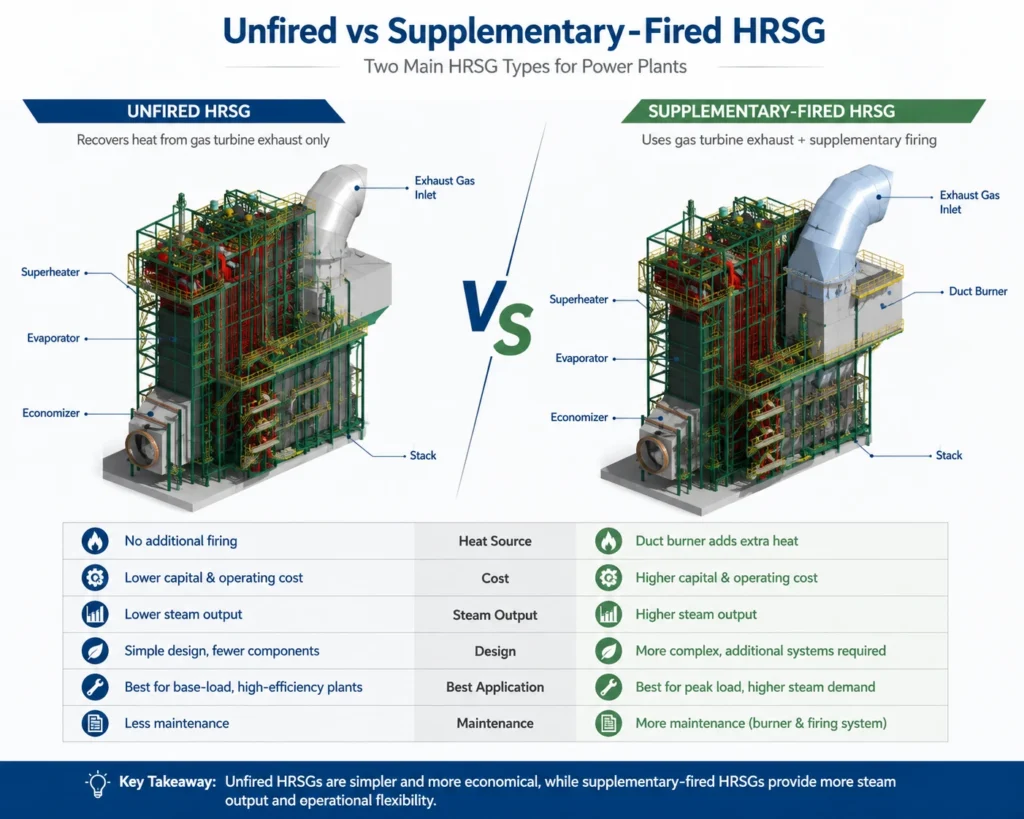
| Your steam demand changes or you need extra peak output | Firing method | Whether exhaust heat is enough or extra fuel is needed | Unfired vs Supplementary-Fired HRSG |
These choices work together. You do not need to select them in isolation. Start by defining your operating needs, steam demand and site limits. Then confirm the final combination with the supplier.
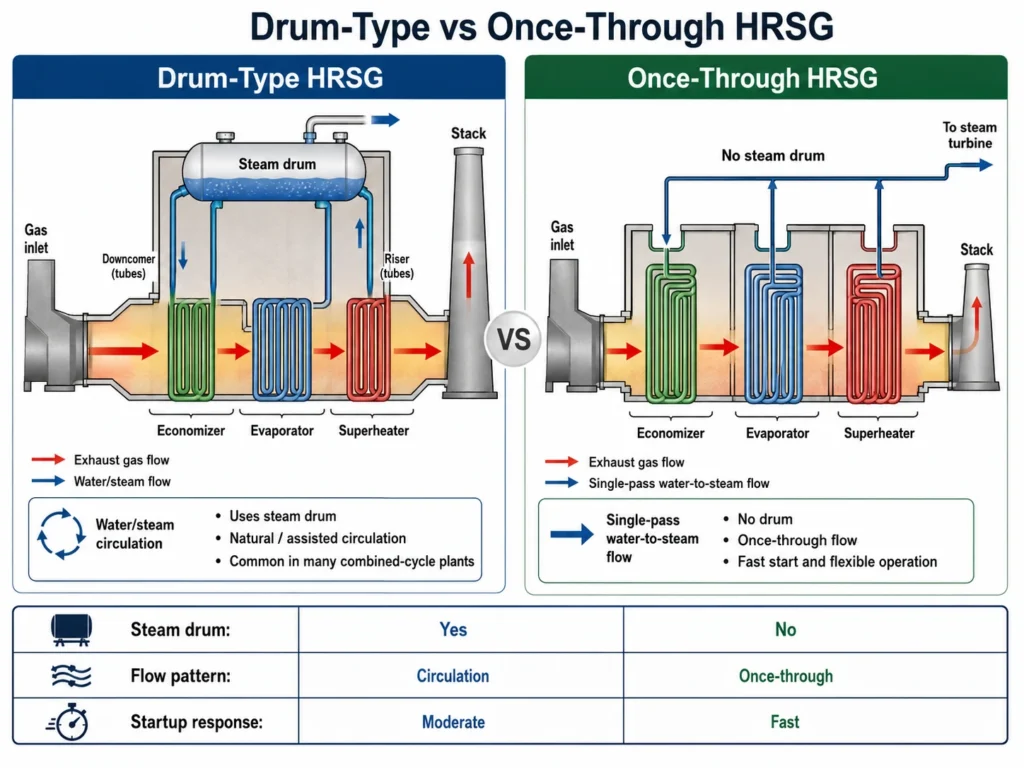
Drum-Type vs Once-Through HRSG
This choice mainly depends on startup speed, operating flexibility and steam pressure.
| Comparison | Drum-Type HRSG | Once-Through HRSG |
|---|---|---|
| Steam drum | Required | Usually not required in the high-pressure circuit |
| Water flow | Uses natural or forced circulation | Water passes through the heating surface once |
| Startup response | Usually slower | Usually faster |
| Load flexibility | Suitable for stable or flexible operation | Better suited to frequent cycling |
| Water-level control | Required | No drum-level control |
| Water quality | Strict | Usually more demanding |
| Typical fit | Proven design for many power and industrial projects | Fast-start and high-pressure projects |
Drum-type HRSG systems are mature and widely used. Once-through HRSG systems support faster starts and flexible operation. The final choice should match the actual start-stop profile.
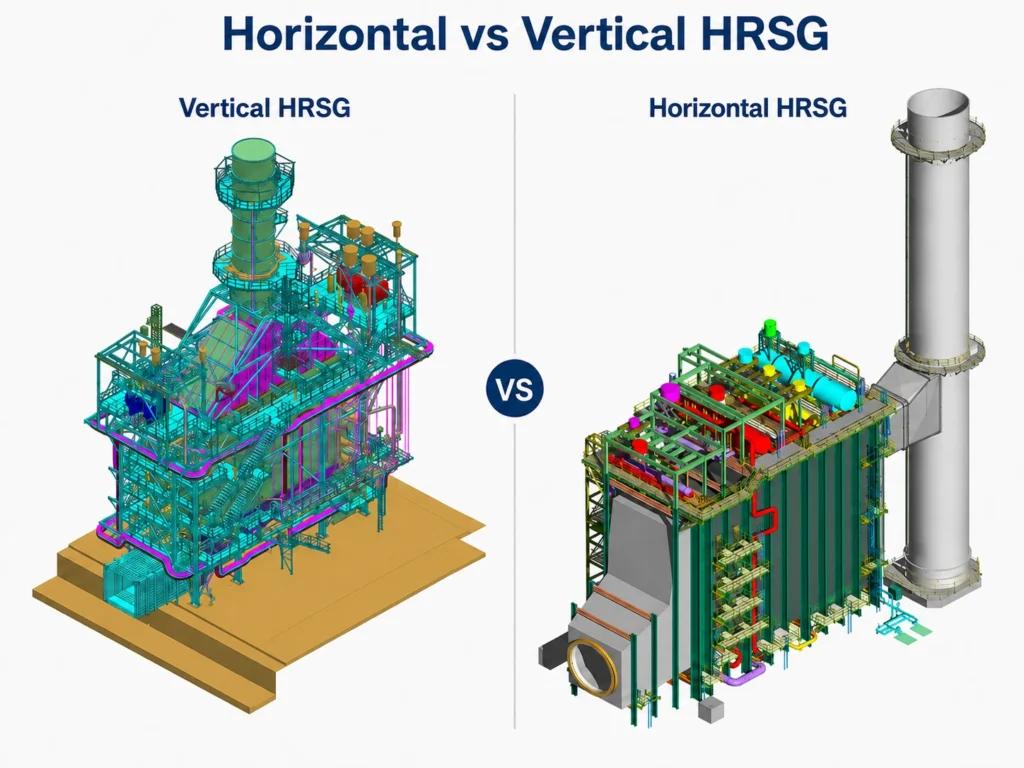
Horizontal vs Vertical HRSG
This choice mainly depends on site layout, equipment height and maintenance access.
| Comparison | Horizontal HRSG | Vertical HRSG |
|---|---|---|
| Gas-flow direction | Horizontal | Vertical |
| Typical tube direction | Vertical | Horizontal |
| Ground footprint | Usually larger | Usually smaller |
| Equipment height | Usually lower | Usually higher |
| Structural form | Long horizontal casing | Tall supporting structure |
| Main advantage | Common layout with flexible module options | Useful where ground space is limited |
| Main selection factor | Site length and side access | Height, lifting and platform access |
Horizontal HRSG and vertical HRSG describe the gas-flow direction. They do not define efficiency. The better option is the one that fits the site and maintenance plan.
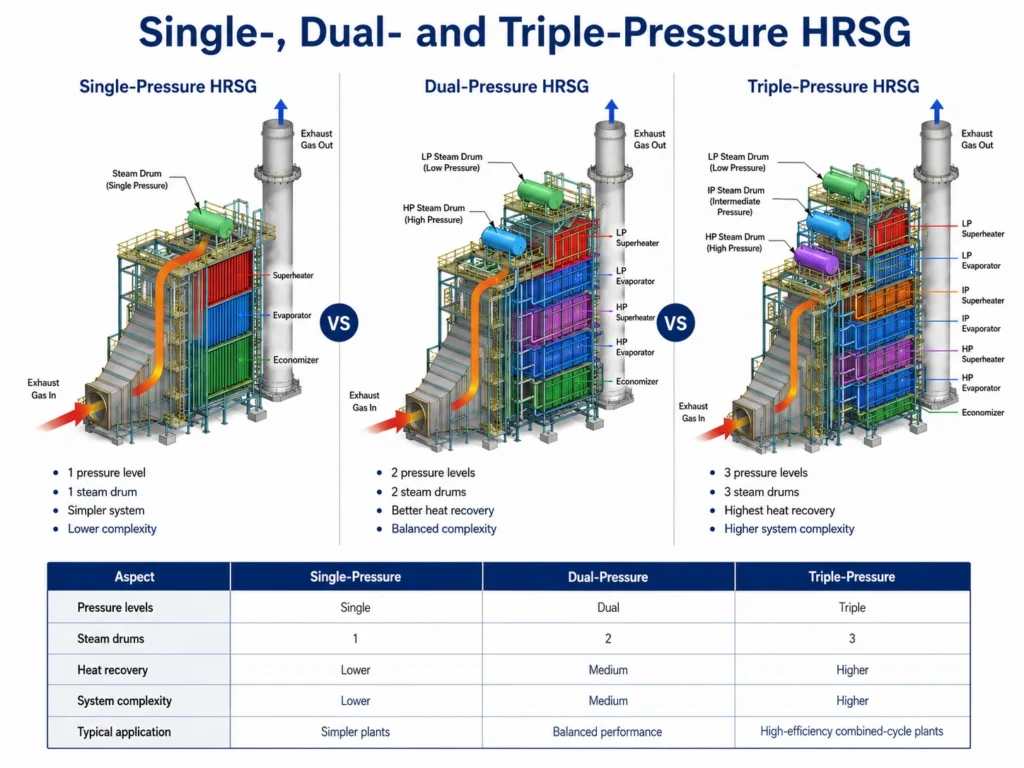
Single-, Dual- and Triple-Pressure HRSG
This choice depends on steam demand, power-cycle efficiency and project budget.
| Comparison | Single-Pressure | Dual-Pressure | Triple-Pressure |
|---|---|---|---|
| Steam pressure levels | One | Two | Three |
| Heat recovery | Basic | Higher | Highest |
| Equipment quantity | Lower | Medium | Higher |
| Control complexity | Lower | Medium | Higher |
| Capital cost | Lower | Medium | Higher |
| Typical fit | Industrial steam and small CHP projects | Medium CHP and combined-cycle projects | Large combined-cycle power plants |
More pressure levels recover heat across a wider exhaust temperature range. They also add drums, piping, controls and maintenance points.
An EPA-cited study found that dual-pressure systems reduced electricity cost by 3.6% compared with single-pressure systems. Triple-pressure systems reduced it by 4.9%. These figures are project-specific.
Unfired vs Supplementary-Fired HRSG
This choice depends on whether exhaust heat alone can meet the required steam output.
| Comparison | Unfired HRSG | Supplementary-Fired HRSG |
|---|---|---|
| Heat source | Gas turbine exhaust | Exhaust gas plus a duct burner |
| Additional fuel | Normally no | Yes |
| Steam output | Follows exhaust conditions | Can increase when demand rises |
| Operating flexibility | Closely linked to gas turbine load | Greater steam-output flexibility |
| Material temperature | Lower | Higher |
| Emission control | Simpler | More demanding |
| Typical fit | Heat recovery and power generation | Peak steam demand and CHP |
Supplementary-fired HRSG systems can increase steam output. They also increase fuel use, tube temperature and emission-control requirements.
The final design is usually a combination of these decisions. As with other types of boilers , one HRSG may be horizontal, drum-type, dual-pressure, and supplementary-fired at the same time.
Thermal design is only one part of the project. Transport, lifting, field welding and shutdown time can also change the final solution.
What Project Data Is Needed Before HRSG Design?
Reliable HRSG design starts with real operating data. A plant capacity or gas turbine model alone is not enough.
| Data Category | Information to Provide | Why It Matters |
|---|---|---|
| Exhaust source | Gas turbine model, exhaust flow, temperature and composition | Defines the available heat |
| Steam demand | Required steam flow, pressure and temperature | Defines the main HRSG duty |
| Feedwater | Inlet temperature, pressure and water quality | Affects heating-surface design |
| Operating profile | Base load, cycling frequency, startup time and load range | Affects flexibility and fatigue design |
| Pressure system | Single, dual or triple pressure; reheat requirement | Defines the steam-cycle arrangement |
| Firing requirement | Unfired or supplementary-fired operation | Affects steam output, fuel use and materials |
| Site conditions | Ambient temperature, altitude, layout and access | Affects performance and equipment arrangement |
| Delivery limits | Maximum transport size, module weight and crane capacity | Defines the modular fabrication plan |
| Codes and standards | ASME, PED, EN or local project requirements | Defines design, inspection and documentation |
| Retrofit data | Existing drawings, measurements, operating history and failure records | Defines the replacement or upgrade scope |
A megawatt rating alone cannot define the HRSG. The supplier also needs exhaust data, steam requirements, operating conditions and site limits. For retrofit projects, actual measurements are as important as the original drawings.
How Should You Compare HRSG Manufacturers and Suppliers?
The lowest price does not always mean the lowest project cost. Compare HRSG manufacturers by the risks they can remove from your project.
| Evaluation Area | What to Check | Why It Matters |
|---|---|---|
| Supply scope | Complete HRSG, modules, pressure parts or replacement sections | Prevents missing equipment and interface gaps |
| Engineering capability | Exhaust review, steam duty, material selection and module design | Ensures the unit matches real operating conditions |
| Manufacturing capability | Drums, headers, coils, finned tubes, casing and ducting | Confirms the supplier can build the required scope |
| Quality control | Material traceability, welding control, NDE and hydrotest | Reduces fabrication and approval risk |
| Modular delivery | Module size, trial assembly, transport and lifting plan | Reduces site work and installation delays |
| Retrofit support | Existing drawing review, measurements and replacement design | Helps fit new parts into an operating plant |
| Codes and documents | Applicable ASME, PED, EN or local requirements | Supports inspection, certification and handover |
| Project support | Technical clarification, interface review and delivery coordination | Reduces late changes and site conflicts |
Not all HRSG suppliers provide the same scope. Some deliver a complete system. Others focus on drums, headers, heating surfaces, modules or replacement pressure parts. Confirm the supply boundary before comparing quotations.
FAQ About HRSG Systems
Is an HRSG Boiler the Same as a Natural Gas Steam Generator?
No. An HRSG mainly uses gas turbine exhaust heat. A natural gas steam generator burns natural gas directly. An HRSG may use supplementary firing, but waste heat remains its main design basis.
Does an HRSG Produce Electricity?
Not directly. The HRSG produces steam. A steam turbine uses that steam to drive a generator and produce electricity.
Can an HRSG Work with a GE Steam Turbine?
Yes. The HRSG must match the required steam flow, pressure and temperature. Turbine brand alone is not enough. The project must also confirm startup, bypass, piping and control interfaces.
What Does Pegging Steam Mean?
Pegging steam supplies steam to the deaerator during startup or low-load operation. It maintains positive pressure, heats the feedwater and helps prevent air from entering the system.
Can an Existing HRSG Be Upgraded Without Replacing the Whole Unit?
Yes. Many projects replace only the damaged or outdated sections. These may include HARPs, headers, economizers, superheaters, finned tubes and other pressure parts. A condition review should define the final replacement scope.
Conclusion
An HRSG project starts with four clear inputs: exhaust conditions, steam demand, operating profile and site limits. These factors shape the pressure system, circulation type, firing method and module plan.
A good HRSG supplier should do more than build equipment. It should also review interfaces, delivery limits, inspection requirements and retrofit risks.
Share your project data with Gelan. We can help define the right equipment, pressure-part, module or replacement scope. Contact Gelan to discuss your HRSG requirements.