

As a newcomer to industrial process equipment and units, or a purchaser who is not familiar with atmospheric tanks, you may be wondering what an atmospheric tank is.
To help you understand it clearly and select the correct option for your application, I will explain everything you should know about atmospheric tanks, based on my 14 years of experience working in the global oil, gas, and petrochemical sectors.
After reading this guide, you can send your project requirements to Gelan for technical review and a detailed quotation. Gelan has been manufacturing atmospheric tanks for a wide range of industrial applications since 2016.
Part 1. What Is an Atmospheric Tank?
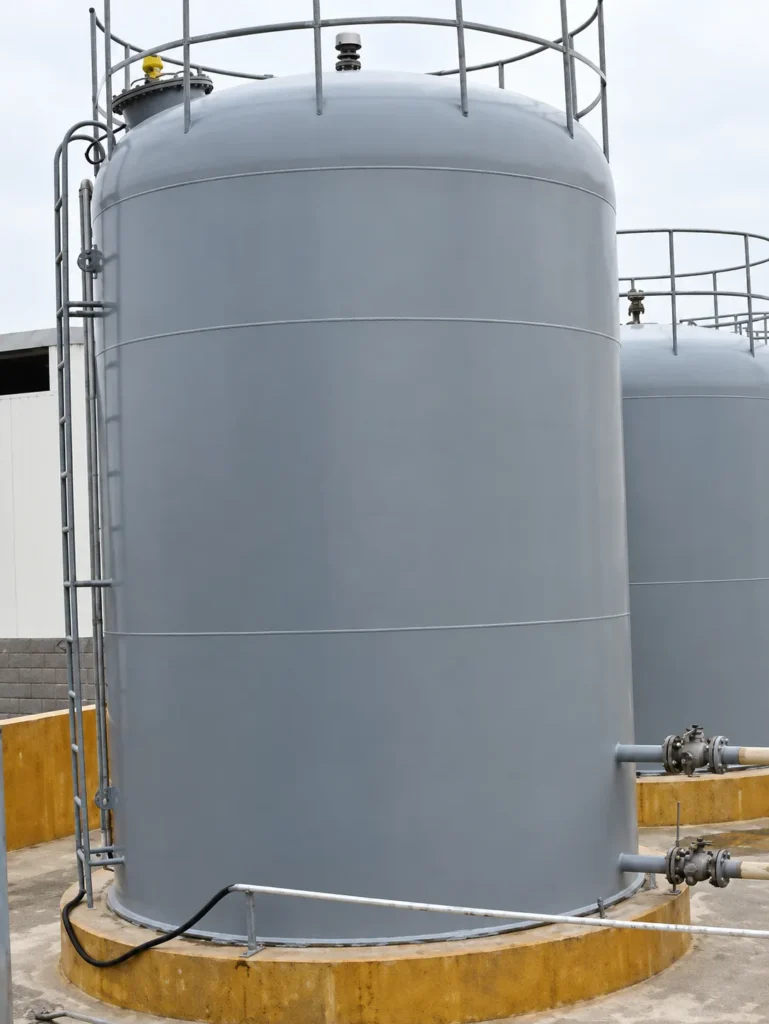
First of all, let’s have a look at the definition of an atmospheric tank. An atmospheric tank, also called an atmospheric storage tank, is designed to store liquids with the vapor space operating at or near ambient atmospheric pressure. This means that the internal pressure is normally close to zero gauge pressure, although the tank may experience a slight positive pressure or vacuum during filling, emptying, heating, cooling, or normal breathing.
Major Functions of Atmospheric Tank
From the definition, you can see that the primary function of an atmospheric tank is to store liquids. However, its function is not limited to storage. Depending on its design and installed components, an atmospheric tank may also perform the following functions:
- Liquid Storage: Store water, wastewater, raw materials, intermediate products and finished products under atmospheric or near-atmospheric pressure.
- Flow Buffering: Balance differences in the liquid flow rates between upstream and downstream processes.
- Inventory Management: Maintain the required liquid inventory for continuous production, transportation or sale.
- Settling and Separation: Allow suspended solids, water or other components with different densities to separate by gravity.
- Blending and Homogenization: Mix liquids or maintain a uniform composition using an agitator or circulation system.
- Thermal Conditioning: Maintain or adjust the liquid temperature using heating coils, cooling coils or other temperature-control systems.
What Does an Atmospheric Storage Tank Store?
The primary function of an atmospheric storage tank is to store liquids while operating at or near atmospheric pressure. Understanding which liquids can be stored is essential when selecting a suitable tank. Commonly stored liquids include:
- Crude oil
- Gasoline
- Diesel
- Fuel oil
- Lubricating oil
- Liquid chemicals
- Solvents
- Process water
- Potable water
- Wastewater
- Liquid feedstocks
- Intermediate products
- Finished liquid products
However, you should understand that not every atmospheric storage tank can store all the liquids listed above. Each tank is designed for specific liquids based on factors such as the properties of the liquid, tank type and structure, construction materials, corrosion resistance, operating temperature, safety requirements, and applicable standards.
What Are the Differences Between an Atmospheric Storage Tank, an Atmospheric Furnace and an Atmospheric Distillation Unit?
Now that you have a general understanding of atmospheric storage tanks, you may wonder about the relationships and differences among an atmospheric storage tank, an atmospheric furnace and an atmospheric distillation unit. You may also wonder whether they can all be involved in the same crude-oil distillation process. The answer is yes. However, an atmospheric storage tank is not used exclusively for crude-oil distillation.
Although all three terms contain the word “atmospheric,” the word does not have exactly the same meaning in each term.
In an atmospheric storage tank, “atmospheric” describes the tank’s operating pressure, which is at or near atmospheric pressure. The tank is primarily used to store liquids.
In an atmospheric furnace, “atmospheric” indicates that the furnace serves an atmospheric distillation unit. It does not mean that the crude oil inside the furnace tubes operates at atmospheric pressure. The furnace heats the crude oil to the temperature required for atmospheric distillation.
In an Atmospheric Distillation Unit, “atmospheric” means that the crude oil is distilled in an atmospheric distillation column operating at or near atmospheric pressure. The unit separates crude oil into different fractions according to their boiling ranges.
In a refinery, an atmospheric storage tank may store crude oil before processing. The crude oil is pumped from the storage tank through a series of heat exchangers and a desalter before entering the atmospheric furnace. The furnace heats and partially vaporizes the crude oil, which then enters the atmospheric distillation column for separation. After separation, the resulting fractions may undergo cooling, treatment or further processing before being transferred to atmospheric storage tanks where appropriate.
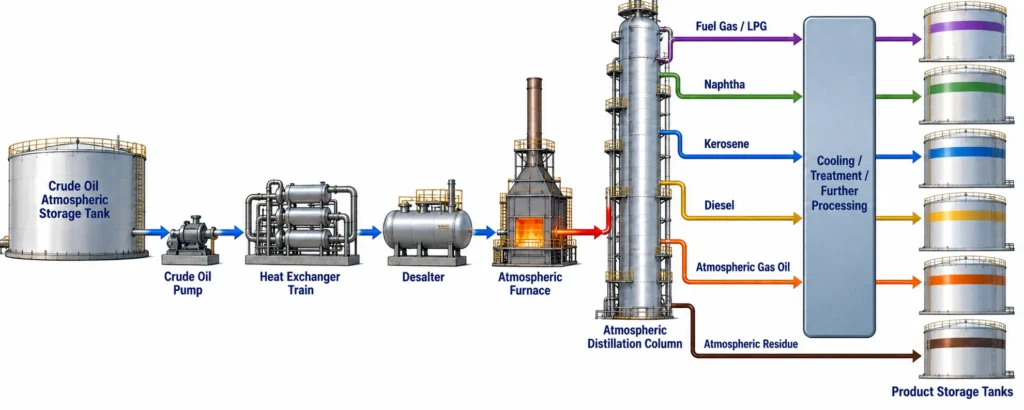
Therefore, an atmospheric storage tank and an atmospheric furnace may both be involved in the same crude-oil refining process, but the storage tank is not necessarily part of the Atmospheric Distillation Unit itself. Atmospheric storage tanks are also used for petroleum products, chemicals, industrial water, wastewater, liquid feedstocks and other suitable liquids.
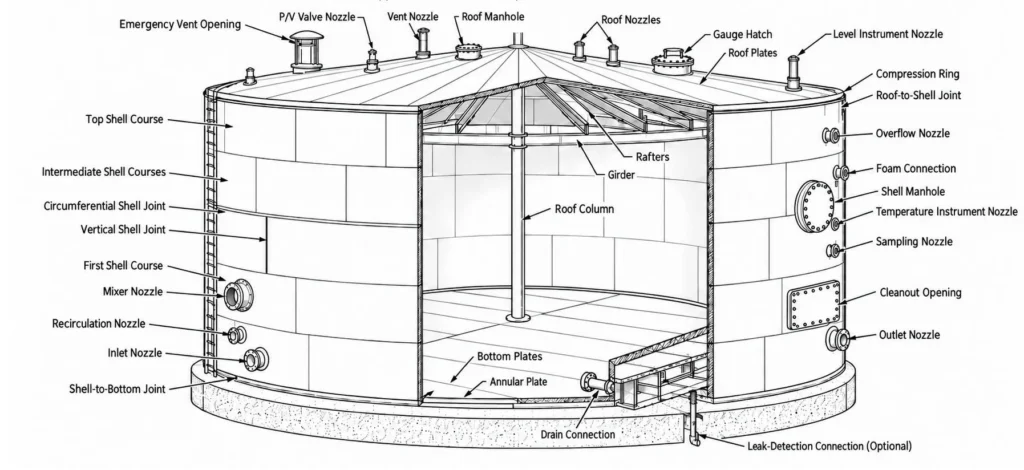
Major Components of an Atmospheric Storage Tank
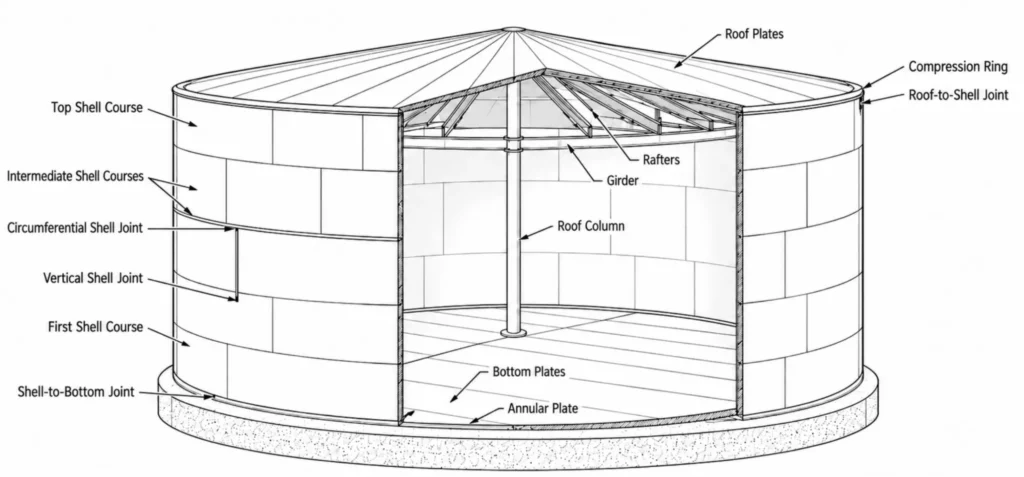
Understanding the major components of an atmospheric storage tank helps you understand how the tank is constructed and operated. It also enables you to check whether the required structural components, nozzles, openings and connections are included in a supplier’s quotation.
The exact configuration varies depending on the tank type, stored liquid, applicable standard and project requirements. However, the major components can generally be divided into two categories:
1. Main Structural Components
These components form the main load-bearing and containment structure of the tank:
- Bottom Plates: Form the base of the tank and contain the stored liquid.
- Annular Plates: Peripheral bottom plates installed beneath the tank shell where required by the design standard and tank configuration.
- Shell-to-Bottom Joint: The welded connection between the tank shell and bottom plates.
- First Shell Course: The lowest section of the tank shell, which generally carries the highest hydrostatic load.
- Intermediate Shell Courses: The shell sections located between the first and top shell courses.
- Top Shell Course: The uppermost section of the tank shell.
- Vertical Shell Joints: Welded joints connecting adjacent shell plates within the same shell course.
- Circumferential Shell Joints: Horizontal welded joints connecting one shell course to another.
- Roof Plates: Form the external covering of a fixed-roof tank.
- Rafters: Support the roof plates and transfer roof loads to the main supporting structure.
- Girders: Provide primary structural support for the roof framing where required.
- Roof Columns: Support the roof structure in column-supported fixed-roof tanks.
- Compression Ring: Strengthens the connection area between the roof and the upper section of the tank shell.
- Roof-to-Shell Joint: Connects the fixed roof to the tank shell.
2. Openings, Nozzles and Connections
These components allow the tank to receive, discharge, inspect, vent, measure and control the stored liquid:
- Inlet Nozzle: Allows the liquid to enter the tank.
- Outlet Nozzle: Allows the stored liquid to leave the tank.
- Drain Connection: Used to drain water, sediment or remaining liquid from the bottom of the tank.
- Overflow Nozzle: Provides an overflow route when the liquid exceeds the specified level, where required.
- Recirculation Nozzle: Connects the tank to a liquid circulation or mixing system.
- Shell Manhole: Provides personnel access to the inside of the tank for inspection, cleaning and maintenance.
- Cleanout Opening: Provides access for removing sludge and sediment from the tank bottom.
- Gauge Hatch: Provides access for manual gauging, sampling or inspection.
- Vent Nozzle: Connects the tank to an open vent or other normal venting device.
- Pressure/Vacuum Valve Nozzle: Provides the connection for a pressure/vacuum relief valve.
- Emergency Vent Opening: Provides emergency pressure relief under specified abnormal conditions.
- Mixer Nozzle: Supports or connects a tank mixer where mixing is required.
- Foam Connection: Allows firefighting foam to enter the tank or foam chamber system.
- Roof Nozzles: Provide roof-mounted connections for instruments, vents or other equipment.
- Roof Manhole: Provides access through the roof for inspection and maintenance.
- Level Instrument Nozzle: Provides a connection for level gauges, transmitters or level switches.
- Temperature Instrument Nozzle: Provides a connection for temperature-measuring devices.
- Sampling Nozzle: Provides a designated connection for collecting liquid samples.
- Leak-Detection Connections: Connect the tank bottom or double-bottom arrangement to a leak-detection system, where provided.
Part 2. Atmospheric Storage Tank Working Principle
After understanding the structure and major components of an atmospheric storage tank, you can better understand how it works.
When liquid enters the atmospheric storage tank, the liquid level rises and the vapor space above the liquid decreases. The air or vapor in the tank is displaced and released through the venting system, keeping the internal pressure within the allowable range.
After the liquid is stored in the tank, changes in the outside temperature can cause the liquid and vapor to expand or contract. When the temperature rises, the expanded air or vapor leaves the tank through the venting system. When the temperature falls, air, nitrogen or recovered vapor enters the tank to prevent excessive vacuum.
When liquid leaves the tank, the liquid level falls and the vapor space increases. Air, nitrogen or recovered vapor enters through the venting system to replace the discharged liquid volume and keep the internal pressure within the tank’s allowable range.
Part 3. Types of Atmospheric Storage Tanks
Atmospheric storage tanks can be classified according to different criteria. One of the main classifications is based on the tank roof structure. According to the roof structure, atmospheric storage tanks can be divided into four main types.
Fixed Roof Tank
A fixed roof tank has a permanent roof attached to the top of the tank shell. The roof does not move as the liquid level rises or falls. The tank is normally equipped with vents to allow air and vapor to enter or leave the tank while keeping the internal pressure within the allowable range.
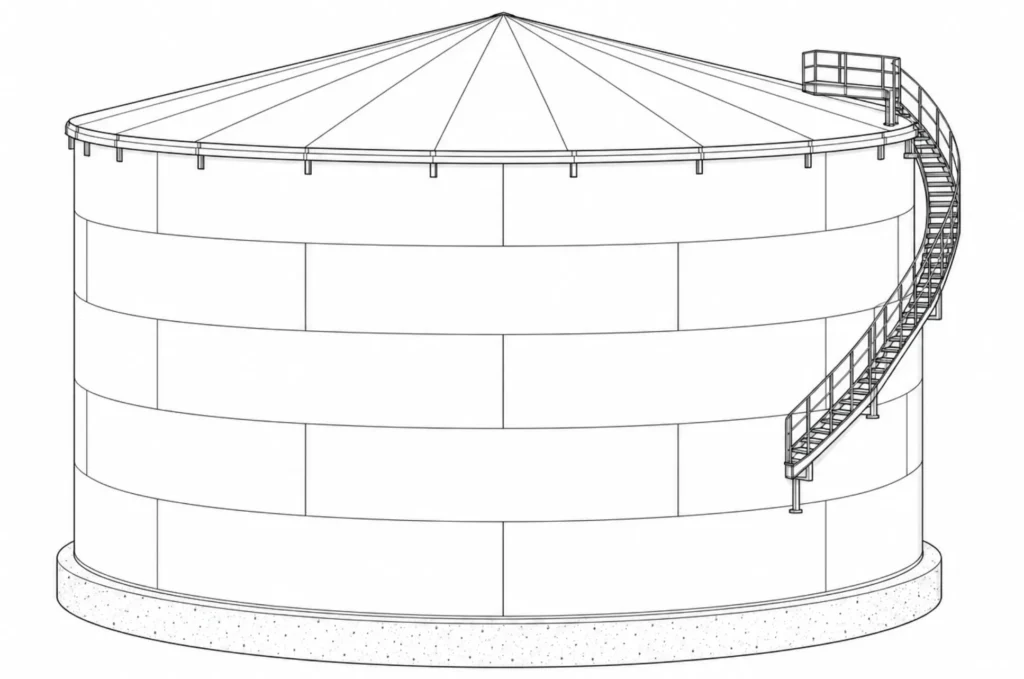
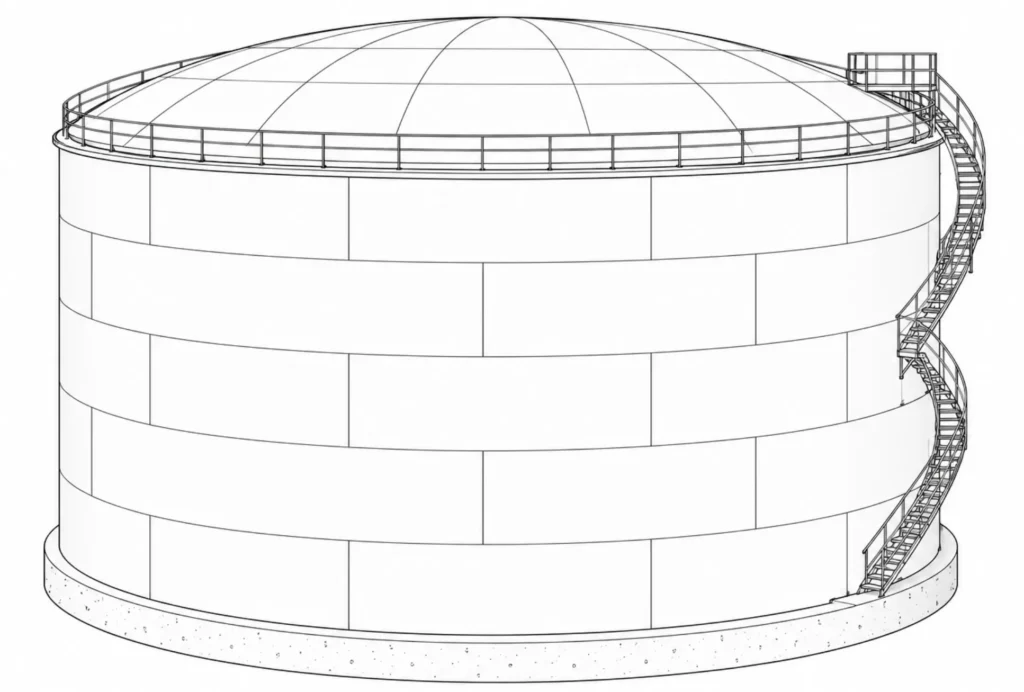
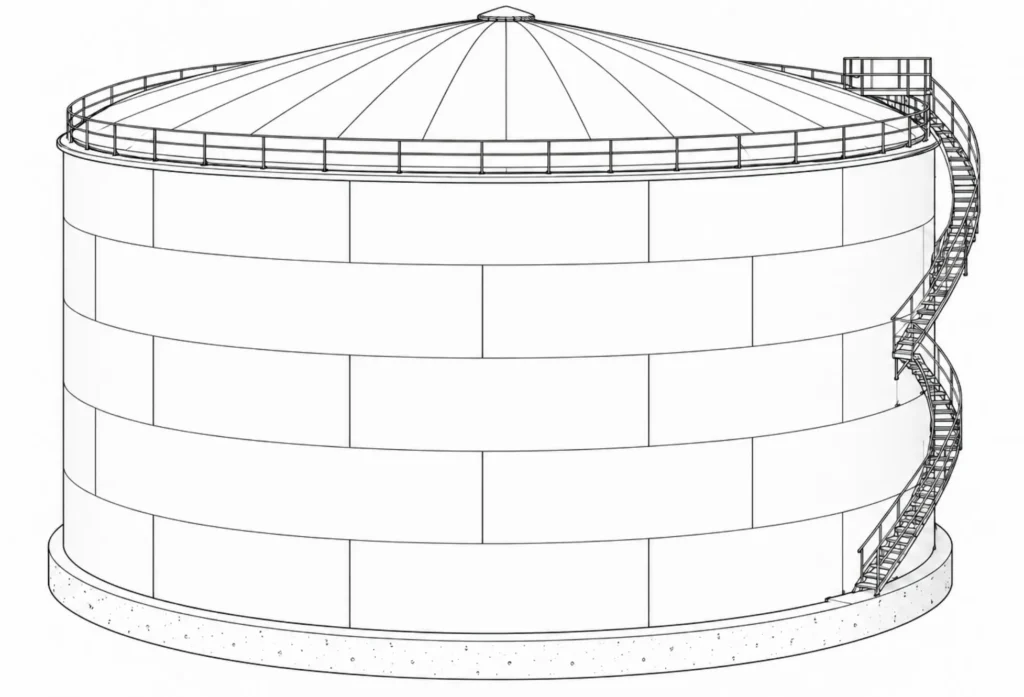
Based on the roof shape, fixed roof tanks can be divided into:
- Cone Roof Tank
- Dome Roof Tank
- Umbrella Roof Tank
Advantages:
This type of atmospheric storage tank has the following advantages:
- Simple Structure and Easy Installation: The fixed roof has a relatively simple structure, making the tank easier to design, manufacture and install.
- Cost-Effective: Its simple structure generally requires less material, labor and installation time than a floating roof system.
- Better Protection: The enclosed roof helps protect the stored liquid from rain, dust, debris and other external contaminants.
- Easy Maintenance: The roof structure and related components are generally easy to inspect and maintain.
Used For:
This type of atmospheric storage tank is suitable for storing liquids with relatively low volatility or liquids whose vapor emissions can be safely controlled, including:
- Water and wastewater
- Diesel and fuel oil
- Lubricating oil
- Heavy petroleum products
- Liquid chemicals
- Raw materials and intermediate products
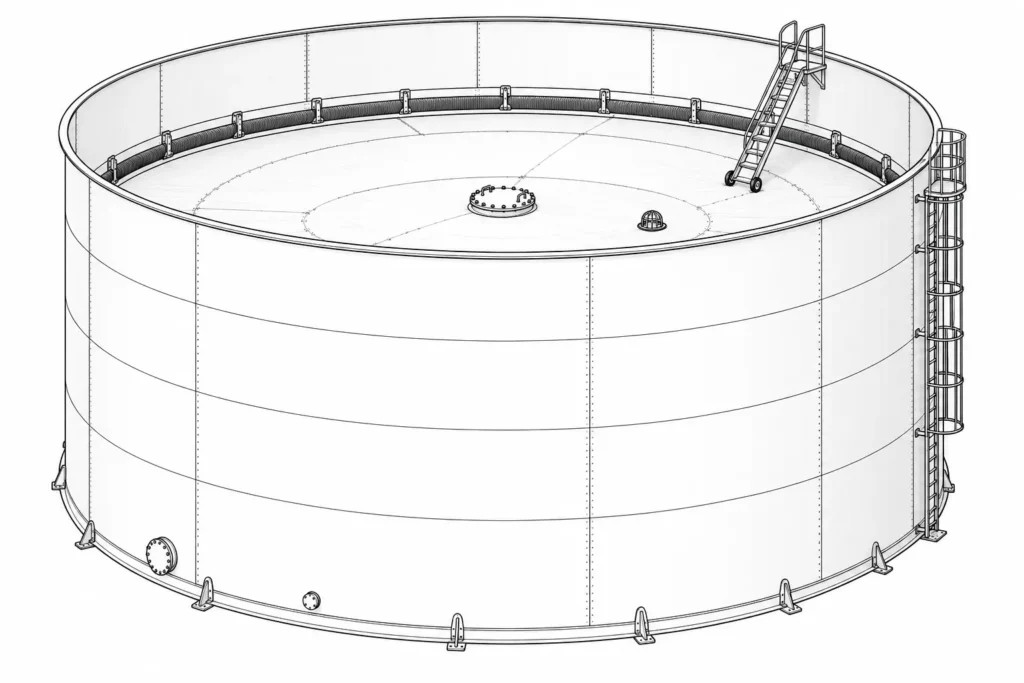
External Floating Roof Tank
An external floating roof tank has a floating roof that rests directly on the liquid surface. The roof moves up and down as the liquid level changes.
Advantages:
- Reduced Evaporation Losses: The floating roof minimizes the vapor space above the stored liquid, helping reduce product loss caused by evaporation.
- Lower Vapor Emissions: It limits the release of hydrocarbon vapors into the atmosphere.
- Suitable for Large Storage Volumes: External floating roof tanks are widely used for the bulk storage of volatile petroleum products.
Used For:
External floating roof tanks are commonly used for storing large quantities of volatile petroleum products, such as:
- Crude oil
- Gasoline
- Naphtha
- Condensate
- Other volatile hydrocarbon liquids
Internal Floating Roof Tank
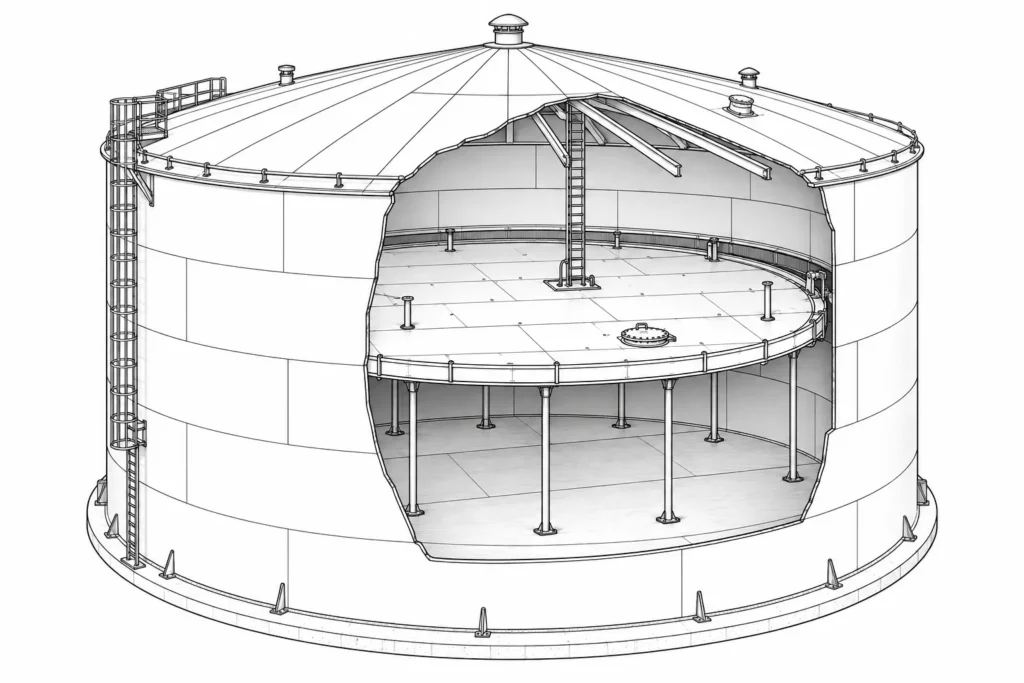
An internal floating roof tank has both a fixed outer roof and an internal floating deck. The internal deck rests on the liquid surface and moves up and down as the liquid level changes.
Advantages:
This design combines some of the advantages of fixed roof tanks and external floating roof tanks:
- Reduced Evaporation Losses: The internal floating roof minimizes the vapor space above the liquid and helps reduce product loss.
- Lower Vapor Emissions: It helps control the release of volatile organic compounds.
- Better Protection: The fixed outer roof protects the floating deck and stored liquid from rain, snow, wind, dust and other external contaminants.
- Reduced Weather Exposure: The internal floating roof and sealing system are less exposed to harsh weather conditions.
Used For:
Internal floating roof tanks are commonly used for volatile or contamination-sensitive liquids, including:
- Gasoline
- Naphtha
- Aviation fuel
- Solvents
- Light petroleum products
- Certain volatile chemicals
Open-Top Tank
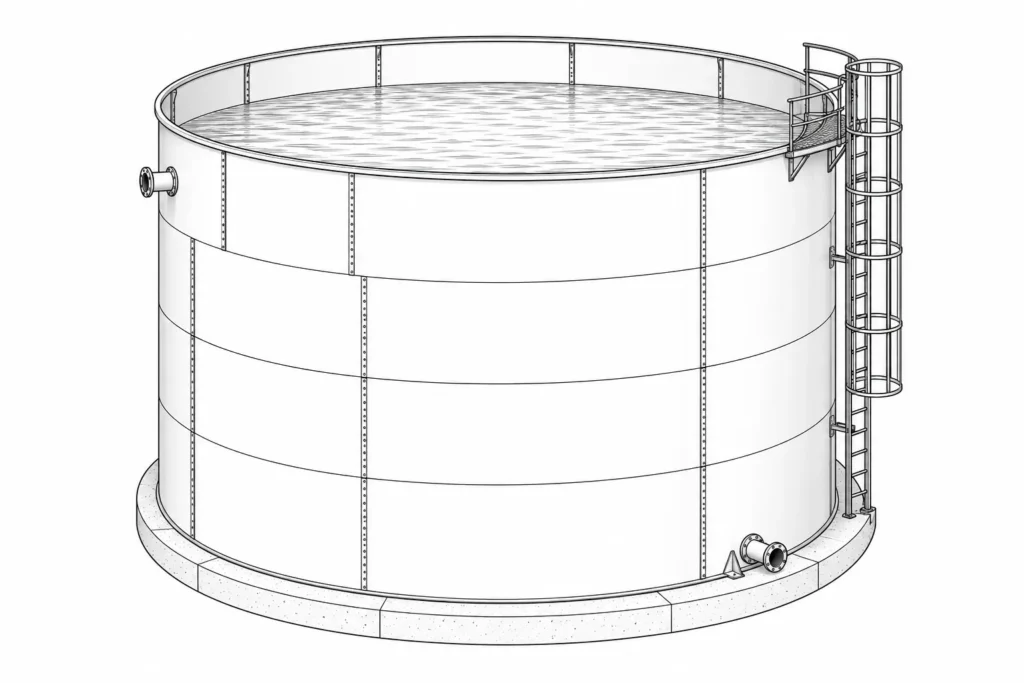
An open-top tank is a storage or process tank without a roof. The stored liquid is directly exposed to the surrounding environment.
Advantages:
Low Cost and Simple Structure: Without a roof system, the tank is generally easier and less expensive to manufacture and install.
Easy Access: The open design provides convenient access for inspection, cleaning, mixing and other operations.
Suitable for Process Operations: It can be used for applications that require frequent access to the liquid or direct installation of mixing equipment.
Used For:
Open-top tanks are generally used for non-volatile and non-flammable liquids or process applications, such as:
- Water treatment
- Wastewater treatment
- Mixing and blending
- Settling and clarification
- Cooling water
- Non-potable water storage
- Non-volatile process liquids
Part 4. Materials of Atmospheric Storage Tanks
In addition to selecting the type of atmospheric storage tank, it is also important to choose the correct material for your application. The main materials used for atmospheric storage tanks are listed below.
Carbon Steel
Carbon steel has good mechanical strength to withstand the hydrostatic pressure generated by the stored liquid. It also has good weldability and can be easily cut, rolled, formed, welded and repaired.
However, carbon steel can corrode and may not be suitable for low-temperature applications unless a suitable grade is selected.
Main Uses of Carbon Steel in Atmospheric Storage Tanks:
Carbon steel is mainly used for the following parts of an atmospheric storage tank:
- Tank Bottom Plates
- Annular Plates
- Tank Shell Plates
- Roof Plates
- Roof Supporting Structures, including Rafters, Girders and Columns
- Compression Rings and Top Angles
- Nozzles and Manholes
- Stairways, Ladders and Platforms
- Wind Girders and Stiffening Rings
- Anchor Chairs and Other Structural Attachments
Stainless Steel
Compared with carbon steel, stainless steel offers better corrosion resistance and performs well in many water, chemical and outdoor environments. At the same time, it offers good weldability and fabricability and can be cut, formed and welded.
Main Uses of Stainless Steel in Atmospheric Storage Tanks:
Stainless steel is mainly used for:
- Tank Bottom Plates
- Annular Plates
- Tank Shell Plates
- Roof Plates
- Floating Roofs and Internal Floating Decks
- Nozzles and Process Connections
- Manholes and Cleanout Openings
- Internal Pipes and Tank Internals
- Heating or Cooling Coils
- Ladders, Platforms and Other Attachments
- Fasteners and Metallic Components of Gaskets
- Internal Linings or Cladding on Carbon Steel Tanks
Low-Alloy Steel
Low-alloy steel has higher mechanical strength than conventional carbon steel and can perform better at low temperatures. It may also provide better corrosion resistance than carbon steel.
However, it has a higher cost, and some grades require special welding procedures.
Main Uses of Low-Alloy Steel in Atmospheric Storage Tanks:
Low-alloy steel is mainly used for:
- Tank Shell Plates
- Tank Bottom Plates
- Annular Plates
- Roof Plates
- Nozzles and Manholes
- Reinforcing Plates
- Compression Rings and Stiffening Rings
- Structural Supports and Attachments
- Low-Temperature Tank Components
- Selected Parts Requiring Higher Strength or Improved Toughness
Aluminum
Aluminum is lightweight and offers good corrosion resistance and low-temperature performance. It is also easy to form.
However, it requires suitable welding conditions and procedures. It also has lower strength and stiffness than steel and generally has a higher cost than carbon steel.
Main Uses of Aluminum in Atmospheric Storage Tanks:
Aluminum is mainly used for:
- Internal Floating Roofs
- External Floating Roof Components
- Aluminum Geodesic Dome Roofs
- Roof Panels and Supporting Structures
- Floating-Roof Pontoons and Decks
- Roof Access Hatches and Gauge Hatches
- Ladders, Walkways and Platforms
- Tank Internals and Selected Process Connections
- Small Tank Shells, Bottoms and Roofs
- Selected Components for Refrigerated Storage Tanks
FRP
FRP has excellent corrosion resistance and can resist many acids, alkalis, salts and other corrosive chemicals. It is lightweight, does not rust and provides good thermal insulation. Its resin system and internal corrosion barrier can also be selected according to the application.
However, FRP has limited temperature resistance. It may be more vulnerable to mechanical impact and handling damage than steel. It also has limitations related to UV exposure and fire resistance.
Main Uses of FRP in Atmospheric Storage Tanks:
FRP may be used for:
- Tank Shells
- Tank Bottoms
- Tank Roofs and Covers
- Nozzles and Flanged Connections
- Manholes and Inspection Openings
- Internal Pipes and Tank Internals
- Ladders, Platforms and Handrails
- Internal Corrosion-Resistant Linings
- Scrubbers and Connected Chemical-Process Components
- Complete Small- and Medium-Capacity Atmospheric Storage Tanks
Lined Carbon Steel
Lined carbon steel combines the structural strength and cost advantages of carbon steel with an internal lining that protects the steel from the stored liquid.
It offers good structural strength and better corrosion resistance than unlined carbon steel. It is suitable for storing corrosive liquids and can be fabricated using conventional cutting, rolling and welding processes before the lining is applied.
However, it requires proper cleaning and surface preparation. It is also sensitive to lining damage and has temperature and chemical limitations.
Main Uses of Lined Carbon Steel in Atmospheric Storage Tanks:
Lined carbon steel may be used for:
- Tank Shell Plates
- Tank Bottom Plates
- Annular Plates
- Roof Plates
- Internal Wetted Surfaces
- Nozzles and Process Connections
- Manholes and Cleanout Openings
- Internal Pipes and Tank Internals
- Heating or Cooling Coil Supports
- Other Components Exposed to the Stored Liquid
The materials listed above are only the major materials used for atmospheric storage tanks. Many other materials may also be used, and each material is available in different grades. When selecting a tank material, the correct material grade should be confirmed based on the specific application and operating conditions.
Part 5. Standards of an Atmospheric Tank
When talking with an engineer or purchasing an atmospheric storage tank, you will often hear about tank standards. So, what are these standards, and which standard should an atmospheric storage tank follow?
Atmospheric storage tank standards are the rules and technical requirements that should be followed during tank design, manufacturing, installation, inspection, operation and repair.
The most commonly used standards for atmospheric storage tanks include:
- API 650: For vertical, cylindrical, aboveground welded steel tanks used to store oil and other liquids at or near atmospheric pressure.
- EN 14015: For site-built, vertical, cylindrical, flat-bottomed, aboveground welded steel tanks used to store liquids at ambient or elevated temperatures.
- UL 142: For shop-fabricated steel aboveground tanks used to store stable, non-corrosive, flammable and combustible liquids.
- AWWA D100: For welded carbon steel tanks used to store water at atmospheric pressure.
- AWWA D103: For factory-coated, bolted carbon steel tanks used to store water.
- AWWA D120: For thermosetting fiberglass-reinforced plastic tanks used to store water.
These are only some of the standards used for atmospheric storage tanks. The same type of atmospheric tank may need to follow different standards depending on its application and installation location. Therefore, if you are purchasing a tank for a project, you should confirm the applicable standard with the project engineer and clearly specify it when requesting a quotation.
Part 6. What Are the Key Differences Between an Atmospheric Tank and a Pressure Tank?
Now that you have a clear understanding of atmospheric storage tanks, you may notice that pressure tanks are often mentioned alongside them. Although both are used to contain fluids, they differ significantly in operating pressure, design, structure and safety requirements.
The following table summarizes their main differences:
| Comparison Item | Atmospheric Tank | Pressure Tank |
|---|---|---|
| Primary Purpose | Primarily used for the bulk storage of liquids at or near atmospheric pressure | Used to contain, store or process liquids, gases or vapors under pressure |
| Typical Fluids | Crude oil, petroleum products, water, wastewater and compatible liquid chemicals | Compressed gases, liquefied gases, vapors and pressurized process fluids |
| Operating Pressure | Normally operates at or near atmospheric pressure, with only limited positive pressure or vacuum as permitted by the tank design | Designed to operate at a defined internal or external pressure above or below atmospheric pressure |
| Common Standards | API 650, EN 14015, UL 142 or applicable AWWA standards, depending on tank type and service | ASME Section VIII, EN 13445 or PD 5500, depending on the project and jurisdiction |
| Pressure Protection | Normally uses open vents, pressure-vacuum vents and emergency venting to prevent excessive pressure or vacuum | Uses pressure-relief devices such as safety valves or rupture discs, as required by the design code |
| Main Safety Risks | Overfilling, leakage, fire, vapor emissions, corrosion and shell or roof damage caused by excessive pressure, vacuum or external loads | Overpressure, leakage, fatigue, brittle fracture and sudden rupture involving the rapid release of stored energy |
| Typical Structure | Usually a large-diameter, relatively thin-walled vertical cylindrical tank with a fixed or floating roof | Usually cylindrical or spherical, with thicker pressure-retaining walls and formed heads |
| Bottom and Support | Usually has a flat bottom supported directly by a prepared foundation | Commonly supported by skirts, saddles or legs, depending on vessel orientation and design |
| Design Focus | Hydrostatic liquid load, settlement, wind, seismic load, corrosion, venting and environmental control | Internal or external pressure, temperature, cyclic loading, material strength, weld integrity and pressure relief |
From the table, you can see that the main difference between an atmospheric storage tank and a pressure tank is their design and operating pressure. They also differ in their applications, structural design, safety requirements and applicable standards. Therefore, they are two distinct types of equipment and should not be used interchangeably.
Ending Note
Now, you know that an atmospheric storage tank is used to store liquids at or near atmospheric pressure. It can be used as part of an atmospheric distillation unit and in many other applications. Moreover, you now understand its working principle, types, materials, standards and differences from a pressure tank.
If you are planning to purchase an atmospheric storage tank, contact Gelan directly. Gelan has manufactured atmospheric storage tanks for different applications since 2016.