

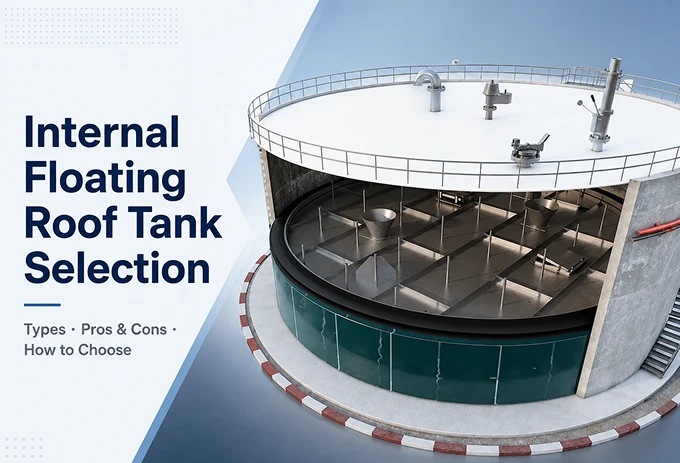
An internal floating roof tank is widely used for volatile liquids in refineries and petrochemical facilities. The floating deck moves with the liquid level and helps reduce evaporative losses and VOC emissions. It is also commonly added to existing fixed-roof tanks as a retrofit solution.
However, not every floating roof tank should use the same internal roof design. Different roof types vary in strength, sealing, installation, maintenance, and long-term reliability. For an internal floating roof storage tank, choosing the right design is therefore an important part of safe and stable operation.
CONTENT:
- What Is an Internal Floating Roof Tank
- Types of Internal Floating Roofs
- Advantages and Disadvantages of Different Internal Floating Roof Types
- How to Select the Right Internal Floating Roof
- FAQ About Internal Floating Roof Tanks
- Conclusion
What Is an Internal Floating Roof Tank
An internal floating roof tank is a fixed-roof storage tank with a floating deck installed inside. The deck sits on or close to the liquid surface and moves with the liquid level. This reduces the vapor space above the stored product and helps control evaporation and VOC emissions. The fixed outer roof remains in place and protects the internal deck from wind and weather.
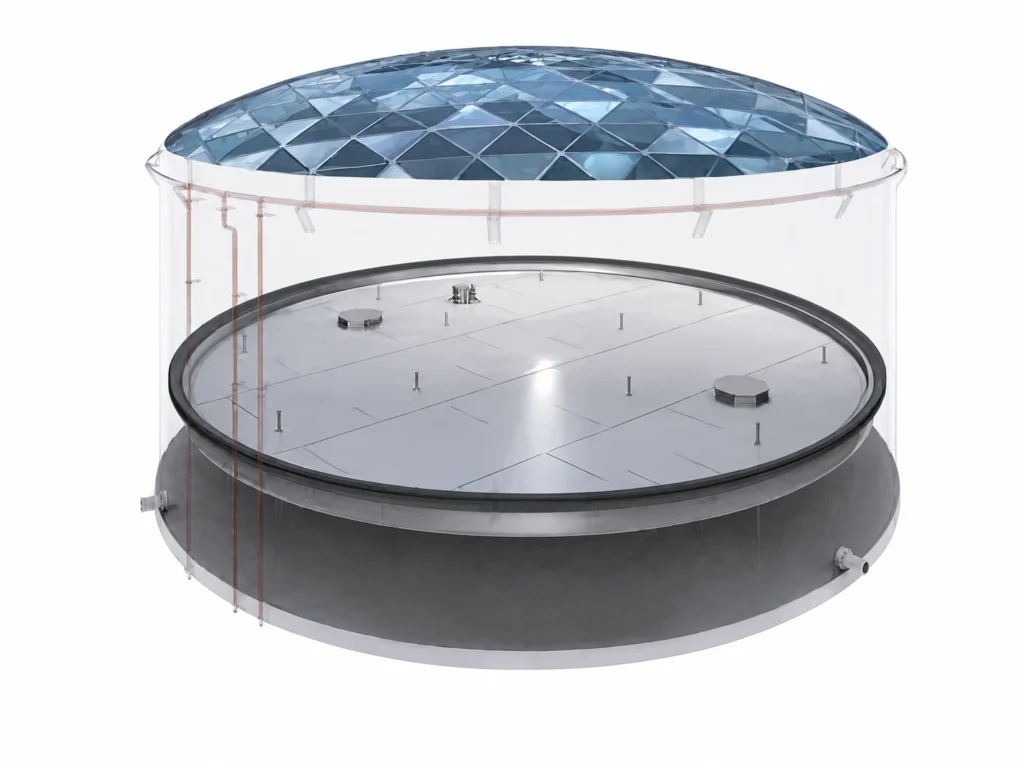
This arrangement also distinguishes an internal floating roof from other common tank designs. A conventional fixed-roof tank has no floating deck, while an external floating roof is exposed directly to the atmosphere. In storage tank projects, this basic configuration is usually the first point to confirm before selecting the roof structure. The next step is to understand the main internal floating roof types and how they differ.
Types of Internal Floating Roofs
Internal floating roofs can be classified by deck structure and material. For project comparison, the deck structure is usually the more useful starting point because it directly affects buoyancy, rigidity, liquid contact, and installation.
The main internal floating roof types include:
- Single-deck internal floating roof: A single central deck with buoyant compartments around the perimeter.
- Double-deck internal floating roof: Two deck plates with enclosed compartments between them.
- Pontoon-type internal floating roof: An assembled deck supported by pontoons. It is often used where easier installation or retrofit is required.
- Box-type internal floating roof: Assembled from multiple buoyant box sections connected together.
- Honeycomb / full-contact internal floating roof: Assembled panels form a continuous deck that stays in close contact with the liquid surface.
A steel internal floating roof is common in single-deck and double-deck designs, while a stainless steel internal floating roof or aluminum design can be used for assembled systems. In our project discussions, we normally look at the structure first and then the material. The same material can perform very differently when used in a different roof design. This is why roof type, not material alone, should be the starting point for comparison.
Advantages and Disadvantages of Different Internal Floating Roof Types
Single-Deck Internal Floating Roof
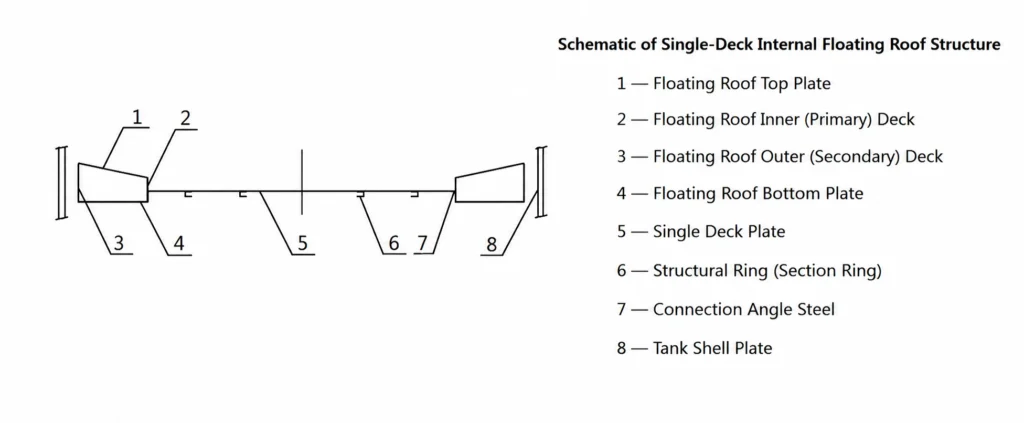
A single-deck internal floating roof normally uses a steel deck with a sealed annular compartment around the perimeter. The center remains a single deck plate.
Advantages: The welded steel structure gives the roof relatively good stability and strength. It is less prone to deformation and leakage during operation. It is also easier to inspect and maintain. For tank-wide internal coating work, the steel deck provides a more practical working base. Foam dam installation is also easier. With proper corrosion protection, this type can offer a long service life and relatively low life-cycle cost.
Disadvantages: Installation is less convenient for an existing tank. A temporary opening may be needed in the tank shell, and on-site work is more complex. Carbon steel roofs also require corrosion protection. In addition, a small vapor space remains below the deck during operation.
Double-Deck Internal Floating Roof
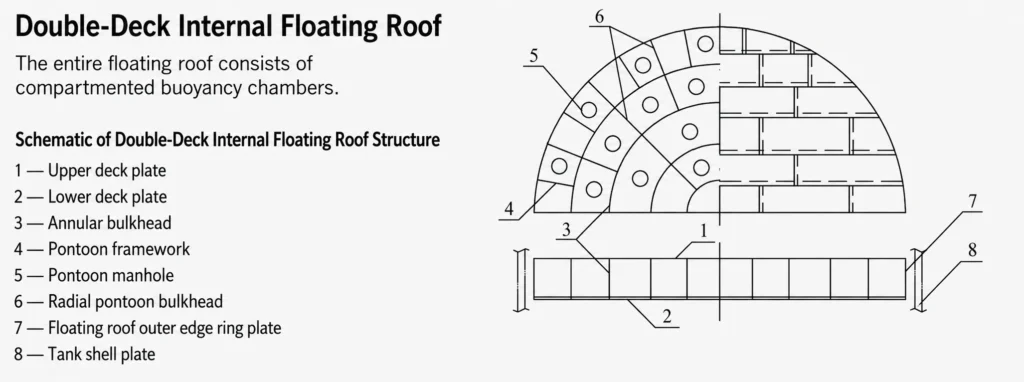
A double-deck internal floating roof is usually made of steel. Unlike a single-deck design, the entire roof is formed by enclosed compartments. This gives the roof higher rigidity and better overall stability.
Advantages: Among the common steel designs, the double-deck roof provides the highest structural strength and good resistance to vapor impact. It is less likely to deform or leak, and its enclosed structure can largely eliminate vapor space below the roof during operation. Inspection, maintenance, internal coating work, and foam dam installation are also relatively convenient. Its long service life helps keep life-cycle cost under control.
Disadvantages: The stronger structure also brings more fabrication and installation work. For existing tanks, large sections are difficult to install through normal access points, so additional construction access may be required. The double-deck arrangement also takes more time to fabricate and assemble than a single-deck roof. If carbon steel is used, corrosion protection adds another step to the construction schedule.
Pontoon-Type Internal Floating Roof
A pontoon-type internal floating roof is an assembled design and is commonly made of aluminum alloy or stainless steel. Its buoyancy comes mainly from separate pontoons, while the deck itself does not fully contact the liquid surface.
Advantages: Its biggest advantage is installation efficiency. The modular structure is easier to bring into an existing tank and can shorten the retrofit period. In our project discussions, this is usually the main reason to consider a pontoon-type roof for an in-service tank. Its overall life-cycle cost can also be reasonable, especially when used with carbon steel tanks.
Disadvantages: The lightweight assembled structure has lower strength than welded steel roofs and is more sensitive to vapor impact. Deformation and leakage are therefore more likely over long-term operation. The roof may also need to be removed during major internal coating work. Its shorter service life and limited rigidity can make effective foam dam installation more difficult. A vapor space also remains below the deck during operation.
Box-Type Internal Floating Roof
A box-type internal floating roof is also an assembled design and is commonly made of aluminum alloy or stainless steel. Its buoyancy comes from multiple connected box sections, which form the main floating structure.
Advantages: The modular design makes installation relatively fast, especially for existing tanks. Compared with pontoon-type roofs, the box sections can reduce the vapor space below the roof because more of the deck stays close to the liquid surface. Its overall life-cycle cost can also remain moderate.
Disadvantages: The main concern is structural reliability. Each box is connected to the next by bolts and sealing materials, so every joint becomes a potential weak point. Deformation or seal failure can lead to leakage during operation. The roof may also need to be removed during major internal coating work. Its relatively low rigidity can make foam dam installation more difficult, and its service life is generally shorter than that of welded steel roofs.
Honeycomb / Full-Contact Internal Floating Roof
A full-contact honeycomb internal floating roof combines features of a double-deck roof with an assembled structure. It is usually made of aluminum alloy or stainless steel panels, and the deck stays in close contact with the liquid surface.
Advantages: The main benefit is installation speed. The assembled panels are easier to install in an existing tank, while the full-contact structure can largely eliminate vapor space below the roof during operation. This makes it attractive for retrofit projects where installation time is an important concern.
Disadvantages: The main concern is structural stability. The roof consists of multiple assembled panels, so the joints become permanent sealing points. Deformation can affect these connections and increase the risk of leakage. Foam dam installation is also more difficult when the roof lacks sufficient rigidity. If the upper or lower sealing layer fails or separates, repair can be difficult. The roof may also need to be removed during major internal coating work, and its life-cycle cost can become relatively high.
How to Select the Right Internal Floating Roof
For internal floating roof selection, we narrow the choice by tank size, material, and operating condition.
- Steel double-deck roof: This is our preferred option for new tanks, tanks above 10,000 m³ nominal capacity, and tanks where corrosion or long-term structural reliability is a major concern. Its higher strength, full-contact structure, and lower risk of deformation make it the more conservative choice for demanding service.
- Steel single-deck roof: For carbon steel tanks below 10,000 m³, a single-deck roof is often a more balanced option. It provides sufficient strength for many applications while keeping fabrication and overall cost lower than a double-deck design.
- Stainless steel pontoon-type roof: For stainless steel tanks below 5,000 m³ that store relatively clean and less corrosive liquids, a pontoon-type roof can be considered. Its main advantage is easier installation, especially when the tank is already in service.
These figures are used here as Gelan’s practical selection references. They should still be checked against the project specification, stored product, tank geometry, and the applicable international code before final design.
FAQ About Internal Floating Roof Tanks
What Is the Difference Between an Internal and External Floating Roof Tank?
An internal floating roof operates inside a fixed-roof tank, while an external floating roof is directly exposed to the atmosphere. Both move with the liquid level, but their structure, weather exposure, and fire protection requirements are different.
Can an Existing Fixed-Roof Tank Be Retrofitted with an Internal Floating Roof?
Yes. An existing fixed-roof tank can be retrofitted with an internal floating roof if the tank structure and operating conditions allow it. Assembled pontoon, box-type, and honeycomb roofs are often easier to install where access is limited. Internal floating roofs are also widely used to reduce evaporative losses from existing fixed-roof tanks.
What Does API 650 Say About Internal Floating Roofs?
API 650 covers internal floating roofs in Annex H. It provides requirements for the design and construction of internal floating roofs used in API 650 storage tanks.
Can an Internal Floating Roof Tank Use Nitrogen Blanketing?
Yes, nitrogen blanketing can be used when required by the stored product, process conditions, or project safety requirements. It is an additional protection measure and does not replace proper floating roof selection.
What Causes an Internal Floating Roof to Sink?
Loss of buoyancy, leakage, severe deformation, or abnormal vapor impact can cause an internal floating roof to lose stability or sink. Roof strength and the integrity of pontoons, compartments, panels, and joints are therefore important for long-term operation.
How Should an Internal Floating Roof Be Inspected?
The roof should be checked for corrosion, deformation, leakage, damaged seals, and problems with buoyancy components or deck joints. API 653 provides requirements for maintaining tank integrity, while API RP 575 gives additional guidance for atmospheric storage tank inspection.
Which Material Is Best for an Internal Floating Roof?
There is no single best material for every tank. Steel is generally preferred where structural strength and long service life are the priority. Stainless steel can be considered for corrosive service, while aluminum assembled roofs can offer easier installation for retrofit projects.
What Fire Protection Is Used for an Internal Floating Roof Tank?
Fire protection depends on the floating roof structure and the applicable project standard. Steel single-deck and double-deck roofs can more easily support foam dam arrangements, while lightweight assembled roofs may require a different protection approach. NFPA 11 specifically addresses foam protection for outdoor covered internal floating roof tanks.
Conclusion
The right internal floating roof depends on tank size, stored liquid, structure, and long-term operating needs. For Gelan, selection should focus on safety, reliability, maintenance, and life-cycle cost rather than initial price alone.