

TL;DR
- •There is no single list of boiler types. Boilers are classified by tube arrangement, heat source, circulation, steam condition, and construction.
- •Fire-tube and water-tube are the two main structural types. Waste heat boilers and HRSGs recover heat from exhaust or process gas.
- •The right boiler depends on steam duty, heat-source conditions, operating range, and site limits. Gelan supports custom boiler design for industrial projects.
Across the refinery, petrochemical, hydrogen, and energy projects I have supported at Gelan, one question often comes first: Which boiler type fits the project?
The answer is rarely one name. A boiler can be water-tube, waste-heat, drum-type, and modular at the same time. Each term describes a different part of the design.
This guide explains the main types of boilers, their classifications, and their industrial applications. It focuses on industrial boilers used in refining, petrochemical processing, hydrogen production, waste heat recovery, and power systems.
CONTENT:
- What Is an Industrial Boiler and How Does It Work?
- How Are the Different Types of Boilers Classified?
- Types of Steam Boilers by Tube Arrangement
- Industrial Boiler Types by Heat Source
- Boiler Types by Circulation, Steam Condition, and Construction
- What Are the Main Components of an Industrial Boiler?
- Different Types of Industrial Boilers and Their Applications
- How to Select the Right Industrial Boiler System
- FAQ About Boiler Types
- Conclusion
What Is an Industrial Boiler and How Does It Work?
An industrial boiler is a pressurized system. It heats treated water to produce hot water or steam for industrial use. The heat may come from fuel combustion, electricity, exhaust gas, or hot process gas.
The operating principle is simple. Heat passes through the boiler’s heating surfaces. Water absorbs this energy. It then leaves the boiler as hot water, saturated steam, or superheated steam. The required output depends on the process duty.
Boilers can use different heat sources, tube arrangements, circulation methods, and construction forms. These differences create the main boiler classifications discussed below.
How Are the Different Types of Boilers Classified?
There is no single universal list of boiler types. Engineering references use several parallel classification methods.
CED Engineering identifies three common bases. These are tube arrangement, heat source, and fabrication method. Other engineering references also distinguish boilers by operating pressure, output, and water circulation. The table below combines these established methods for industrial project discussions.
| Classification Basis | Design Aspect Described | Common Types |
|---|---|---|
| Tube arrangement | Relative flow paths of water, steam, and hot gas | Fire-tube, water-tube |
| Heat source | Source of thermal energy supplied to the boiler | Gas-fired, oil-fired, electric, waste heat |
| Operating pressure | Pressure level of the generated hot water or steam | Low-pressure, high-pressure |
| Output and steam condition | Form and condition of the delivered thermal output | Hot-water, saturated-steam, superheated-steam |
| Water circulation | Method used to move water through the evaporating system | Natural circulation, forced circulation, once-through |
| Fabrication and delivery | Degree and location of factory assembly | Package, shop-assembled, modular, field-erected |
These categories can overlap. One unit may be water-tube, gas-fired, natural-circulation, high-pressure, and modular at the same time.
Terms such as utility boiler, process waste heat boiler, HRSG, and incinerator boiler mainly describe the application. They will be discussed separately in the industrial applications section. The next section starts with the most common structural classification: fire-tube and water-tube boilers.
Types of Steam Boilers by Tube Arrangement
The most common structural classification separates types of steam boilers into fire-tube and water-tube designs. The difference is the location of the water and hot gas. This affects pressure capability, steam output, load response, and equipment size.
Fire-Tube Boilers
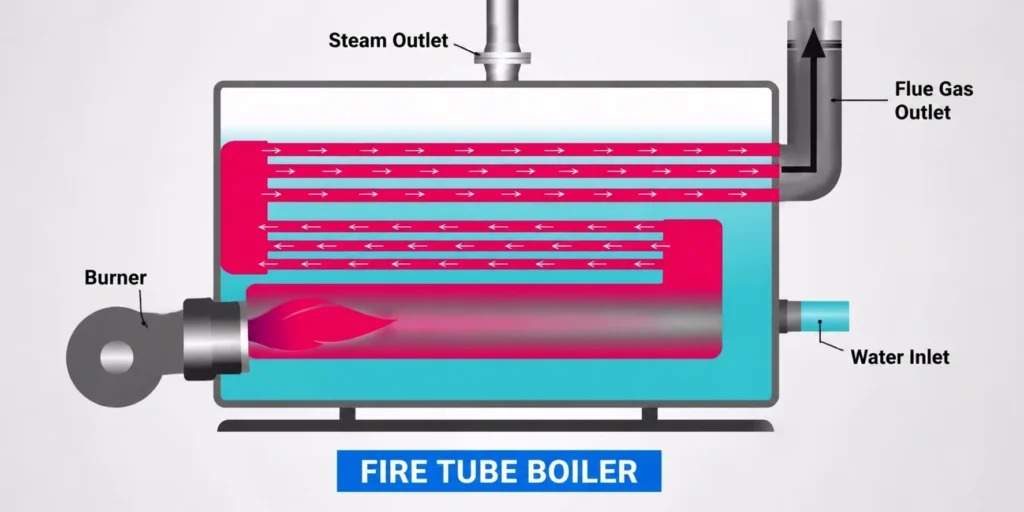
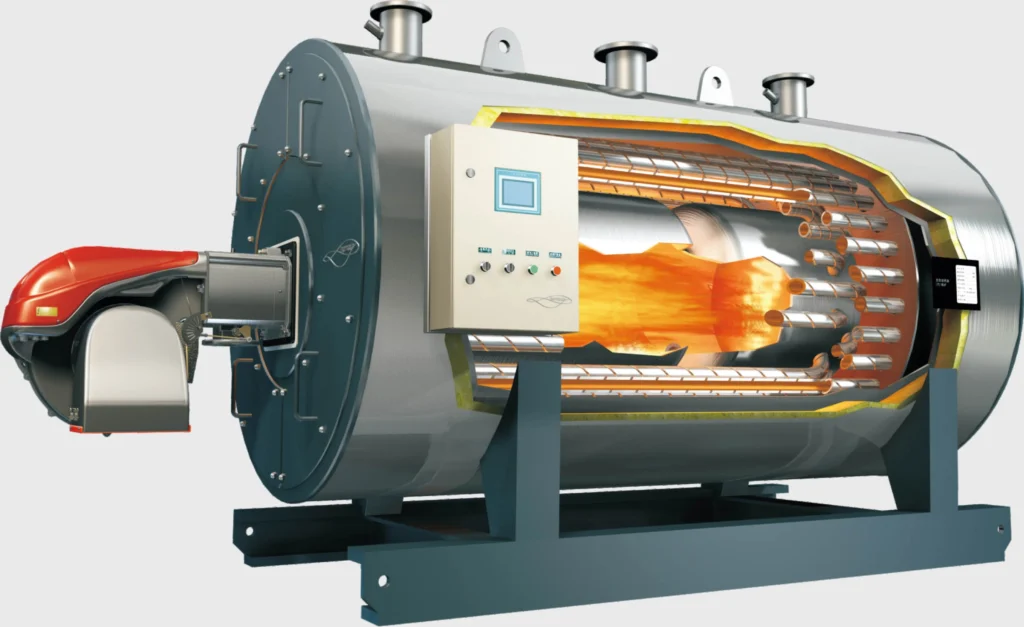
In a fire-tube boiler, hot gas flows inside the tubes. Water surrounds the tubes inside a pressure shell. Heat passes through the tube walls and enters the water. This design is simple and compact. It is often delivered as a complete package unit.
Fire-tube units usually hold a larger volume of water. This helps limit sudden pressure changes. It also increases startup time. The large pressure shell limits their use at very high steam pressures. The DOE sourcebook notes that Scotch marine boilers are generally not used above 300 psig. This is a general reference, not a fixed project limit.
Common Types of Fire-Tube Boilers
The main types of fire tube boilers include horizontal return tubular, Scotch marine, and firebox designs. Modern units may also use one-pass, two-pass, three-pass, or four-pass gas paths. More passes increase the available heat-transfer path. They can also reduce the outlet gas temperature under comparable conditions.
Water-Tube Boilers
In a water-tube boiler, water and steam flow inside the tubes. Hot gas passes around the tube surfaces. Pressure is contained inside smaller-diameter tubes. This supports higher steam pressures and larger outputs.
Water-tube boilers can produce saturated or superheated steam. They are widely used in refining, petrochemical processing, hydrogen production, and power generation. Small systems may be package-built. Larger systems may be divided into shop-fabricated or modular sections.
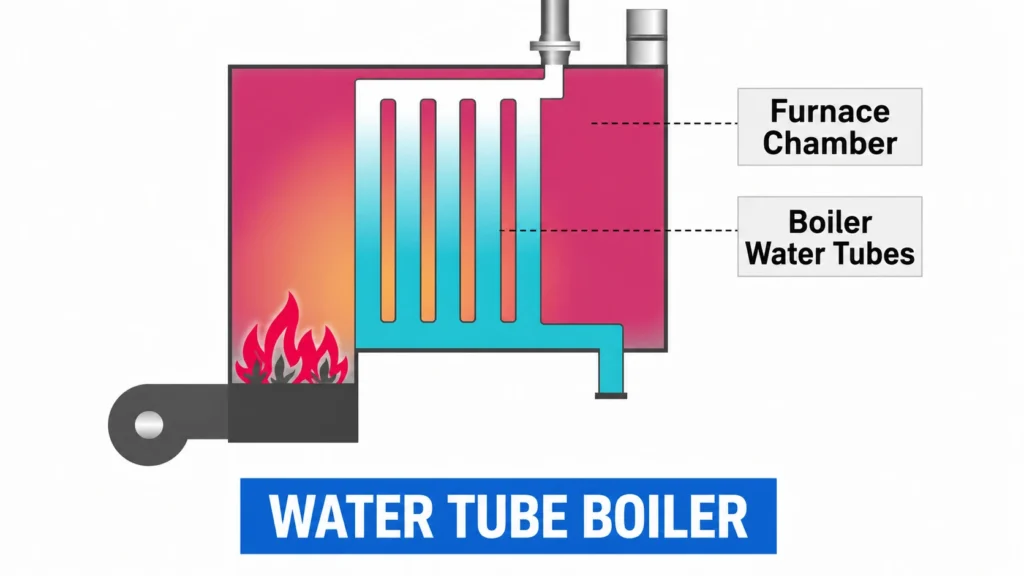
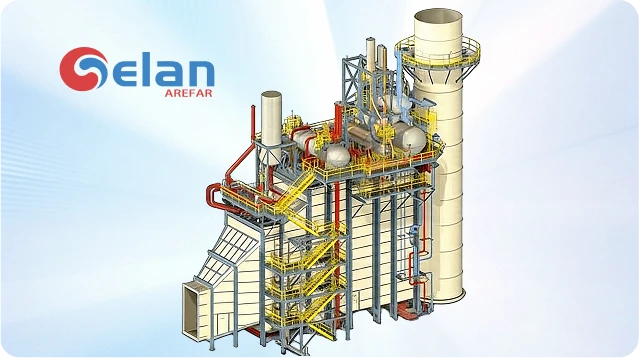
For Gelan’s refinery, petrochemical, hydrogen, and energy projects, water-tube arrangements are more common. They are used in fired-heater exhaust recovery, reformer waste heat recovery, incinerator systems, and HRSG applications. The heating surface, steam drum, superheater, economizer, duct, and module boundaries are customized around the gas conditions and required steam duty.
Common Types of Water-Tube Boilers
The main types of water tube boilers include package water-tube, drum-type, once-through, and field-erected designs. Waste heat boilers and HRSGs may also use water-tube heating surfaces. The final arrangement depends on steam conditions, gas flow, available space, and transport limits.
Fire-Tube vs Water-Tube Boilers
| Factor | Fire-Tube Boiler | Water-Tube Boiler |
|---|---|---|
| Flow arrangement | Hot gas inside tubes | Water and steam inside tubes |
| Typical steam duty | Small to medium | Medium to very large |
| Pressure direction | Lower to moderate | Moderate to very high |
| Water inventory | Usually higher | Usually lower |
| Startup | Usually slower | Usually faster |
| Load response | Stable under moderate changes | Better suited to rapid changes |
| Delivery form | Often package-built | Package, modular, or field-erected |
| Common applications | General process steam and some process-gas WHBs | Refineries, chemical plants, HRSGs, and power systems |
Water-tube designs dominate many types of high pressure boilers. Pressure is not the only selection factor. Process-gas pressure, dust, fouling, erosion, cleaning access, and transport size can change the final choice. In waste heat projects, we review these conditions before fixing the tube arrangement.
Industrial Boiler Types by Heat Source
Boilers can also be classified by the source of thermal energy. Common sources include natural gas, fuel oil, coal, biomass, electricity, and industrial waste heat. The heat source affects efficiency, emissions, operating cost, and auxiliary equipment.
Gas-Fired Boilers
An industrial gas boiler burns natural gas, refinery gas, propane, or another gaseous fuel. A burner mixes the fuel with combustion air. The generated heat produces steam or hot water. Gas-fired units support stable and controllable steam generation.
In refinery projects, “gas-fired” does not always mean a fixed natural-gas composition. A DOE study found that by-product fuels supplied 49% of U.S. refining boiler capacity in 2005. Fuel composition can affect burner selection, controls, efficiency, and emissions. We therefore review the full fuel-gas range before fixing the boiler design.
Oil-Fired Boilers
Oil-fired boilers use distillate or residual fuel oil. Some plants use oil as the main fuel. Others keep it as a backup. The burner must match the fuel properties and required load range.
Coal-Fired and Biomass Boilers
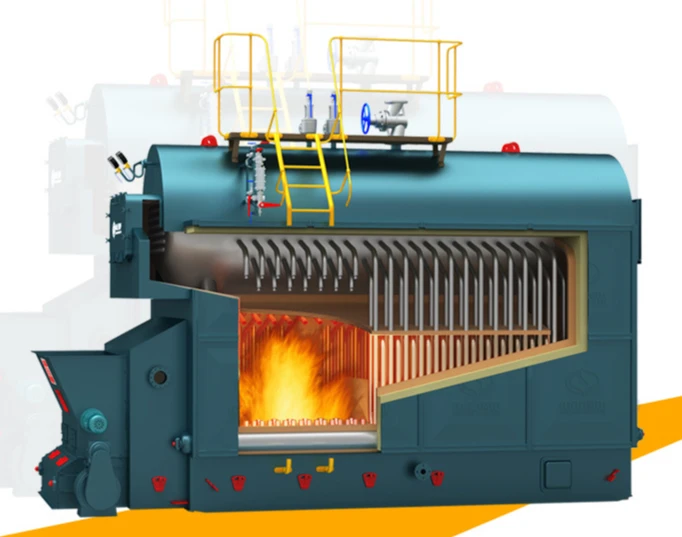
Coal and biomass boilers are common in some large industrial and power systems. They require fuel feeding, ash handling, and emission-control equipment. Biomass may also be co-fired with coal. These systems are outside Gelan’s main project focus, so this guide does not expand them further.
Electric Boilers
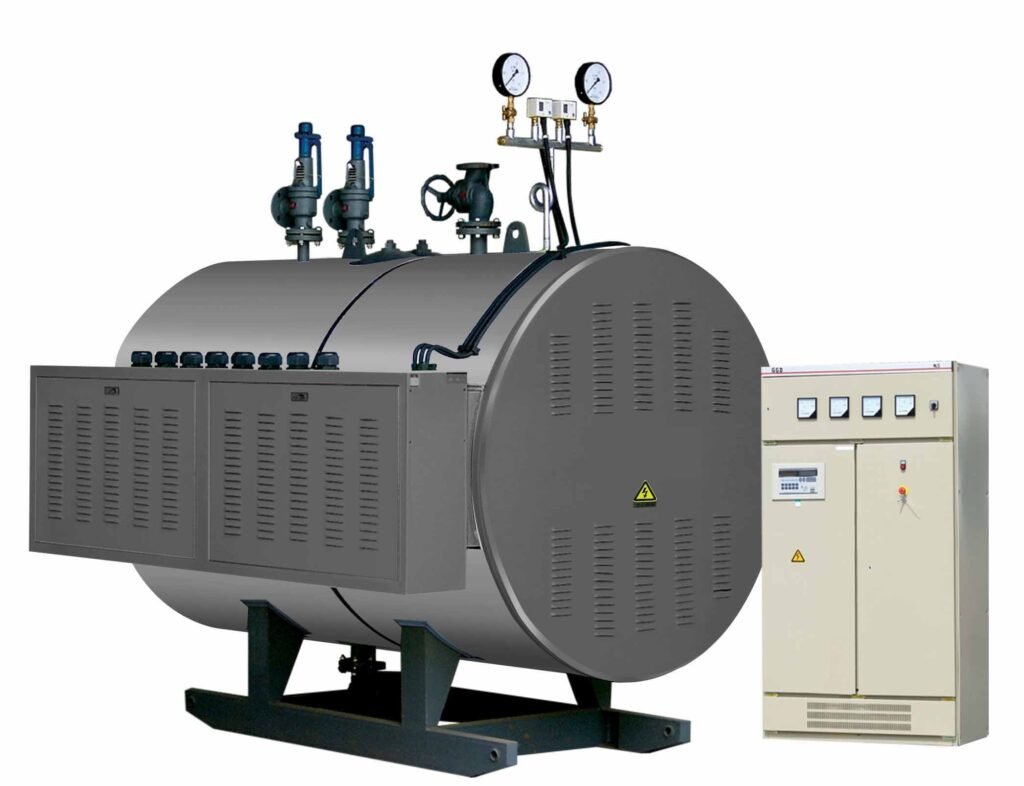
Electric boilers convert electrical energy into heat. They do not require an on-site combustion burner. Their suitability depends on steam demand, available electrical capacity, power cost, and the source of the electricity.
Waste Heat Recovery Boilers
A fired boiler creates heat through combustion. A waste heat boiler uses heat already carried by exhaust gas or process gas. It can generate steam without adding a separate main burner. Its output still depends on the upstream process. Steam production falls when the heat source falls or stops.
The main types of waste heat recovery boilers are usually named after their heat source or process duty:
| Waste Heat Boiler Type | Typical Heat Source | Main Duty |
|---|---|---|
| Heater or reformer WHB | Fired heater or SMR exhaust | Steam generation from flue-gas heat |
| Process-gas WHB | Hot pressurized process gas | Gas cooling and steam generation |
| Incinerator or TO WHB | Incinerator, DTO, or RTO exhaust | Heat recovery before discharge |
| Sulfur recovery WHB | High-temperature SRU process gas | Rapid gas cooling and steam generation |
| HRSG | Gas turbine exhaust | Steam production for power or cogeneration |
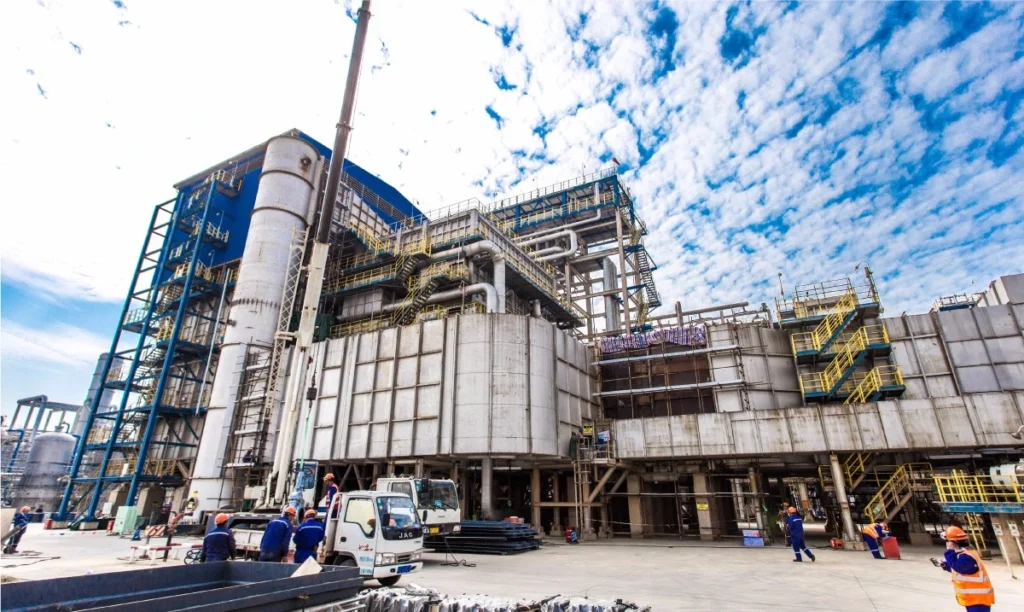
In one Gelan hydrogen project, the boiler recovered reformer exhaust heat for a 12 million t/y refinery. The supply also included a 70 m steel stack. This project showed that the heat source, steam duty, duct, and stack must be reviewed as one system.
Boiler Types by Circulation, Steam Condition, and Construction
Boilers may also be classified by water circulation, steam condition, and delivery form. These terms describe how water moves, what the boiler produces, and how the unit reaches the site.
Natural-Circulation Boilers
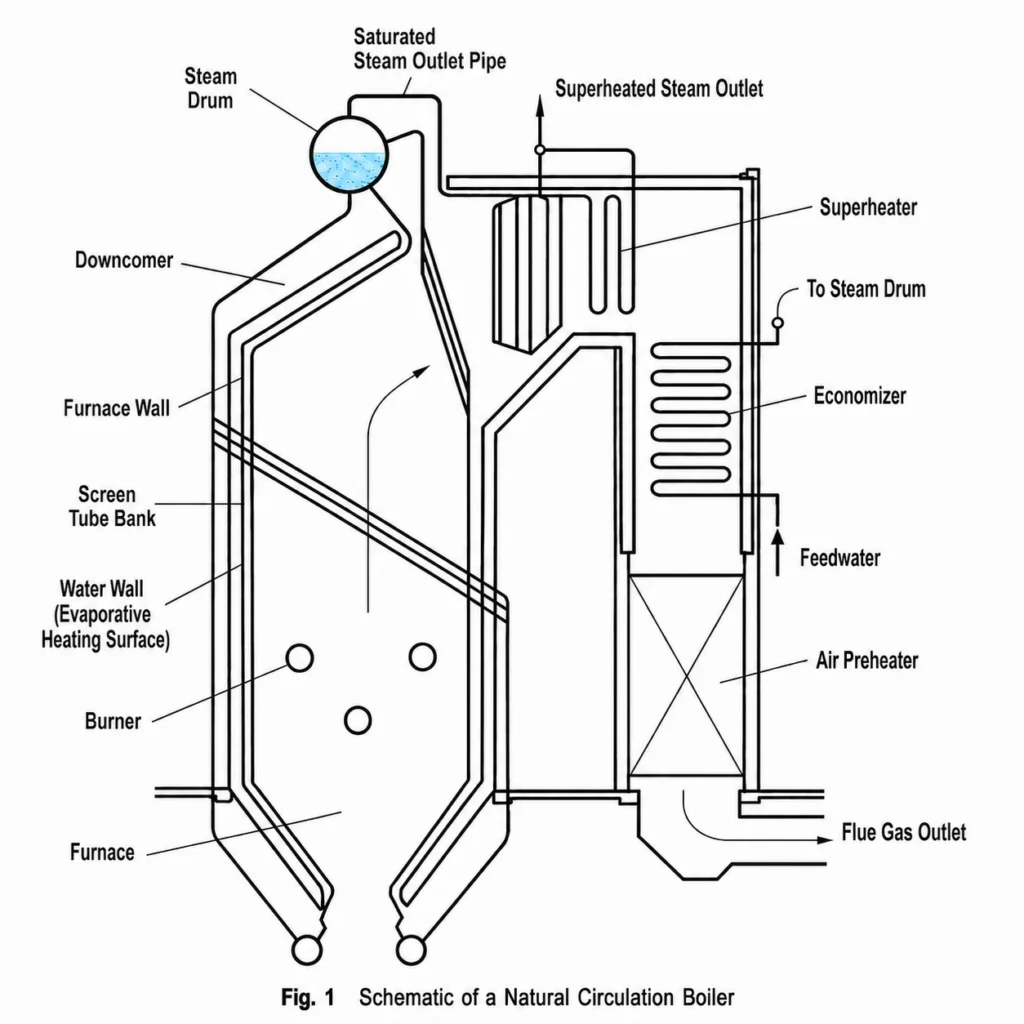
In natural-circulation boilers, water moves through density differences. Cooler water flows downward through downcomers. The lighter steam-water mixture rises through heated tubes. A steam drum separates the steam from the water.
This design does not need a main circulation pump. It is common in drum-type water-tube boilers and many waste heat systems.
Forced-Circulation Boilers
In forced-circulation boilers, a pump moves water through the evaporating tubes. This supports compact layouts and services with weak natural circulation.
The pump adds power demand and another critical operating component. Flow control and pump reliability must therefore be included in the design.
Once-Through Boilers
In once-through boilers, feedwater passes through the heating surfaces once. It becomes steam without returning to a conventional steam drum.
This design can support high-pressure service and frequent load changes. It also needs accurate feedwater control and strict water chemistry. Some once-through HRSG designs remove the high-pressure drum to improve cycling flexibility.
Saturated vs Superheated Steam Boilers
Boilers may also be described by the condition of the steam they produce.
| Steam Condition | Description | Common Use |
|---|---|---|
| Saturated steam | Steam at the boiling temperature for its pressure | Process heating, tracing, cleaning, and utility service |
| Superheated steam | Steam heated above its saturation temperature | Turbines, power generation, and high-temperature steam systems |
A superheater adds heat after the water has fully evaporated. The required steam condition affects the heating-surface arrangement, materials, controls, and downstream piping.
Package, Modular, and Field-Erected Boilers
The construction method describes where the boiler is assembled and how it is delivered.
| Construction Type | Main Characteristic | Typical Project Fit |
|---|---|---|
| Package boiler | Mostly assembled in the factory | Smaller systems with suitable transport access |
| Modular boiler | Divided into transportable factory-built sections | Large systems, overseas projects, and limited site work |
| Field-erected boiler | Major assembly completed at the site | Very large units or restricted transport routes |
A historical DOE analysis found that about 67% of the U.S. refinery boiler population was package-built. About 33% consisted of large field-erected units. This is not current market-share data. It shows that both delivery methods have long been used in refinery projects.
Gelan can divide large waste heat boilers into sections such as the duct, evaporator, economizer, superheater, and steam drum. Module boundaries are set around transport size, lifting limits, site access, and installation plans.
These classifications define how the boiler circulates water, delivers steam, and reaches the site. The next section explains the main components used to build these systems.
What Are the Main Components of an Industrial Boiler?
After the boiler type is defined, its component arrangement determines how the system performs. Most boilers share pressure parts, heating surfaces, feedwater equipment, and safety controls. Other parts are added for specific fuels, steam conditions, or gas conditions.
| Component | Main Function | Typical Use |
|---|---|---|
| Heating surfaces and boiler tubes | Transfer heat to water or steam | Common to all boilers; tube form varies |
| Pressure shell, headers, or steam drum | Contain and distribute pressurized water and steam | Arrangement depends on boiler type |
| Feedwater system | Supplies treated water at the required pressure | Common |
| Safety and control system | Controls pressure, temperature, level, and shutdowns | Common |
| Blowdown system | Removes concentrated salts and deposits | Common in drum and shell-type steam boilers |
| Burner and furnace | Generate heat through fuel combustion | Fired boilers only |
| Superheater | Raises steam above saturation temperature | Used when superheated steam is required |
| Economizer | Uses remaining gas heat to preheat feedwater | Optional heat-recovery section |
| Air preheater | Uses exhaust heat to preheat combustion air | Fired boilers, when required |
| Soot blower or cleaning system | Removes ash and deposits from heating surfaces | Dusty or fouling gas service |
| Duct and stack | Convey and discharge flue gas or exhaust gas | Fired boilers, WHBs, and HRSGs |
Not every boiler contains every component. Once-through boilers do not use a conventional steam drum. Electric boilers do not need a combustion burner. Water-tube WHBs and HRSGs may use separate evaporator, drum, superheater, economizer, and duct sections.
Some optional components strongly affect final performance. These components can be supplied by Gelan as part of a complete boiler system or as standalone items. Steam drums, headers, tube bundles, superheaters, economizers, air preheaters, finned tubes, ducts, stacks, and steel structures can all be customized.
Different Types of Industrial Boilers and Their Applications
Steam supplies about 30% of industrial process heat in manufacturing. Boilers support process heating, separation, mechanical drives, and power generation. The best boiler type depends on the required duty and the available heat source.
The table below connects the different types of industrial boilers and applications commonly found in process plants.
| Industrial Application | Common Boiler Direction | Main Duty | Main Design Concern |
|---|---|---|---|
| General process steam | Fire-tube or package boiler | Heating, cleaning, and utility steam | Load range and operating simplicity |
| Refinery utility steam | Gas-fired water-tube boiler | Supply stable steam across the plant | Fuel variation, pressure, and turndown |
| Fired heater exhaust | Waste heat boiler or economizer | Recover heat before stack discharge | Draft, pressure drop, and dew point |
| SMR hydrogen unit | Reformer waste heat boiler | Recover exhaust heat and generate steam | Reformer, steam, duct, and stack interfaces |
| Pressurized process gas | Custom fire-tube or water-tube WHB | Cool process gas and generate steam | Gas pressure, thermal stress, and fouling |
| Incinerator or DTO exhaust | Custom water-tube WHB | Recover heat after waste-gas treatment | Dust, corrosion, cleaning, and pressure drop |
| Gas turbine exhaust | HRSG | Produce process steam or power steam | Cycling, steam pressure, and supplementary firing |
| Power plant | High-pressure water-tube boiler or HRSG | Supply steam to a turbine | Steam purity, reliability, and load response |
In refinery and petrochemical plants, steam supports distillation, reboiling, process heating, stripping, vacuum systems, pumps, and compressors. The boiler must match the plant steam header and normal operating load. Peak demand alone should not define the design.
Waste heat applications require a different approach. More heat recovery may increase gas-side pressure drop. A lower outlet temperature may also increase corrosion risk. Dirty gas can require wider tube spacing and online cleaning.
In Gelan’s Yulin refinery project, the WHB produced 4.02 MPa and 348°C superheated steam. The inlet duct, superheater, evaporator, economizer, outlet duct, and steam drum were delivered in sections. Road transport limits directly affected the module design.
In another hydrogen project, Gelan supplied a reformer WHB for a 12 million t/y refinery. The scope included a 70 m steel stack. The boiler, duct, stack, gas flow, and steam system had to be reviewed as one system.
How to Select the Right Industrial Boiler System
A suitable boiler must match the full process duty. Capacity alone is not enough. In Gelan projects, we review steam demand, heat source, operating conditions, water quality, and site limits together.
Clients may not have a complete data sheet at the early stage. Gelan can use the available information to support preliminary boiler design. Missing conditions can then be identified and confirmed during technical clarification.
| Selection Factor | Basic Data Needed | Why It Matters |
|---|---|---|
| Steam requirement | Flow, pressure, temperature, and load range | Defines the boiler duty |
| Heat source | Fuel, exhaust gas, or process gas | Identifies fired or waste heat direction |
| Gas conditions | Temperature, flow, pressure, and composition | Guides heat recovery and configuration |
| Operating conditions | Startup, turndown, dust, and corrosion risk | Affects materials, cleaning, and controls |
| Water quality | Feedwater condition and steam purity | Affects corrosion, deposits, and blowdown |
| Site limits | Layout, transport, lifting, and maintenance space | Guides package or modular delivery |
| Project requirements | Code, inspection, and plant interfaces | Defines design and documentation scope |
Gelan supports custom boiler design from early technical review to equipment configuration, material selection, interface definition, and modular delivery planning. Learn more about Gelan Custom Engineering Services.
FAQ About Boiler Types
What Are the Three Main Types of Boilers?
Searchers often ask what are the 3 types of boilers, but there is no universal set of three. By tube arrangement, the two basic types are fire-tube and water-tube. By fuel, common types include gas-, oil-, and coal-fired boilers. Electric and waste heat boilers form additional categories.
Is a Package Boiler Fire-Tube or Water-Tube?
It can be either. “Package” describes the fabrication and delivery form. It does not describe the tube arrangement. ABMA notes that packaged boilers are available in both fire-tube and water-tube forms.
Is an HRSG a Type of Boiler?
Yes. An HRSG captures heat from an exhaust or process stream and transfers it to water to generate steam. It is commonly installed after a gas turbine. Some HRSGs also use supplementary firing.
Is a Steam Generator the Same as a Boiler?
The terms often overlap in industrial and power applications. Babcock & Wilcox uses the term “steam generator (boiler)” for equipment that converts water into steam. “Steam generator” is often preferred for large power units, once-through systems, and HRSGs.
What Is the Difference Between a Steam Boiler and a Hot-Water Boiler?
A steam boiler changes water into steam. A hot-water boiler heats water but keeps it in the liquid state. The required output affects the pressure, controls, distribution system, and final application.
How Are Industrial Boilers Rated?
Common ratings include steam evaporation rate, heat output in kilowatts, and boiler horsepower. A project specification must also state the steam pressure, temperature, feedwater condition, and operating load.
Need help confirming the boiler type or developing a project-specific arrangement? Gelan Custom Engineering Services supports process review, equipment configuration, material selection, modular layout, and manufacturable delivery.
Conclusion
There is no single best boiler type. The right choice depends on the steam duty, heat source, operating conditions, site limits, and project codes.
Gelan supports preliminary design and custom boiler configurations for refinery, petrochemical, hydrogen, and energy projects.